What an Imaging Report Means: The 10 Phrases Patients Misread Most Often

Key Takeaways
- Imaging reports describe patterns and possibilities, not a diagnosis by themselves.
- Words that sound alarming, such as “lesion” or “abnormal,” often have broad, non-cancerous meanings.
- A single phrase in a report should be interpreted together with symptoms, exam findings, and the reason for the scan.
- Comparison with earlier images can be as important as the new finding itself.
- Questions about wording are normal and can be clarified by the ordering doctor or radiologist.
Medically reviewed by the Acıbadem clinical team — June 13, 2026
Imaging reports are written for clinicians, but patients often read them first and understandably feel uncertain. This guide explains 10 commonly misread phrases, what they usually mean, and how to discuss findings with a doctor confidently.
Overview
Reading an imaging report can feel a little like being handed a technical summary in another language. Terms such as “opacity,” “lesion,” or “recommend follow-up” are often written for clinicians who already know the clinical context, so the wording can sound more dramatic than it really is when read on its own.
An imaging report is best understood as one piece of a larger medical picture. It describes what the radiologist sees on an X-ray, ultrasound, CT, MRI, mammogram, or other study, then offers a professional interpretation based on that appearance. It does not usually stand alone as a final diagnosis.
For international patients, this can be especially confusing when reports are received electronically, after travel, or in a language that is not the patient’s first. In those situations, a careful explanation matters just as much as the scan itself. The goal is not to “decode” the report in isolation, but to connect the wording with the reason for the test, the person’s symptoms, and the next step in care.
This article walks through 10 phrases that are frequently misread and explains what they generally mean in plain language. The emphasis is on clarity, not alarm, because most report wording has a wider and more ordinary meaning than patients first assume.
Symptoms
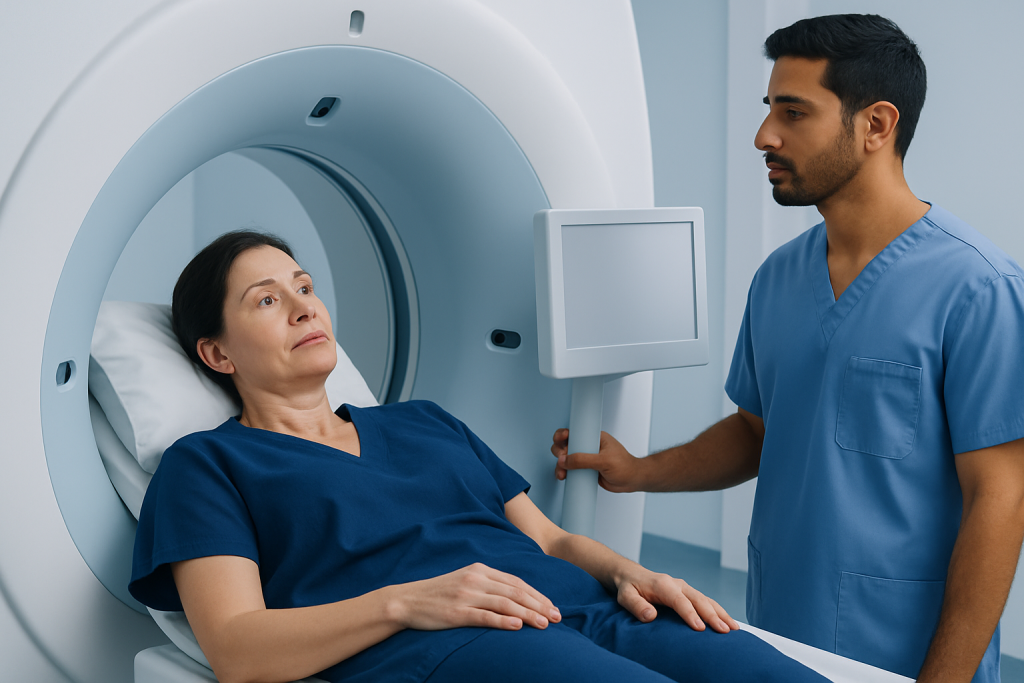
Imaging reports themselves do not cause symptoms, but they often enter the picture after someone has pain, a lump, shortness of breath, a persistent cough, a headache, or another concern that led to the scan. That is why patients may read the report through the lens of fear: they are already trying to connect a finding with how they feel.
Common emotional reactions include worry about the word “abnormal,” uncertainty about whether “small” means harmless, and confusion when a report mentions several findings, some of which are incidental. It is also common to focus on a single phrase and ignore the rest of the report, even though radiologists usually build meaning from the full set of observations.
These misunderstandings are not a sign that a patient is overreacting. Imaging language is specialized, and many phrases are intentionally cautious. The safest approach is to treat the report as a draft of interpretation that should be reviewed with a qualified doctor who knows the full clinical story.
Causes & Risk Factors

The most common reason patients misread imaging reports is not the medical finding itself, but the style of medical writing. Radiology language is concise, cautious, and often filled with terms that describe appearance rather than certainty. A phrase may indicate what something looks like, while leaving the cause open until the clinician considers symptoms, prior studies, or laboratory results.
Another reason is that many imaging findings are incidental. That means they were noticed while looking for something else. Incidental findings can be completely harmless, related to an old injury, or simply a normal variation of anatomy. When patients see an unexpected phrase, they may assume the worst, even when the report is describing a common and stable finding.
Risk factors for misunderstanding are higher when the report is read without context, especially if the patient is recovering abroad, lacks access to the ordering doctor, or is comparing different reports from different hospitals. Separate facilities may use slightly different language, which can make the same underlying finding look inconsistent when it is not.
- Limited familiarity with radiology terms
- Reading the report before speaking with the doctor
- Receiving results during an anxious health episode
- Prior abnormal findings that make new wording feel more serious
- Language barriers or translated reports
Diagnosis
Imaging reports are part of the diagnostic process, but they are rarely the entire diagnosis. A radiologist evaluates patterns on the image and then documents the level of confidence, possible explanations, and whether comparison with earlier scans changes the interpretation. The final diagnosis is usually made by the treating doctor, who combines imaging with history, examination, and sometimes blood tests or other studies.
Patients often ask why a report says “suggestive of,” “compatible with,” or “cannot exclude.” These phrases reflect careful medical reasoning. They show that the radiologist is describing the most likely interpretation while acknowledging that imaging alone may not answer every question.
For someone reading from another country, it helps to remember that the report is a communication tool between clinicians. It is not meant to be judged line by line as if each word were a final verdict. A doctor can explain whether the finding is expected, whether it matters now, and whether follow-up imaging or a specialist visit is appropriate.
Treatment Options
There is no one treatment for an imaging report phrase, because the phrase itself is not the illness. The next step depends on what the scan actually showed and why it was done. In some cases, no treatment is needed at all, only reassurance or routine observation.
If the report identifies a condition that needs care, treatment may include medication, a procedure, rehabilitation, or surgery, depending on the organ involved and the severity of the finding. Sometimes the treatment is aimed at the underlying cause of symptoms, while in other cases it focuses on monitoring a stable issue over time.
These are the 10 phrases patients misread most often, with plain-language explanations:
- “Abnormal” — This simply means the finding is different from the expected appearance. It does not automatically mean serious disease.
- “Lesion” — A broad term for an area that looks different from surrounding tissue. It can describe something minor, old, inflammatory, benign, or more significant, depending on context.
- “Opacity” — Usually describes a region that looks whiter or denser on an image, often on chest imaging. It is a visual description, not a diagnosis.
- “Shadow” — An informal way some patients use to describe something seen on an image; the report may be referring to a real finding, an overlap of structures, or an artifact. Your doctor can clarify what the radiologist meant.
- “Mild” — Often means limited in extent or degree. Mild findings can still matter, but the word generally signals a smaller severity than moderate or severe.
- “Unremarkable” — This is usually good news. It means the part of the scan being described appears normal or without notable abnormality.
- “Recommend follow-up” — This does not necessarily mean something dangerous was found. It may simply mean the radiologist wants comparison over time, a clearer view, or routine surveillance.
- “Cannot exclude” — The image does not provide enough certainty to rule something out completely. The phrase is cautious, not confirmatory.
- “Likely” or “probable” — The radiologist thinks one explanation is more likely than others, but the wording reflects thoughtful uncertainty rather than a final diagnosis.
- “Stable” — Usually means a finding has not changed compared with an earlier scan. Stability often suggests reassurance, but the significance depends on what the finding is and how long it has been unchanged.
When patients ask for treatment clarification, it helps to ask one focused question: “What does this finding mean for me right now?” That question turns a confusing phrase into a practical plan.
Prevention & Self-care
Patients cannot prevent every incidental finding or every technical phrase that appears in a report, but they can reduce confusion by preparing before and after the scan. Keeping a personal record of prior imaging studies, symptoms, medications, and previous recommendations makes it easier for a doctor to interpret any new result in context.
It also helps to request the report together with the images when possible. The images themselves are not always easy for a patient to interpret, but they can be useful for second opinions or follow-up care, especially if the person is traveling home after treatment or wants continuity across different health systems.
Self-care in this setting is mostly about slowing down the interpretation process. Rather than searching every term online, patients can write down the exact phrase that seems confusing and bring it to a doctor or radiologist. A brief explanation from a professional usually resolves more anxiety than hours of internet searching.
- Save prior reports so changes can be compared accurately
- Ask for a plain-language explanation of any unfamiliar term
- Keep the report and images together in one file or folder
- Note the reason the scan was ordered, since that shapes interpretation
- Do not assume that “abnormal” or “lesion” means cancer
When to See a Doctor
A doctor should review an imaging report whenever the wording is unclear, the finding is new, or the result seems out of step with the person’s symptoms. This is especially important if the report suggests follow-up imaging, specialist evaluation, or correlation with another test. A scan is most useful when it leads to a clear and shared plan.
It is sensible to contact a doctor sooner if the report seems to describe a finding that matches worsening pain, fever, shortness of breath, neurological symptoms, a new lump, or unexplained weight loss. The exact urgency depends on the body part involved and the overall clinical picture, but prompt review helps avoid delays and unnecessary worry.
For patients receiving care across borders, follow-up planning matters. A report written in one health system should be understandable to the clinician who continues care in another. Acibadem Health Point’s multidisciplinary specialists and JCI-accredited hospitals can help international patients diagnose and treat imaging-related conditions with coordinated review and follow-up when needed.
Most importantly, patients should feel comfortable asking: “What does this report mean, and what happens next?” That simple question is often the most useful step in turning technical wording into practical care.
Frequently asked questions
Does an “abnormal” imaging report always mean something serious?
No. In imaging, “abnormal” simply means the finding is different from what is expected or typical. Many abnormal findings are minor, old, or not dangerous, so the meaning depends on the full report and the clinical context.
Why do radiology reports use words like “cannot exclude” or “suggestive of”?
These phrases reflect caution and professional judgment. Imaging can point toward a likely explanation, but it does not always provide complete certainty, so radiologists use careful language rather than overstate the result.
Is a “lesion” the same as a tumor?
Not necessarily. “Lesion” is a broad term for an area that looks different from surrounding tissue, and it can describe many kinds of findings, including benign ones. The exact meaning depends on the location, appearance, and other clinical information.
What does “stable” mean on a follow-up scan?
It usually means the finding has not changed compared with a previous scan. Stability is often reassuring, but the importance of that result depends on what the finding is and how long it has remained unchanged.
Should patients read the report before speaking with the doctor?
They can, but it is often better to see the report as a first draft of information rather than the final answer. A doctor can explain the wording in context and help separate routine findings from anything that needs attention.
What if the report was done in another country or translated into English?
That can make the wording harder to interpret because report styles and terminology vary across systems. A doctor who can review the images, the report, and the reason for the scan can usually clarify whether the wording reflects anything new or important.
References
- American College of Radiology
- Radiological Society of North America
- Mayo Clinic
- National Health Service
- National Cancer Institute
This article is for general information only and is not a substitute for professional medical advice. Please consult a qualified doctor about your individual situation.