Ultrasound vs. CT for Abdominal Pain: Why Doctors Choose One Over the Other

Key Takeaways
- Ultrasound is often preferred first when doctors want a quick, radiation-free look at the gallbladder, liver, kidneys, pelvis, or blood flow.
- CT provides more detailed cross-sectional images and is especially helpful when the cause of abdominal pain is unclear or complications are suspected.
- The choice depends on the likely diagnosis, urgency, pregnancy status, age, body habitus, and whether contrast material is needed.
- Neither test treats pain; they help doctors identify the source so care can be targeted appropriately.
- If pain is severe, persistent, or accompanied by fever, vomiting, fainting, or swelling, medical evaluation should not be delayed.
Medically reviewed by the Acıbadem clinical team — June 13, 2026
When abdominal pain needs imaging, doctors often choose between ultrasound and CT based on the suspected cause, the patient’s age, and how quickly results are needed. Each test has strengths, and the best option is usually the one that answers the clinical question with the least risk and the most useful detail.
Overview
Abdominal pain can come from many different organs, and the right scan depends on what the clinician is trying to rule in or rule out. In everyday practice, ultrasound and CT are the two imaging tests most often considered, but they are not interchangeable. They answer different questions, and doctors choose one over the other based on the pattern of symptoms, examination findings, and the level of concern.
Ultrasound uses sound waves to create live images. It is especially useful when the doctor wants to see fluid-filled structures, measure movement, or avoid radiation exposure. CT, short for computed tomography, uses X-rays to create detailed cross-sectional images of the abdomen and pelvis. It is often chosen when the pain is broad, the diagnosis is uncertain, or a more complete map of the internal organs is needed quickly.
For patients, the key point is that the “best” test is the one most likely to clarify the problem safely and efficiently. A person with right upper abdominal pain may be sent for an ultrasound first, while someone with sudden severe pain and possible appendicitis, bowel obstruction, or internal bleeding may need a CT right away. Doctors usually think in terms of the suspected cause rather than the scan itself.
For international patients arranging care from another country, this decision can affect the pace of the workup, travel timing, and follow-up planning. A clear imaging strategy helps the medical team avoid unnecessary tests and move more confidently toward treatment.
Symptoms and the Situations That Lead to Imaging
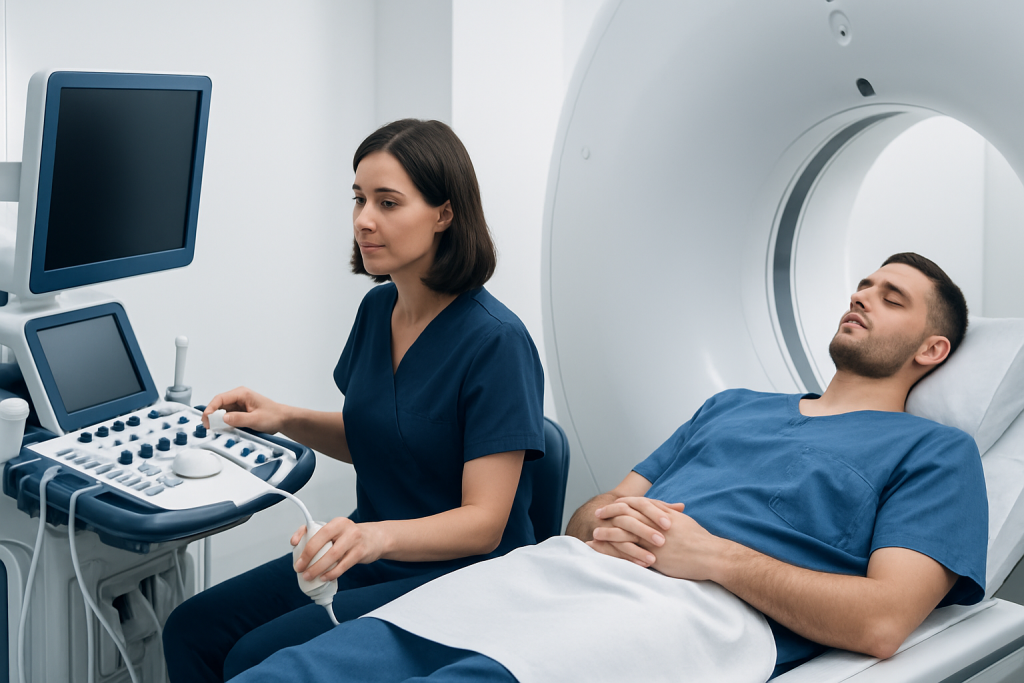
Abdominal pain is not a diagnosis; it is a signal that something in the digestive, urinary, reproductive, vascular, or even musculoskeletal system may be irritated or inflamed. Imaging is usually considered when the history and physical examination cannot fully explain the pain, or when doctors need to confirm a concern such as gallstones, appendicitis, kidney stones, ovarian cysts, or an abdominal infection.
Symptoms that may prompt imaging include pain that is severe, persistent, localized to one area, or associated with vomiting, fever, bloating, changes in bowel habits, urinary symptoms, or jaundice. The exact location of the pain often provides clues. Pain in the right upper abdomen raises different possibilities than pain in the lower right quadrant, for example, and the image choice may change accordingly.
Doctors also pay attention to timing and pattern. Sudden pain that worsens over hours may call for a faster, broader test. Pain that appears after eating, during menstruation, after dehydration, or after trauma may suggest a narrower set of causes. In some cases, imaging is ordered not because the pain is dramatic, but because it keeps returning without a clear explanation.
- Right upper abdominal pain may suggest gallbladder or liver problems.
- Lower right pain may raise concern for appendicitis.
- Flank pain can point toward a kidney stone.
- Pelvic pain may involve gynecologic causes, which ultrasound often evaluates well.
Causes & Risk Factors

The suspected cause is the main reason one scan is chosen over another. Ultrasound is often favored for gallstones, gallbladder inflammation, liver enlargement, fluid collections, pelvic conditions, and many kidney or urinary tract issues. Because it can show structures in real time, it is helpful for assessing blood flow, guided procedures, and organ movement.
CT is often preferred when the cause could involve the bowel, appendix, pancreas, diverticula, perforation, inflammation spreading beyond one organ, or internal bleeding. It is also valuable when the abdomen is difficult to examine, when symptoms are complex, or when doctors need a broad survey of multiple organ systems at once. CT can reveal small pockets of air, inflammatory changes, abscesses, and other details that ultrasound may miss.
Patient factors also influence the choice. Pregnancy often shifts the balance toward ultrasound because it avoids ionizing radiation. In children, ultrasound may be used first for the same reason, depending on the question. Body size, bowel gas, prior surgery, and the ability to hold still can also affect image quality and may steer the team toward CT if a clearer view is needed.
Risk factors for more urgent imaging include older age, a history of abdominal surgery, known cancer, anticoagulant use, recent trauma, immunosuppression, and signs of systemic illness. These do not point to one diagnosis, but they can increase the need for a test that gives the broadest and fastest answer.
Diagnosis: How Doctors Decide Between Ultrasound and CT
The decision usually begins with a clinician’s assessment rather than a fixed algorithm. Doctors ask where the pain is, how it started, what makes it better or worse, and whether there are symptoms such as fever, nausea, urinary changes, vaginal bleeding, or weight loss. A physical exam may reveal tenderness in one region, guarding, bloating, or signs of dehydration, which can narrow the imaging choice.
Ultrasound is often selected first when the likely problem is in an organ that is easy to view without radiation. It may be enough to confirm gallstones, assess the gallbladder wall, check for fluid in the pelvis, or look for hydronephrosis in the kidneys. If the ultrasound answers the question clearly, no additional scan may be needed.
CT becomes more attractive when the diagnosis remains uncertain after the initial evaluation or when the doctor needs more anatomic detail. A contrast-enhanced CT can show inflammation, infection, bleeding, tumors, bowel obstruction, and complications in a way that is useful for urgent decision-making. In some cases, doctors may start with ultrasound and then move to CT if the first study is inconclusive.
The best imaging plan is often a practical one. It takes into account urgency, safety, availability, and the specific clinical question. For a patient arriving from abroad, the team may also coordinate image timing with lab work, surgical consultation, or same-day treatment so that diagnosis and next steps stay efficient.
Treatment Options: What the Scan Helps Guide
Neither ultrasound nor CT treats abdominal pain directly, but both can shape the treatment plan. Once the source is identified, care may range from observation and medication to surgery or a procedure. Imaging helps determine whether the issue is mild and self-limited or whether it requires urgent intervention.
If the scan shows gallstones without major complications, treatment may involve pain control, dietary advice, and planned surgical discussion. If appendicitis, bowel obstruction, a perforation, or an abscess is found, the patient may need surgery, drainage, antibiotics, or hospital monitoring. When kidney stones are seen, treatment may focus on hydration, pain relief, and deciding whether the stone can pass naturally or needs a procedure.
Ultrasound is also useful in guiding needle placement, drainage, or other procedures because it can show real-time anatomy. CT can help plan more complex interventions and define the extent of disease before treatment starts. In emergency settings, the scan result may change the entire path of care within a short time.
For some patients, especially those traveling internationally for evaluation, imaging results also help determine whether treatment can start immediately or whether a local doctor can continue the plan safely at home. That discussion is an important part of good medical coordination.
Prevention & Self-care
Imaging itself does not need prevention, but thoughtful preparation can make the experience smoother. Patients are usually asked to bring prior scans, medication lists, and any lab results that may help compare findings. If contrast is planned, the care team may ask about kidney disease, allergies, asthma, or previous reactions to contrast material.
Good self-care before and after the scan depends on the situation. Some ultrasound exams require fasting, while others do not. Some CT scans require drinking contrast or receiving contrast through a vein, and the instructions can vary by the body part being examined. Following the specific preparation guidance helps improve image quality and reduces the chance of delay.
After the scan, most people can resume normal activities unless they received sedation or were told otherwise. If contrast was used, drinking fluids may be recommended unless a doctor advises differently. Patients should also keep in mind that the scan is only one part of care; symptom tracking, medication adherence, and follow-up appointments matter just as much as the image itself.
- Ask whether fasting is needed before the test.
- Share any history of allergies or kidney problems.
- Bring prior imaging if available.
- Follow instructions about contrast, fluids, and medications.
When to See a Doctor
Medical evaluation is appropriate when abdominal pain is severe, lasts more than a short time, keeps returning, or interferes with eating, walking, or sleep. It is especially important to seek prompt care if the pain comes with fever, persistent vomiting, a swollen abdomen, black or bloody stools, yellowing of the skin or eyes, fainting, chest pain, or difficulty breathing.
Imaging should not be delayed when clinicians are concerned about appendicitis, bowel obstruction, internal bleeding, ectopic pregnancy, kidney obstruction, or other urgent conditions. In those situations, the question is not simply whether a scan is needed, but which scan will give the safest and fastest answer.
Patients who are pregnant, immunocompromised, older, or recovering from recent surgery should mention those details early, because they can influence the imaging pathway. The same is true for anyone who is traveling for care: a concise summary of symptoms, prior records, and the timing of the pain can make the appointment more productive and reduce repeat testing.
Acibadem Health Point’s multidisciplinary specialists and JCI-accredited hospitals diagnose and treat abdominal pain for international patients, with imaging choices tailored to the clinical question and the overall care plan.
What the Experience Is Like: A Practical Patient View
For many patients, the hardest part is not the scan itself but not knowing what the doctor is looking for. An ultrasound is usually performed with gel and a handheld probe on the skin, and the exam often takes place in a quiet room with brief instructions to hold the breath or change position. A CT is faster, and the patient usually lies still on a table that passes through the scanner while the machine takes detailed images.
If contrast is needed, the team will explain what to expect and monitor for any immediate issues. Some patients feel warmth or a metallic taste during contrast injection, which can be temporary and normal. The staff should also clarify when results will be reviewed, especially if the scan was ordered for a suspected urgent condition.
For patients coming from abroad, a well-organized imaging day can reduce stress. When the scan, interpretation, and specialist review happen in sequence, it becomes easier to plan next steps before travel or before returning home. That kind of coordination is often as valuable as the image itself.
Bottom Line
Ultrasound and CT are both important tools for abdominal pain, but they are used for different reasons. Ultrasound is often the first choice when doctors want a safe, radiation-free look at specific organs or blood flow. CT is often selected when a broader, more detailed view is needed or when the cause of pain is still unclear.
The most helpful scan is the one matched to the clinical question. A good imaging decision reflects the symptoms, examination findings, urgency, and individual patient factors, including pregnancy, age, and prior medical history. Patients do best when they share complete information and ask what the doctor hopes to learn from the test.
With timely evaluation and the right imaging, many causes of abdominal pain can be identified quickly and managed more effectively. That clarity is often the first step toward relief and a safer recovery.
Frequently asked questions
Why would a doctor choose ultrasound instead of CT for abdominal pain?
Ultrasound is often chosen first when the suspected problem involves the gallbladder, liver, kidneys, pelvis, or blood flow. It does not use radiation and can be a good fit when the doctor expects a focused answer. It is also commonly preferred in pregnancy and in many pediatric evaluations.
When is CT better than ultrasound?
CT is often better when the pain could have many possible causes or when doctors need a more detailed look at the bowel, appendix, pancreas, or signs of infection or bleeding. It can also be more useful when ultrasound images are limited by bowel gas, body habitus, or a need for a broader survey. In urgent situations, CT may give the fastest and clearest answer.
Does a CT scan use radiation?
Yes. CT uses ionizing radiation, which is one reason doctors do not order it unless the added detail is useful for diagnosis or treatment. When radiation-free imaging can answer the question, ultrasound is often considered first.
Do I need contrast for these scans?
Not always. Some ultrasound exams do not require contrast at all, while CT scans may or may not use contrast depending on the clinical question. The care team decides based on what needs to be seen and whether contrast is safe for that patient.
Can ultrasound miss serious problems?
Yes, sometimes it can, especially if the area is difficult to visualize or if the condition involves bowel, deeper structures, or subtle complications. That is why doctors may order CT after an ultrasound if the first test does not fully explain the symptoms. The goal is to use the right test in the right sequence.
How should someone prepare if they are traveling for abdominal imaging?
They should bring previous scans, reports, medication lists, and any relevant test results if possible. It also helps to share whether the pain started suddenly, how it has changed, and whether there are symptoms like fever, vomiting, or urinary changes. Clear records can reduce repeat testing and make the consultation more efficient.
References
- American College of Radiology
- Radiological Society of North America
- National Institute of Diabetes and Digestive and Kidney Diseases
- World Health Organization
- Mayo Clinic
This article is for general information only and is not a substitute for professional medical advice. Please consult a qualified doctor about your individual situation.