

Spine Anatomy

Key Takeaways
- The spine is made of stacked vertebrae, discs, ligaments, muscles, and nerves that work together.
- Its main roles are support, movement, flexibility, and protection of the spinal cord.
- Pain, stiffness, weakness, or numbness can come from many different spine-related causes.
- Most spine concerns begin with a careful history, physical examination, and targeted imaging when needed.
- Early evaluation is important if symptoms follow an injury or include neurological changes.
The spine is a central support structure that helps the body stand upright, move, and protect the spinal cord. Understanding its anatomy can make symptoms such as back pain, numbness, or stiffness easier to interpret and discuss with a doctor.
Overview
The spine is often described as the body’s central pillar, but it is more than a support column. It is a carefully engineered chain of bones, cushions, joints, muscles, and nerves that allows a person to bend, twist, walk, lift, and keep balance.
From the outside, the spine may seem like a single structure. In reality, it is divided into regions with different roles: the neck, upper back, lower back, sacrum, and tailbone. Each segment contributes to posture and movement while also protecting the spinal cord, which carries signals between the brain and the rest of the body.
For patients trying to understand back or neck symptoms, spine anatomy provides useful context. A doctor may use this framework to explain why pain feels local in one area, radiates into an arm or leg, or appears with weakness, tingling, or reduced mobility.
Core anatomy: what the spine is made of
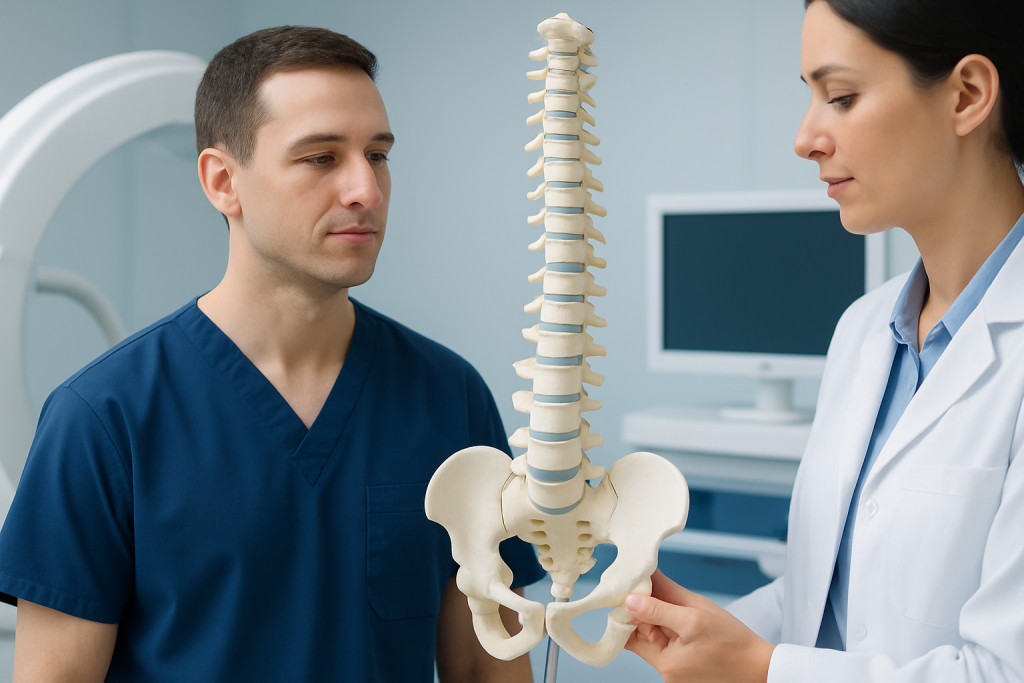
The spine is built from 33 vertebrae arranged in a stack. These bones are grouped into cervical, thoracic, lumbar, sacral, and coccygeal regions. The cervical spine supports the head and allows it to turn; the thoracic spine connects with the rib cage; and the lumbar spine bears much of the body’s weight during standing and lifting.
Between many vertebrae sit intervertebral discs, which act as shock absorbers and allow controlled motion. A disc has a tough outer ring and a softer center. When healthy, discs help the spine move smoothly; when injured or worn, they can contribute to pain or nerve irritation.
Ligaments hold the vertebrae together, while muscles provide strength and coordinated movement. Small joints at the back of the spine, called facet joints, help guide bending and twisting. Nerves exit through openings between vertebrae and travel to the arms, trunk, or legs, carrying sensation and movement commands.
- Vertebrae: the bony building blocks
- Discs: flexible cushions between many bones
- Ligaments and muscles: stabilizers and movers
- Spinal cord and nerve roots: communication pathways
How the spine works in daily life
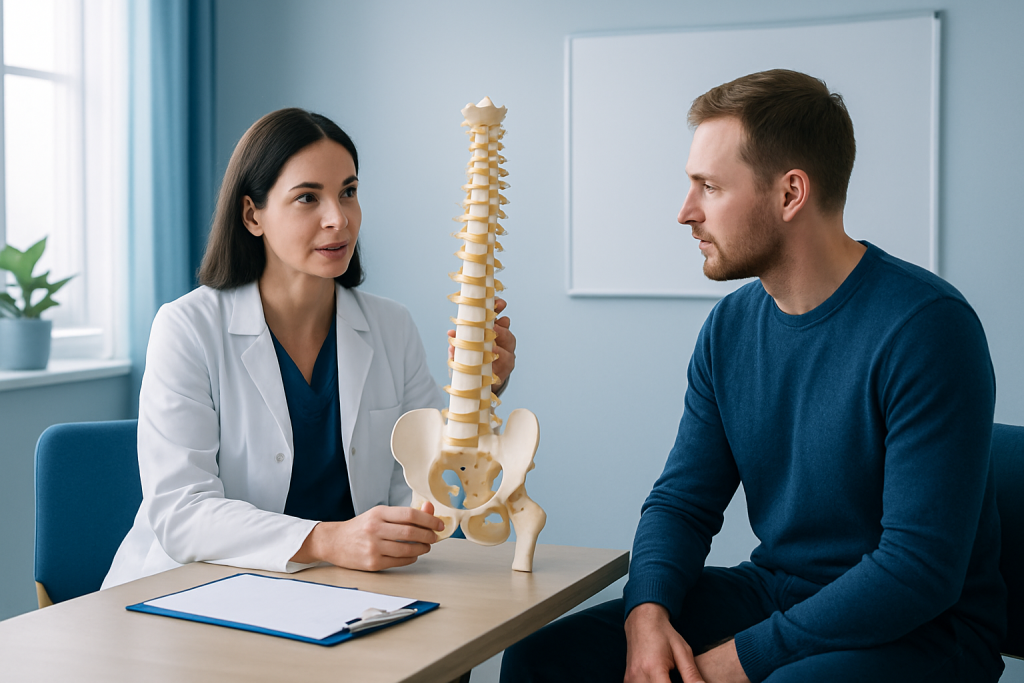
Everyday actions place different demands on the spine. Sitting, standing, looking down at a phone, reaching overhead, and lifting luggage all load the spinal structures in different ways. A healthy spine distributes this pressure across bones, discs, joints, and muscles.
The spine also has natural curves that improve balance and shock absorption. These curves are normal, not a sign of deformity. When posture, injury, or degenerative changes alter the curves, a person may notice discomfort, stiffness, or reduced tolerance for long periods of sitting or standing.
Because the spine is so closely linked to nerve pathways, symptoms do not always stay where the problem begins. A disc issue in the lower back may cause pain that travels into the leg, while a problem in the neck may affect the shoulder, arm, hand, or grip strength.
Symptoms linked to spine problems
Spine-related symptoms vary widely. Some people feel a dull ache after activity, while others develop sharp pain, stiffness, or a sense that movement is limited. Symptoms may be brief and mild, or they may persist and interfere with work, travel, sleep, or daily routines.
When nerves are involved, symptoms often become more specific. Tingling, numbness, burning pain, weakness, or changes in coordination can point to irritation of a nerve root or the spinal cord itself. These signs deserve medical attention, especially if they appear suddenly or worsen over time.
Common signs that may come from the spine include:
- Localized neck or back pain
- Pain that spreads into an arm or leg
- Stiffness after rest or in the morning
- Numbness, tingling, or weakness
- Difficulty with balance, walking, or fine hand movements
Symptoms alone cannot identify the exact structure involved. A thorough evaluation is often needed because muscles, discs, joints, nerves, and even non-spine conditions can produce similar discomfort.
Causes and risk factors
Spine symptoms can develop for many reasons. Some arise from sudden strain or injury, while others are linked to gradual wear, posture patterns, or inflammatory conditions. In many cases, several factors contribute at once rather than a single clear cause.
Age-related changes are common. Discs may lose hydration over time, joints can become less smooth, and bones may develop degenerative changes. These findings are frequent on imaging and do not always mean a person will have pain, which is why symptoms and examination matter as much as scan results.
Risk factors may include:
- Heavy lifting or repetitive physical work
- Long periods of sitting or poor ergonomic setup
- Previous spine injury
- Reduced muscle conditioning
- Smoking, which can affect disc and bone health
- Inflammatory or rheumatologic conditions
- Advanced age
Travel can also affect symptoms. Long flights, carrying heavy bags, disrupted sleep, and prolonged sitting may aggravate a sensitive back or neck. For international patients, it is often helpful to plan mobility, luggage weight, and rest breaks before traveling for assessment or treatment.
How doctors evaluate the spine
Evaluation usually begins with a detailed conversation about symptoms. A doctor may ask where the pain started, whether it spreads, what worsens it, and whether there are neurological changes such as weakness or numbness. A history of injury, fever, weight loss, cancer, infection, or previous surgery can change the next steps.
A physical examination follows. This may include checking posture, spinal range of motion, muscle strength, reflexes, sensation, and walking pattern. The purpose is to understand whether the problem is likely muscular, joint-related, disc-related, or nerve-related.
Imaging or other tests are used when they are likely to answer a specific question. X-rays may help assess alignment and bone structure. MRI is often useful for discs, nerves, and the spinal cord. CT scans can provide detailed views of bone. In some situations, blood tests or nerve studies may be recommended to clarify the cause.
Treatment options and medical management
Treatment depends on the cause, severity, and duration of symptoms. Many spine problems improve with conservative care, especially when there is no sign of significant nerve damage or structural instability. A doctor may recommend activity modification, guided exercise, pain-relief strategies, or physical therapy.
Rehabilitation often focuses on restoring movement, reducing muscle guarding, and improving core and postural strength. For many patients, this is a key part of recovery because the spine performs best when surrounding muscles support it well. Education about lifting mechanics, sitting habits, and pacing activity is also important.
In some cases, medications or injections may be considered to reduce pain and inflammation. If symptoms are caused by nerve compression, spinal deformity, severe narrowing, fracture, infection, or tumor, more specialized treatment may be needed. Surgery is not the first answer for every spine problem, but it can be appropriate when there is persistent pain, neurological decline, or clear structural disease.
For international patients, treatment planning may also include pre-travel consultation, review of imaging from home, coordination of interpreter support, and follow-up planning after return. At Acibadem Health Point, multidisciplinary specialists and JCI-accredited hospitals diagnose and treat spine conditions for international patients in a coordinated setting.
Prevention and self-care
Not every spine problem can be prevented, but daily habits can reduce strain and support recovery. A spine-friendly routine usually combines movement, posture awareness, and muscle conditioning rather than a single “perfect” sitting position.
Practical self-care measures include regular low-impact exercise, changing position during long periods of sitting, using a backpack or suitcase wisely, and keeping screens at a more comfortable height. Sleep setup can also matter, especially for people whose pain changes with mattress firmness or pillow support.
Helpful habits include:
- Take movement breaks during long flights or desk work
- Use proper lifting technique and avoid sudden twisting
- Maintain general fitness and core strength
- Stop smoking if applicable
- Follow a physical therapy plan consistently if prescribed
Self-care should stay gentle and realistic. Sharp pain, new weakness, or worsening numbness should not be “worked through” without medical guidance.
When to see a doctor
Medical assessment is appropriate when spine pain lasts more than a short period, keeps returning, or interferes with normal activity. A doctor can help determine whether the issue is mechanical, inflammatory, nerve-related, or coming from another source entirely.
Prompt evaluation is especially important after an accident, fall, or Knee Pain Relief: Causes and Treatment" class="ahp-ilk">Pain Relief" class="ahp-ilk">sports injury. It is also important if pain is accompanied by weakness, numbness, balance problems, changes in bladder or bowel control, fever, unexplained weight loss, or pain that is severe at night or steadily worsening.
People planning Herniated Disc Treatment Abroad: Injection, Rehab, or Surgery?" class="ahp-ilk">treatment abroad should ideally gather prior imaging reports, medication lists, and previous procedure notes before traveling. That preparation helps the medical team understand the spine history efficiently and may reduce delays in decision-making after arrival.
Because spine anatomy is closely tied to movement and nerve function, even seemingly simple symptoms can have different explanations. A qualified doctor can help separate routine strain from conditions that need targeted care.
Conclusion
Spine anatomy is best understood as a working system rather than a single bone column. Vertebrae, discs, joints, muscles, ligaments, and nerves all contribute to stability, flexibility, and protection of the spinal cord.
When any part of that system is irritated or injured, the effects may be felt as pain, stiffness, numbness, or weakness. With careful assessment and the right treatment plan, many spine conditions can be managed effectively and safely.
Frequently asked questions
How many bones are in the spine?
The spine is made up of 33 vertebrae, although some of these are fused together in adulthood. They are organized into regions that support movement, balance, and protection of the spinal cord.
What is the difference between the spine and the spinal cord?
The spine is the bony framework made of vertebrae, discs, and supporting tissues. The spinal cord is a nerve pathway protected inside that framework and carries signals between the brain and the body.
Why does spine pain sometimes travel into the arm or leg?
Pain can spread when a nerve root is irritated or compressed. The location of the pain may reflect the nerve pathway rather than the exact place where the problem started.
Can poor posture permanently damage the spine?
Posture alone does not usually cause permanent damage, but prolonged strain can contribute to discomfort and muscle fatigue. Over time, posture habits may worsen existing spine problems or make symptoms more frequent.
When is MRI needed for a spine problem?
MRI is often useful when a doctor needs to look closely at discs, nerves, the spinal cord, or soft tissues. It is not needed for every case of back pain, so the decision depends on the symptoms and examination.
Is back pain always caused by the spine?
No. Muscle strain, hip problems, kidney issues, and other conditions can also cause pain in the back area. That is one reason a medical evaluation is important when symptoms are persistent or unusual.
References
- World Health Organization
- National Institute of Neurological Disorders and Stroke
- American Academy of Orthopaedic Surgeons
- Mayo Clinic
- NHS
This article is for general information only and is not a substitute for professional medical advice. Please consult a qualified doctor about your individual situation.
More from the Health Library


Related Specialists

Prof. Dr. Ahmet Alanay
Orthopedic Surgery & Traumatology
Dr. Sinan Aksu
Orthopedic Surgery & Traumatology
Dr. Sirri Baştürk
Orthopedic Surgery & Traumatology
Prof. Dr. Korhan Özkan
Orthopedic Surgery & Traumatology