MRI Safety Checklist: Implants, Claustrophobia, and Other Deal-Breakers

Key Takeaways
- Safety screening before an MRI is essential and should cover implants, metal fragments, pregnancy, allergies, and kidney health.
- Some implants are MRI-conditional, some are MRI-safe, and some may make scanning unsafe unless special precautions are taken.
- Claustrophobia is common and can often be managed with preparation, communication, and sometimes mild sedation or an open MRI approach.
- Patients should bring implant cards, medication lists, and details of prior surgeries or device placements to the imaging team.
- A radiology team can usually adapt the exam, but a doctor should be contacted first if there is any uncertainty about metal in the body or device compatibility.
Medically reviewed by the Acıbadem clinical team — June 13, 2026
An MRI is a powerful imaging test, but safe scanning depends on more than simply showing up for the appointment. Implanted devices, metal fragments, pregnancy status, kidney function, and claustrophobia can all affect how the scan is planned and whether an alternative is better.
Overview
An MRI can reveal soft-tissue details that other scans may miss, which is why it is often used for the brain, spine, joints, abdomen, and many other parts of the body. Yet the strength of the magnetic field also means that the scan depends on careful screening before the patient enters the room.
That screening is not a formality. It is the step that helps the imaging team decide whether the MRI can go ahead as planned, needs a modified protocol, or should be replaced by another test such as CT, ultrasound, or a different type of MRI sequence.
For people arranging care across borders, this conversation matters even more. A complete list of implants, past operations, and any history of metal exposure helps the radiology team prepare safely in advance, especially when records need to be reviewed before travel.
Why MRI safety screening matters
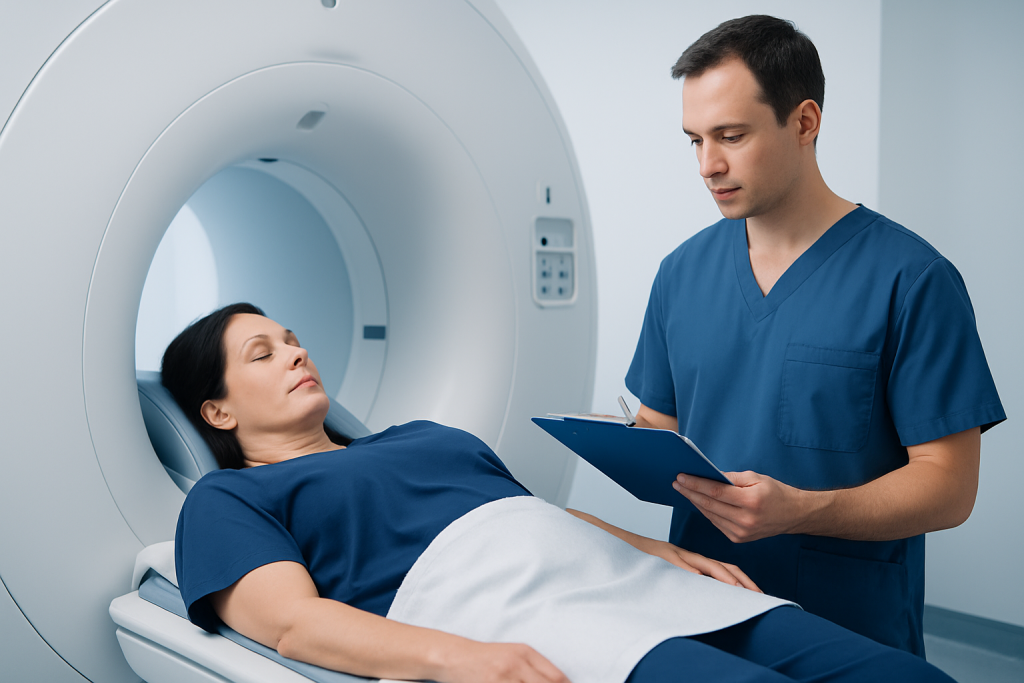
An MRI scanner uses a powerful magnetic field and radio waves, not ionizing radiation. That makes it valuable for many conditions, but it also means certain metals and devices can react to the magnet or distort the images.
Some items may heat up, move slightly, stop working correctly, or create images that are too blurred to interpret. Others are specifically designed to be used in MRI environments, but only under certain conditions such as a specific field strength or scan setting.
Because of this, a routine questionnaire is only the starting point. The radiology team often needs exact device details, operative notes, or an implant card before deciding what is safe and what is not.
Implants and metal: what needs to be checked

Not every implant rules out MRI. Many modern devices are MRI-safe or MRI-conditional, meaning they can be scanned under defined circumstances. The exact label matters, and it is not enough to assume that a device is fine simply because it has been in the body for years.
Common items that require review include pacemakers and defibrillators, aneurysm clips, cochlear implants, neurostimulators, insulin pumps, vascular stents, artificial joints, and certain dental or surgical hardware. Shrapnel, old injury fragments, and metal workers’ eye injuries also deserve special attention.
- Bring implant identification cards whenever possible.
- Share the date and type of every surgery involving metal or a device.
- Tell the team about tattoos, permanent makeup, or previous metal exposure if they caused symptoms before.
- Do not remove or adjust any implanted device on your own.
When records are incomplete, the imaging team may contact the manufacturer, the operating surgeon, or the referring doctor to confirm compatibility. That extra step can prevent delays and help avoid unnecessary risk.
Claustrophobia and scan anxiety
Many people who need an MRI are not worried about the magnet itself; they are worried about the tunnel, the noise, and the feeling of having to stay still for several minutes. Claustrophobia is common and can make the appointment feel harder than the diagnosis being investigated.
Fortunately, anxiety does not automatically mean the scan cannot be done. Patients can often manage more comfortably by knowing what to expect, asking for a detailed walk-through, bringing a support person when allowed, or using relaxation techniques such as paced breathing and guided imagery.
In some cases, the team may offer an open MRI or a wider-bore scanner, if suitable for the clinical question. For patients with severe panic, a doctor may consider medication or light sedation, but this should always be planned in advance so travel, fasting instructions, and discharge arrangements are safe.
Other situations that may change the plan
Implants and claustrophobia are the most familiar concerns, but they are not the only ones. Pregnancy, kidney function, certain allergies, and some recent procedures may also change how an MRI is scheduled or whether contrast is used.
Contrast material is not needed for every MRI, but when it is recommended, the doctor may check renal function and review any prior reaction to contrast agents. People with severe kidney disease need a personalized discussion because the type of contrast and the reason for imaging both matter.
Recent surgery, an unhealed wound, or an active infection near the area being scanned can also affect timing. If the MRI is being arranged from another country, it helps to send recent lab results and operative notes ahead of time so the team can decide whether the appointment should be adjusted before arrival.
How to prepare before the appointment
A practical MRI checklist starts with information, not clothing. Patients should arrive ready to discuss every implant, prior operation, and episode of metal exposure, even if it seems unrelated to the body part being scanned.
It also helps to wear simple clothing without metal fasteners, leave jewelry at home, and remove credit cards, hearing aids, wigs with metal parts, and any removable dental or body accessories before entering the scan area. The imaging center may give more specific instructions based on the scanner and the type of exam.
- Carry a list of medications and allergies.
- Bring prior imaging reports if they are available.
- Inform the team about pregnancy or possible pregnancy.
- Ask ahead whether eating, drinking, or sedation instructions apply.
- Plan for extra time if records must be reviewed or translated.
For international patients, preparation should also include practical planning after the scan, such as who will explain the results, how follow-up questions will be handled, and whether a return visit or online review is likely to be needed.
What happens during and after the MRI
During the scan, the technologist will usually stay in communication and remind the patient when to remain still or hold their breath. The machine can be loud, so ear protection is commonly provided, and some people find the rhythmic sounds easier to tolerate once they know they are normal.
If contrast is used, it is typically given through an intravenous line while the team watches for immediate reactions. Most patients leave shortly after the exam and return to normal activities unless sedation was given or their doctor advises otherwise.
Image interpretation usually follows after the scan, and in many cases the practical value of the MRI depends on the quality of the pre-scan screening. When the safety checklist is complete, the radiologist can focus on producing images that are both safe and diagnostically useful.
When to see a doctor
A doctor should be contacted before booking an MRI if there is any uncertainty about an implanted device, metal fragment, prior eye injury involving metal, or previous reaction to contrast. The same is true if the patient has severe anxiety, kidney disease, pregnancy-related questions, or a recent surgery that might affect the timing of imaging.
If an MRI is urgently needed, the referring physician and radiology team can often decide quickly whether it is appropriate and how to adapt the scan. Clear communication is especially helpful when records come from different hospitals or countries.
Acibadem Health Point’s multidisciplinary specialists and JCI-accredited hospitals diagnose and treat patients who need MRI-based evaluation, including international patients who require coordinated planning before travel and follow-up after the scan.
Frequently asked questions
Can someone with a pacemaker have an MRI?
Sometimes, yes. Many newer pacemakers are MRI-conditional, which means scanning may be possible under specific conditions and with careful coordination. The exact device model and the scanning protocol must be checked before the appointment.
What if the patient is claustrophobic?
Claustrophobia is a common reason people feel uneasy about MRI, and it can often be managed. Open or wide-bore scanners, clear explanations, breathing techniques, and occasionally sedation may help, depending on the case.
Why is the MRI staff asking so many questions about metal?
The questions help the team identify anything that could move, heat up, malfunction, or interfere with image quality in the magnetic field. This screening is a standard safety step and is meant to protect the patient, not to delay care unnecessarily.
Is contrast always needed for an MRI?
No. Many MRI exams are done without contrast, while others gain important detail from it. The decision depends on the body part being examined and the medical question being asked.
Can a metal implant from years ago still matter?
Yes, because older implants may not have the same MRI labeling as newer ones. Even if the surgery happened long ago, the device still needs to be identified and checked for compatibility.
What should an international patient bring to an MRI appointment?
It is helpful to bring implant cards, prior reports, medication lists, and any recent test results. If possible, patients should also share records in advance so the radiology team can review them before travel.
References
- Radiological Society of North America
- American College of Radiology
- U.S. Food and Drug Administration
- Mayo Clinic
- National Institute of Biomedical Imaging and Bioengineering
This article is for general information only and is not a substitute for professional medical advice. Please consult a qualified doctor about your individual situation.