

Goniometer

Key Takeaways
- A goniometer measures joint angles and range of motion in a repeatable way.
- It is commonly used in rehabilitation, orthopedics, sports medicine, and physical therapy.
- The tool helps clinicians monitor recovery after injury, surgery, or illness.
- Goniometer readings are most useful when paired with a full clinical examination and patient symptoms.
- Home exercises, follow-up visits, and proper technique can support better joint mobility over time.
A goniometer is a simple measuring tool used to assess how far a joint can move. It helps clinicians track recovery, compare progress over time, and guide rehabilitation plans with clearer, more objective information.
Overview
A goniometer is a measuring instrument used to determine the angle of a joint. In everyday care, it helps clinicians answer a practical question: how well is a shoulder, knee, elbow, wrist, neck, or ankle moving today, and how does that compare with previous visits?
For many patients, the device appears during physiotherapy, orthopedic assessment, or post-operative follow-up. It may look simple, but it adds structure to decisions about rehabilitation. Instead of relying only on a person’s description of stiffness or improvement, the care team can document movement in degrees and follow change over time.
That matters for international patients as well. When someone is traveling for treatment, a clear baseline measurement helps the team plan therapy before discharge and creates a more precise record for continued care back home. A goniometer is one of the tools that makes that continuity easier.
What a Goniometer Measures

The goniometer measures range of motion, which is the amount a joint can bend, straighten, rotate, or move in a particular direction. The clinician places the device alongside the body segment and reads the angle formed by the joint position.
Different joints require slightly different handling. A shoulder assessment may focus on lifting the arm, while a knee check may look at bending and straightening after surgery or injury. The same basic principle applies in all cases: the tool helps translate movement into a number that can be compared at later appointments.
Range-of-motion data can be useful in several ways:
- to identify stiffness or limitation
- to monitor progress during rehabilitation
- to compare the affected side with the unaffected side
- to support decisions about exercise progression or activity changes
Common Symptoms That Lead to a Goniometer Exam
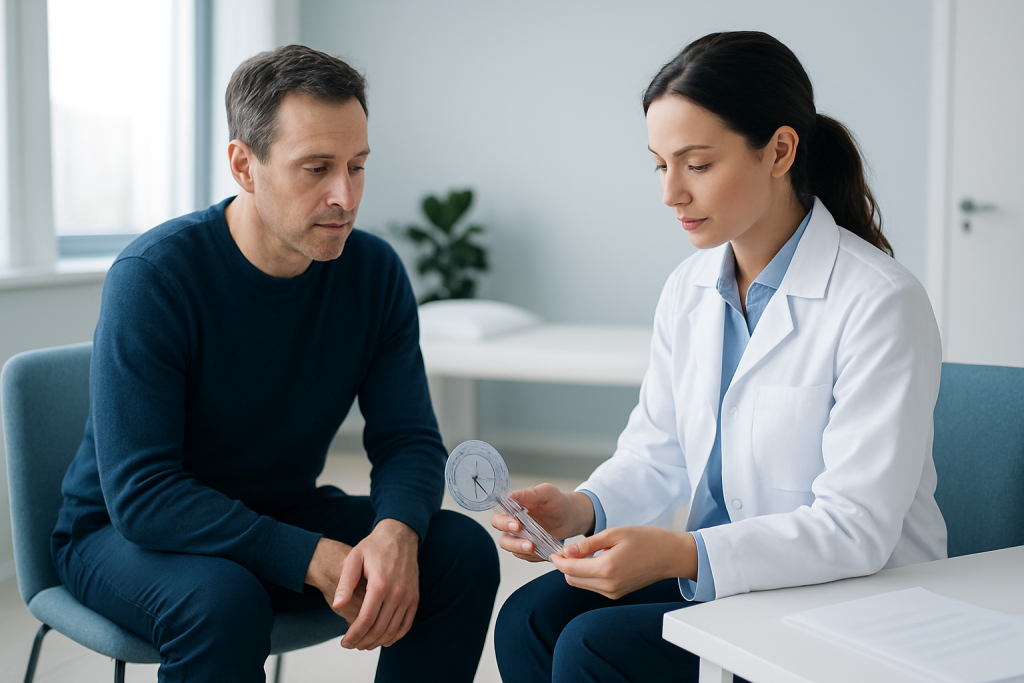
People usually do not seek out a goniometer on its own. It is used because a clinician wants to understand why movement feels restricted, painful, or uneven. Common reasons include joint stiffness after resting, limited bending after an injury, or weakness that changes how a limb moves.
Patients may notice difficulty with familiar tasks, such as climbing stairs, reaching overhead, turning the head, or straightening the elbow fully. Swelling, pain, muscle tightness, or post-surgical protection can all reduce motion and make everyday activity feel less predictable.
In rehabilitation settings, a goniometer can also be used even when symptoms are improving. A person may feel better, but the numbers help show whether that improvement is reflected in actual joint mobility and function.
Causes & Risk Factors for Limited Motion
Restricted joint movement can have many causes, and the goniometer itself does not identify the reason. It simply records the result. Common contributors include injury, arthritis, post-surgical healing, muscle imbalance, tendon irritation, neurological conditions, and prolonged inactivity.
Risk tends to be higher after fractures, ligament injuries, joint replacement, or procedures that require immobilization. Older adults may also develop stiffness more easily, especially if pain leads to less movement over time. In children, abnormal movement patterns or developmental issues can also prompt range-of-motion assessment.
Because joint limitation is often the visible end point of a broader issue, clinicians use goniometer readings together with medical history, physical examination, and sometimes imaging or laboratory tests.
Diagnosis and Clinical Assessment
During an exam, the clinician first observes posture, alignment, swelling, pain response, and how the patient moves. The goniometer then provides a more precise measurement of the joint’s position at rest and at its limit of movement.
Most assessments are quick and non-invasive. The clinician may ask the patient to move actively, then repeat the measurement while gently guiding the limb. This helps distinguish between motion the patient can produce independently and motion possible with assistance.
The reading is usually documented alongside other findings, such as strength, tenderness, gait, balance, or neurological status. This fuller picture is important because a joint may measure within a certain range yet still function poorly if pain, weakness, or instability is present.
Treatment Options
A goniometer is not a treatment on its own; it is a guide that helps shape treatment. If the measurement shows limited motion, the care plan may include physical therapy, targeted exercises, stretching, manual therapy, bracing, pain management, or recovery time after surgery.
When the goal is to regain mobility, progress is often gradual. Clinicians may reassess with the goniometer at follow-up visits to see whether the joint is responding as expected. If progress is slow, the plan may be adjusted to better match the underlying problem and the patient’s tolerance.
For people traveling for care, this approach can be especially useful. The team can measure movement before discharge, explain the home exercise plan in clear terms, and provide a reference point for a local therapist or physician in the patient’s home country.
Prevention & Self-care
Not every movement problem can be prevented, but healthy joints usually benefit from regular, appropriate motion. Staying active within one’s medical limits, warming up before exercise, and paying attention to posture can all support better flexibility and function.
After an injury or procedure, following the recommended rehabilitation plan is often the most effective way to protect motion. Skipping exercises, returning too quickly to demanding activity, or ignoring swelling and pain can slow recovery and increase stiffness.
Helpful self-care habits may include:
- doing prescribed stretches and exercises consistently
- using movement breaks during long periods of sitting
- managing swelling as advised by the care team
- keeping follow-up appointments so changes can be measured
Patients should avoid forcing a joint through sharp pain. A gradual, supervised approach is usually safer and more effective than pushing hard on a stiff or healing area.
When to See a Doctor
A medical evaluation is appropriate if a joint becomes suddenly difficult to move, if stiffness is worsening, or if pain, swelling, redness, or weakness is interfering with normal activity. New limitation after a fall, Knee Pain Relief: Causes and Treatment" class="ahp-ilk">Pain Relief" class="ahp-ilk">sports injury, or surgery should also be checked promptly.
People should seek care sooner if the problem affects walking, balance, hand use, breathing-related chest movement, or neck motion with numbness or tingling. These symptoms do not always point to a serious condition, but they deserve careful assessment.
If treatment is being planned in another country, it is helpful to gather previous reports, imaging, and rehabilitation notes before travel. A well-documented baseline, including goniometer measurements, can make follow-up simpler and more coordinated. Acibadem Health Point’s multidisciplinary specialists and JCI-accredited hospitals diagnose and treat conditions affecting joint motion for international patients with coordinated, evidence-based care.
Why the Goniometer Still Matters in Modern Care
Even with advanced imaging and digital health records, the goniometer remains relevant because it measures something patients care about every day: how well they can move. Its value lies in consistency. When the same joint is checked over time, small improvements or setbacks become easier to see.
That consistency helps patients, too. Clear measurements can make recovery feel less vague and can support realistic expectations. For someone healing after surgery or returning to activity after an injury, seeing progress in degrees can be reassuring and motivating.
In the end, the goniometer is a modest tool with a practical role. It gives rehabilitation teams a common language for movement and gives patients a clearer picture of where they are in recovery.
Frequently asked questions
What is a goniometer used for?
A goniometer is used to measure the angle of a joint and estimate range of motion. Clinicians use it to track stiffness, recovery, and functional progress over time.
Does a goniometer exam hurt?
Usually it does not hurt. The test is non-invasive, although a person may feel discomfort if the joint is already painful or very stiff.
Is a goniometer only used by physical therapists?
No. Physical therapists use it often, but orthopedic surgeons, rehabilitation physicians, sports medicine clinicians, and other health professionals may also use it.
Can a goniometer show what is wrong with a joint?
It shows how much a joint can move, but it does not identify the cause of limitation by itself. It is one part of a broader assessment that may include examination and imaging.
Why are repeated measurements important?
Repeated measurements help the care team see whether treatment is helping, staying the same, or needing adjustment. They also make it easier to compare recovery across visits or across different locations of care.
Can patients use a goniometer at home?
Some patients do use simple versions at home under professional guidance. However, correct positioning matters, so measurements are most reliable when a clinician teaches the technique.
References
- American Physical Therapy Association
- Mayo Clinic
- Merck Manual Professional Edition
- World Health Organization
This article is for general information only and is not a substitute for professional medical advice. Please consult a qualified doctor about your individual situation.
More from the Health Library


Related Specialists

Prof. Dr. Ahmet Alanay
Orthopedic Surgery & Traumatology
Dr. Sinan Aksu
Orthopedic Surgery & Traumatology
Dr. Sirri Baştürk
Orthopedic Surgery & Traumatology
Prof. Dr. Korhan Özkan
Orthopedic Surgery & Traumatology