Which Scan Answers Your Question Best: Ultrasound, CT, MRI, or X-Ray?

Key Takeaways
- No single scan is best for every problem; the right test depends on the body part and the clinical question.
- X-ray is often useful for bones and chest problems, while ultrasound is helpful for soft tissues and pregnancy-related checks.
- CT gives fast, detailed cross-sectional images and is often used in urgent situations or for complex anatomy.
- MRI offers excellent soft-tissue detail without ionizing radiation, but it usually takes longer than CT or X-ray.
- Doctors consider symptoms, medical history, pregnancy status, implants, and the need for contrast before choosing a scan.
Medically reviewed by the Acıbadem clinical team — June 13, 2026
When symptoms point to a problem inside the body, the best scan depends on the question being asked. Ultrasound, CT, MRI, and X-ray each have strengths, limits, and specific uses, and doctors choose them based on safety, speed, and the level of detail needed.
Overview
In many real-world situations, the first scan is chosen because it is the simplest way to rule in or rule out a likely cause. In others, one scan leads to another because the first image raises a new question. That stepwise approach is normal and often protects patients from unnecessary testing.
It also helps to remember that scans are tools, not diagnoses by themselves. The image must be interpreted alongside symptoms, examination findings, and sometimes blood tests or other studies. The most useful scan is the one that helps the doctor make the next decision clearly.
Symptoms and Situations That Lead to Imaging
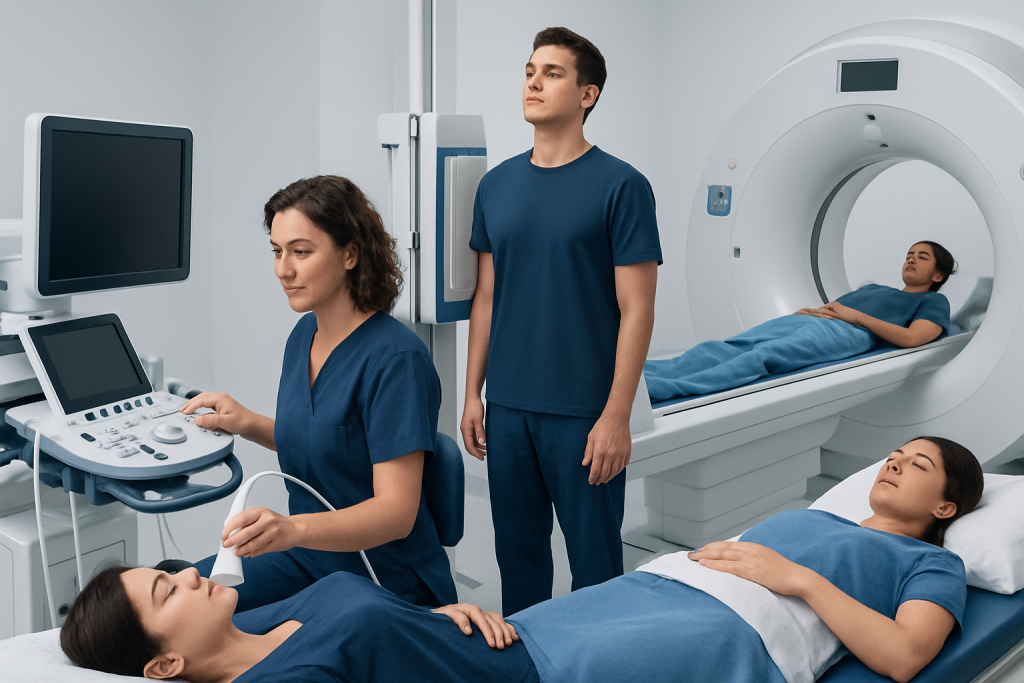
-
Bone pain or suspected fracture: X-ray is often the first step.
-
Gallstones, pelvic concerns, or pregnancy-related assessment: Ultrasound is commonly preferred.
-
Sudden severe pain, trauma, or internal bleeding concerns: CT may be chosen for speed and detail.
-
Back pain with nerve symptoms, joint injuries, or brain/spine questions: MRI may provide the clearest answer.
The final choice depends on how quickly the answer is needed and which tissue needs to be seen most clearly. If a patient has had previous imaging, the doctor may also compare old and new scans to understand change over time.
Causes & Risk Factors: Why One Scan Fits Better Than Another

For example, a patient with kidney stone symptoms may be sent for CT because it can show stones clearly and quickly. Someone with suspected gallbladder disease may start with ultrasound because it looks well at the right upper abdomen without radiation. A person with a knee injury may need MRI if ligament damage is suspected after an X-ray rules out a fracture.
That is why scan choice is individualized. The best imaging study is the one that reveals the likely problem with the least unnecessary burden on the patient.
How Doctors Choose the Right Test
Contrast material may be recommended for some CT and MRI studies to highlight blood vessels, inflammation, or certain masses. Whether contrast is used depends on the question, the patient’s kidney function, allergies, and other health details. Ultrasound can also use specialized contrast in select cases, though it is not needed for most routine exams.
Before the scan, the team may ask about pregnancy, implants, prior surgeries, and medications. These details are not formality; they help select the safest and most useful test.
What Each Scan Shows Best
No scan is perfect. Ultrasound depends on the skill of the operator and the patient’s body habitus, CT exposes the patient to radiation, MRI takes longer and may be difficult for people who feel anxious in enclosed spaces, and X-ray provides limited soft-tissue detail. Those trade-offs are why doctors do not default to one test for everything.
In practice, the “best” scan is the one that gives enough information to guide care without unnecessary delay or risk.
What to Expect During the Exam
-
Clothing and metal: Patients may need to remove jewelry, watches, or clothing with metal parts.
-
Fasting: Some CT or ultrasound studies may require a few hours without food.
-
Motion: Remaining still helps produce sharper images, especially for MRI and CT.
-
Results: A radiologist interprets the images, and the treating doctor explains what they mean in context.
If a contrast agent is planned, the team may ask about allergies or kidney function beforehand. That preparation is routine and designed to keep the exam as safe and informative as possible.
Prevention & Self-care
After the scan, most people can return to normal activities right away unless they were given sedation or specific instructions. Drinking water may be encouraged after some contrast studies, but the team will explain what is appropriate for the individual situation.
Self-care also means waiting for the full interpretation rather than trying to infer meaning from the pictures alone. The report may contain technical terms, but the doctor can translate them into a practical plan.
When to See a Doctor
If a person already has imaging results from another country, bringing the actual images and the written report is ideal. Doctors can often interpret them more accurately when both are available. This can save time and reduce repeat testing.
When in doubt, it is reasonable to ask one simple question: “What are we trying to learn from this scan?” The answer usually makes the choice clearer and helps the patient feel more involved in the decision.
Frequently asked questions
How do doctors decide between ultrasound, CT, MRI, and X-ray?
They match the scan to the clinical question, the body part being examined, and how quickly the answer is needed. They also consider safety factors such as pregnancy, kidney function, implants, and prior contrast reactions.
Which scan is best for bones?
X-ray is often the first test for suspected fractures, and CT can be useful when the bone injury is complex or detailed 3D views are needed. MRI may be used if the doctor suspects a hidden injury to marrow, cartilage, or nearby soft tissues.
Which scan is best for soft tissue problems?
MRI usually provides the most detail for soft tissues such as the brain, spinal cord, ligaments, cartilage, and many organs. Ultrasound can also be very helpful for certain soft-tissue and fluid-filled structures, especially when a real-time view is useful.
Is CT the same as an X-ray?
They both use X-ray technology, but CT takes many X-ray images from different angles and combines them into detailed cross-sectional pictures. That makes CT more informative for many complex or urgent problems, though it also involves more radiation than a simple X-ray.
Is MRI always better because it has no radiation?
Not always. MRI is excellent for many soft-tissue questions, but it takes longer, may be less available, and is not the best choice for every situation. The right scan depends on what the doctor needs to see, not only on whether radiation is involved.
Can a scan diagnose everything?
No single scan answers every question. Sometimes the result is clear, and sometimes another test, follow-up imaging, or a specialist opinion is needed to complete the picture.
References
- World Health Organization
- RadiologyInfo.org
- American College of Radiology
- Mayo Clinic
- NHS
This article is for general information only and is not a substitute for professional medical advice. Please consult a qualified doctor about your individual situation.