

Bulgarian Split Squat: How To Do It
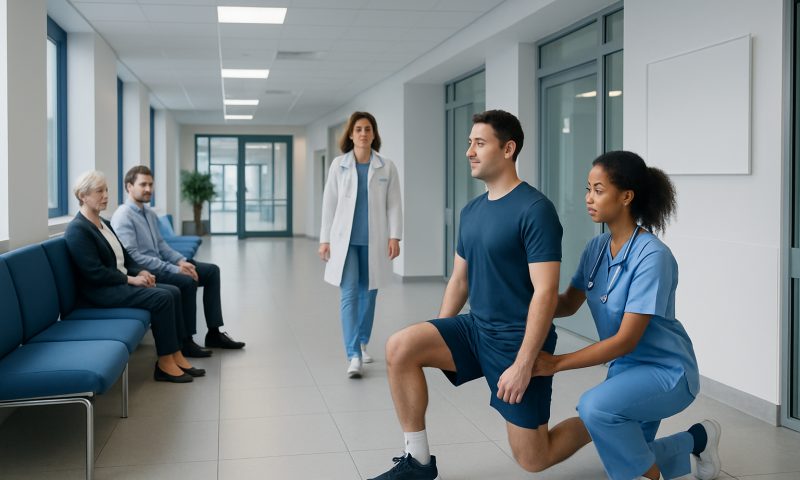
Key Takeaways
- It is a unilateral exercise that trains one leg at a time, helping reveal and correct side-to-side strength differences.
- Good setup and posture matter more than depth; the exercise should feel controlled rather than forced.
- It can strengthen the quadriceps, glutes, hamstrings, and stabilizing muscles around the hips and knees.
- People with knee, hip, ankle, or balance issues may need modifications or professional guidance before starting.
- Pain, swelling, or persistent instability during training should be assessed by a qualified clinician.
Medically reviewed by the Acıbadem clinical team — August 19, 2026
The Bulgarian split squat is a single-leg lower-body exercise that can build strength, balance, and control when performed with good technique. It is also a useful movement for people returning to exercise, provided it is introduced gradually and adapted to individual mobility or joint concerns.
Overview
The Bulgarian split squat is a single-leg strength exercise performed with the back foot elevated on a bench, step, or stable platform. Although it is widely used in fitness settings, it is also valuable in rehabilitation and return-to-activity plans because it asks the legs to work hard without requiring heavy external load.
What makes it different from a standard squat is the demand on one side at a time. That can be useful for people who notice one leg feels weaker, less stable, or less coordinated than the other. It also encourages better awareness of hip, knee, and ankle alignment, which is one reason physiotherapists and sports professionals often include it in training programs.
For international patients deciding whether to resume exercise during or after treatment, this movement can be part of a structured plan. The exercise itself is simple, but the right version for one person may not be right for another, especially if there is a history of knee pain, recent surgery, or balance problems.
How the Exercise Is Performed
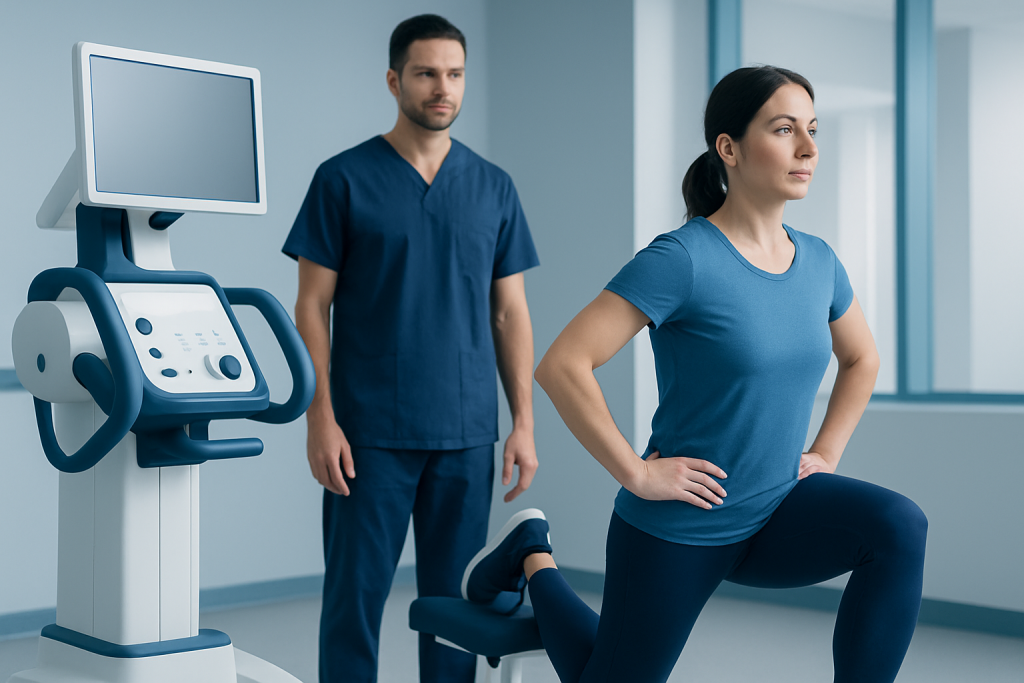
In a typical Bulgarian split squat, the front foot stays on the floor while the rear foot rests behind the body on a bench or elevated surface. The torso stays upright or only slightly inclined, and the front knee bends as the body lowers in a controlled line. Most of the work should be felt in the front leg.
Setup matters. The front foot should usually be far enough forward that the knee can bend comfortably without the heel lifting. The rear foot is mainly there for balance and positioning, not for pushing the body upward. A stable base, slow pace, and even breathing help keep the movement smooth and reduce unnecessary strain.
Many people begin with body weight only. If technique remains steady, a clinician or coach may later suggest adding dumbbells, kettlebells, or other resistance. For some patients, especially those in rehabilitation, even a partial-range version or assisted version is enough to achieve the intended benefit.
Muscles Worked and Benefits
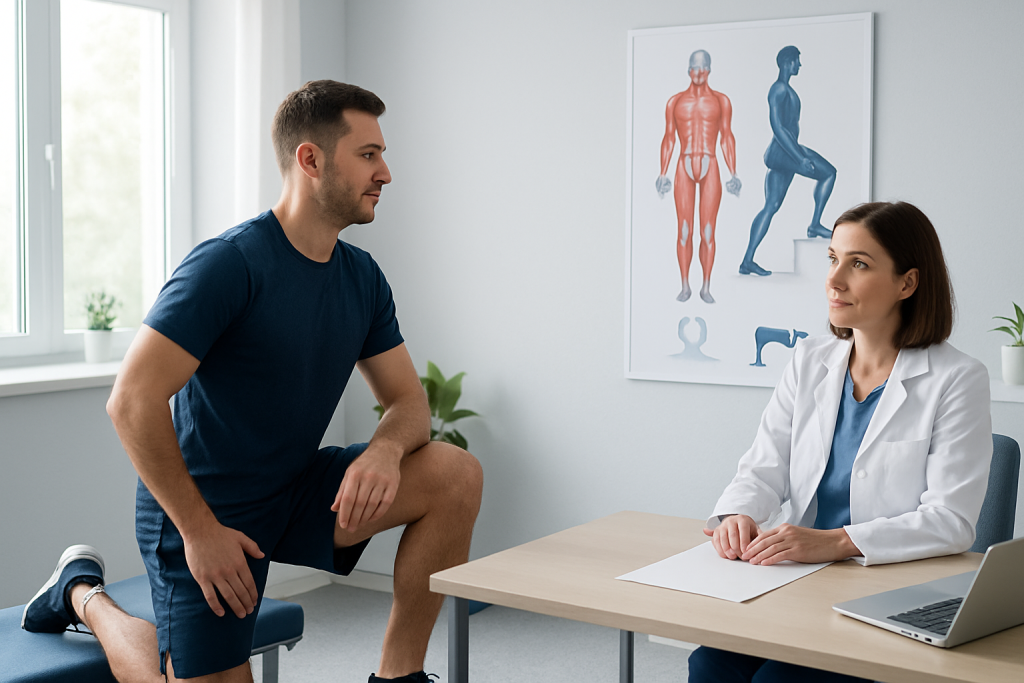
This exercise primarily trains the quadriceps, gluteal muscles, and hamstrings of the front leg. It also challenges the calf muscles, core, and the smaller stabilizers around the hip and ankle, which helps the body stay aligned as it moves.
Because it is a unilateral exercise, it can help reduce hidden strength imbalances between the left and right sides. That may be important for athletes, but it is also relevant for everyday function such as climbing stairs, rising from a chair, carrying shopping bags, or recovering confidence after a period of reduced activity.
In a rehabilitation context, a Bulgarian split squat may support goals such as improved leg strength, better balance, and more controlled lower-limb movement. It is not a cure-all, and it should not be used to “push through” joint pain, but when prescribed appropriately it can be a practical bridge between basic strengthening and more demanding exercise.
Common Mistakes and How to Avoid Them
One common mistake is placing the front foot too close to the bench, which can force the knee into an uncomfortable position and make balance difficult. Another is leaning excessively forward or collapsing through the trunk, which reduces control and can shift load away from the intended muscles.
People also sometimes rush the movement. Dropping quickly into the bottom position or bouncing out of it makes the exercise less effective and may irritate sensitive joints. A controlled descent, brief pause if needed, and steady return usually provide a better training effect.
- Keep the front heel grounded.
- Track the front knee in line with the toes rather than letting it cave inward.
- Use a surface that is stable and appropriate in height.
- Start with a smaller range of motion if mobility is limited.
- Stop if sharp pain, locking, or giving way occurs.
Causes & Risk Factors for Discomfort
Although the Bulgarian split squat is a healthy exercise for many people, discomfort can appear when the movement is poorly matched to a person’s current mobility, strength, or injury status. Knee pain may be more likely if there is poor tracking of the knee, limited ankle movement, or a sudden jump in training load.
Hip tightness, balance difficulties, and previous lower-limb injuries can also make the exercise feel awkward at first. For some people, the rear foot position creates stress in the ankle, toe, or hip of the back leg, especially if the elevated surface is too high.
Risk is not just about the exercise itself; it is also about the wider context. Fatigue, inadequate warm-up, hard training surfaces, unsuitable footwear, and trying advanced versions too soon can all increase the chance of irritation. A cautious progression is usually the safest path.
Diagnosis and Professional Assessment
The exercise does not require a medical diagnosis to perform, but evaluation becomes important when pain, swelling, instability, or recurrent asymmetry appears. A clinician may ask where the discomfort starts, when it occurs, and whether it changes with depth, speed, or load.
Assessment often includes observing the person perform the movement, checking hip and ankle mobility, and looking for signs of weakness or compensatory patterns. If symptoms suggest a joint or tendon problem, further examination may be recommended to clarify the cause.
For patients already under orthopedic or rehabilitation care, the Bulgarian split squat may be used as a functional test as well as an exercise. In that setting, the key question is not simply whether the movement can be done, but whether it can be done with adequate control and without aggravating symptoms.
Treatment Options, Modifications, and Progression
If the exercise causes discomfort, the first step is usually to simplify it rather than abandon it completely. A shorter range of motion, a lower back-foot elevation, support from a rail or wall, or a body-weight-only version may be enough to keep training safe and productive.
When a clinician recommends the Bulgarian split squat as part of treatment, it may be combined with other exercises for glute strength, calf mobility, core control, or balance. This kind of layered approach is often more helpful than focusing on a single movement.
Possible progressions include:
- Assisted body-weight split squats.
- Partial-range Bulgarian split squats.
- Full-range body-weight versions.
- Loaded versions with light external resistance.
Progress should be gradual. If symptoms increase after exercise and do not settle with rest, the plan may need adjustment by a physiotherapist, sports medicine clinician, or orthopedist.
Prevention & Self-care
A good warm-up can make the movement feel smoother and reduce unnecessary tension. Light walking, gentle mobility work, and a few easier squats or lunges can prepare the joints and muscles for the task ahead.
Pay attention to recovery as well. Adequate rest between sessions, reasonable training volume, and supportive footwear all help the exercise remain useful rather than irritating. People who travel for care or are following a home program after treatment should also be realistic about available space, equipment, and fatigue from the journey.
Self-care is mostly about listening to the body. Mild muscle effort is expected; sharp pain, repeated swelling, or a feeling that the leg may buckle is not. Keeping a simple log of exercise depth, load, and symptoms can help patients and clinicians make smarter decisions over time.
When to See a Doctor
Medical assessment is advisable if the exercise repeatedly causes knee, hip, ankle, or back pain, or if one leg feels noticeably unstable compared with the other. Swelling, catching, locking, or a clear loss of function should also be evaluated.
People recovering from surgery, fracture, ligament injury, tendon problems, or arthritis should ask a clinician before adding this exercise, especially if they are unsure about safe depth or resistance. A personalized plan can prevent setbacks and help maintain confidence during recovery.
Acibadem Health Point’s multidisciplinary specialists and JCI-accredited hospitals diagnose and treat musculoskeletal conditions for international patients, including those who need exercise guidance as part of rehabilitation. For anyone unsure whether this movement suits their current condition, a qualified doctor or physiotherapist can help tailor the next step.
Frequently asked questions
What is the main benefit of the Bulgarian split squat?
Its main benefit is building single-leg strength while also training balance and coordination. Because each leg works independently, it can help uncover side-to-side differences that a regular squat might hide.
Is the Bulgarian split squat hard on the knees?
It can be comfortable for many people, but it is not suitable for everyone in every phase of recovery. Knee comfort depends on setup, mobility, depth, and current joint health, so modifications are often useful.
Can beginners do this exercise?
Yes, but beginners should start with body weight, a stable support nearby, and a limited range of motion if needed. Learning control first is usually more important than adding resistance early.
What should pain during the exercise mean?
Mild muscle effort is normal, but sharp, worsening, or joint-centered pain is not something to ignore. If pain persists after the session or keeps returning, a clinician should assess the movement and the underlying cause.
How is it different from a regular split squat?
Both exercises are similar, but the Bulgarian split squat uses an elevated rear foot. That increase in instability and range of motion can make it more challenging and shift the training demand more strongly to the front leg.
Can it be part of rehabilitation after injury or surgery?
Often, yes, but only when a clinician feels the person is ready for it. Rehabilitation programs usually introduce it gradually and may start with easier variations before moving to the full exercise.
References
- American Academy of Orthopaedic Surgeons
- National Institute of Arthritis and Musculoskeletal and Skin Diseases
- American College of Sports Medicine
- NHS
This article is for general information only and is not a substitute for professional medical advice. Please consult a qualified doctor about your individual situation.
Joint and spine care in Turkey — expert assessment & treatment
JCI-accredited · board-certified surgeons · reply within 24h
Add us as a Preferred Source to see more of our trusted health content across Google Search, AI Overviews and Discover.
More from the Health Library



Related Specialists

Prof. Dr. Ahmet Alanay
Orthopedic Surgery & Traumatology
Dr. Sinan Aksu
Orthopedic Surgery & Traumatology
Dr. Sirri Baştürk
Orthopedic Surgery & Traumatology
Prof. Dr. Korhan Özkan
Orthopedic Surgery & Traumatology