Ultrasound for Thyroid Nodules: When Follow-Up Is Enough and When More Is Needed

Key Takeaways
- Ultrasound helps doctors judge whether a thyroid nodule looks low risk, intermediate risk, or suspicious.
- Many thyroid nodules can be monitored over time without immediate treatment.
- Changes in size, shape, or ultrasound features may lead to biopsy or other tests.
- Symptoms such as hoarseness, swallowing difficulty, or a rapidly growing lump deserve medical review.
- Follow-up plans depend on the nodule’s appearance, size, and the person’s overall health.
Medically reviewed by the Acıbadem clinical team — June 13, 2026
Thyroid nodules are common, and ultrasound is the main tool doctors use to look at their size and appearance. In many cases, careful follow-up is all that is needed; in others, additional testing helps clarify whether a nodule requires treatment.
Overview
A thyroid nodule is a lump or growth within the thyroid gland, a small butterfly-shaped organ at the base of the neck. Most nodules are benign, and many people never know they have one until an examination or imaging test reveals it.
Ultrasound is usually the first and most useful imaging test for thyroid nodules. It does not use radiation, it shows the nodule’s structure in detail, and it helps doctors decide whether the finding can be watched over time or needs a closer look.
For many patients, the question is not simply whether a nodule exists, but what it looks like on ultrasound. Features such as margins, shape, composition, and tiny calcifications often matter more than size alone when deciding on follow-up or further testing.
Symptoms
Most thyroid nodules cause no symptoms at all and are discovered incidentally during a neck exam, ultrasound for another reason, or imaging done for unrelated concerns. When symptoms do occur, they often relate to the nodule’s size or location rather than its cause.
Possible signs may include a visible lump in the neck, a feeling of pressure, trouble swallowing, or a sense that something is “sticking” in the throat. Some people notice voice changes, although hoarseness can have many causes and does not automatically point to a serious thyroid problem.
Because many nodules are silent, ultrasound often plays a central role in evaluation. It can identify nodules that feel harmless on the surface but still deserve monitoring because of their appearance or growth pattern.
Causes & Risk Factors

Thyroid nodules can develop for several reasons. Some are related to simple overgrowth of normal thyroid tissue, some contain fluid, and others may reflect inflammation, cysts, or less commonly a tumor. The majority are noncancerous.
Risk can be influenced by age, family history of thyroid disease, prior radiation exposure to the neck, and living in areas where iodine intake has been too low or too high. Women are diagnosed more often than men, though nodules can occur in anyone.
A doctor also considers whether the thyroid is functioning normally. A nodule may appear in someone with normal hormone levels, an overactive thyroid, or an underactive thyroid, and the broader clinical picture helps guide next steps.
Diagnosis
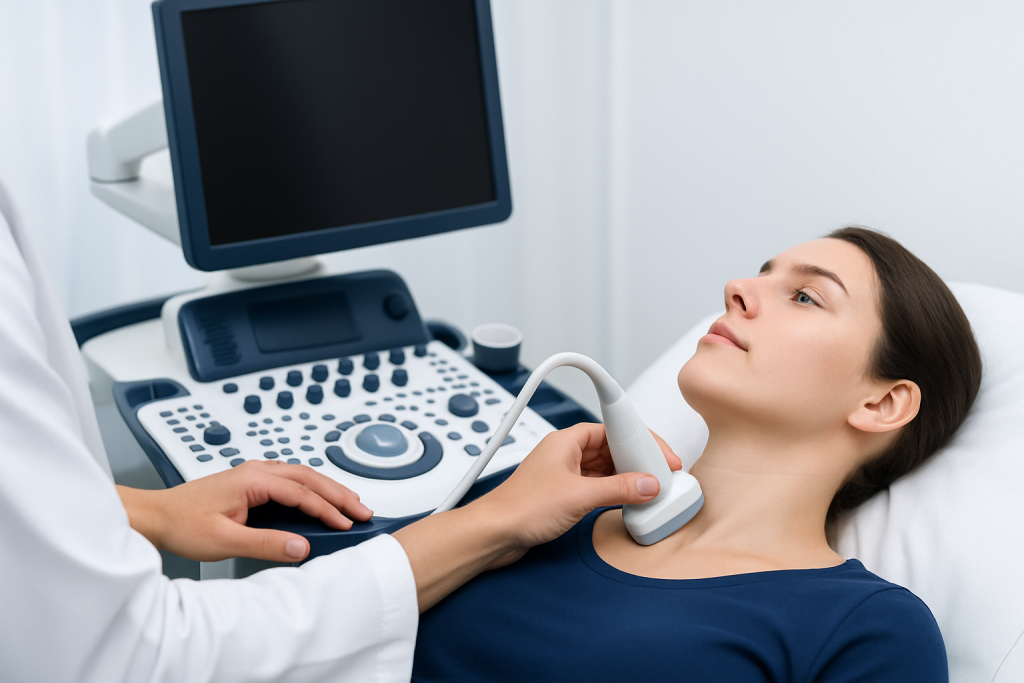
Ultrasound gives the clearest first impression of a thyroid nodule. The exam is quick, painless, and usually done with the person lying comfortably while a small probe is moved across the skin of the neck.
On ultrasound, doctors look at whether the nodule is solid or fluid-filled, whether it is wider than tall, how its borders appear, and whether there are features that raise concern. These details are often organized using a risk-stratification system so follow-up decisions are consistent and evidence-based.
If the nodule has a low-risk appearance, a doctor may recommend repeat ultrasound rather than immediate intervention. If the pattern is more suspicious, the next step may be a fine needle aspiration biopsy, blood tests, or occasionally other imaging depending on the situation.
- Low-risk appearance: often monitored with repeat imaging
- Indeterminate or suspicious appearance: may need biopsy
- Associated thyroid dysfunction: may require blood tests and endocrine review
Treatment Options
Not every thyroid nodule needs treatment. For nodules that appear benign and remain stable, observation is often the safest and most appropriate path. The purpose of follow-up is to make sure the nodule does not change in a way that suggests a need for action.
If a biopsy is recommended, fine needle aspiration is usually the standard test. It uses a thin needle to collect cells from the nodule, typically under ultrasound guidance, and helps clarify whether the lump is benign, indeterminate, or malignant.
When treatment is needed, options depend on the diagnosis and symptoms. Some nodules are managed with thyroid medication, though medication is not routinely used to shrink most benign nodules. Others may need surgery, especially if they are cancerous, very large, causing pressure symptoms, or repeatedly inconclusive on biopsy.
In certain cases, minimally invasive treatments may be discussed, but the best choice depends on local expertise, the nodule’s characteristics, and the patient’s overall health and preferences. For international patients, the plan is often built to balance safety, clarity, and follow-up logistics after returning home.
Prevention & Self-care
There is no guaranteed way to prevent thyroid nodules. Still, general thyroid health is supported by balanced nutrition, appropriate iodine intake, and medical review of any new neck lump rather than waiting to see whether it disappears on its own.
For people already under follow-up, consistency matters. Keeping ultrasound appointments, bringing prior reports when traveling for care, and noting changes in swallowing, voice, or neck size all help doctors interpret the situation accurately over time.
Self-care also includes avoiding unnecessary worry. Many nodules stay unchanged for years, and a follow-up plan is often a sign that the nodule has been assessed and found suitable for observation. Patients who receive care abroad may benefit from asking for copies of imaging reports and pathology results to share with their home doctor.
When Follow-Up Is Enough — and When More Is Needed
Follow-up alone is often enough when a nodule has reassuring ultrasound features, is small, and does not cause symptoms. In these cases, the main goal is to watch for stability rather than to intervene early and unnecessarily.
More evaluation is usually needed if the ultrasound shows suspicious characteristics, if the nodule is growing, or if it is causing pressure symptoms. Doctors may also move more quickly when there is a personal history of head and neck radiation, a strong family history of thyroid cancer, or abnormal lymph nodes near the thyroid.
In practice, the decision is rarely based on one factor alone. A nodule with a low-risk look may still be followed closely if it is new or changing, while a seemingly modest nodule may need biopsy if its structure raises concern. That is why ultrasound findings are interpreted together with age, symptoms, thyroid blood tests, and the full medical history.
When to See a Doctor
Any new lump in the neck should be evaluated, especially if it persists beyond a short time or is noticed with swallowing or voice changes. People who already know they have a thyroid nodule should seek review if it becomes painful, enlarges quickly, or starts causing a feeling of pressure.
Medical attention is also important if there is unexplained hoarseness, difficulty breathing, trouble swallowing, or swollen lymph nodes in the neck. These symptoms do not always mean something serious, but they do deserve assessment rather than watchful waiting alone.
For patients arranging care internationally, it helps to seek a center that can coordinate ultrasound, biopsy, endocrinology, and surgical review in one pathway if needed. Acibadem Health Point’s multidisciplinary specialists and JCI-accredited hospitals can diagnose and treat thyroid nodules for international patients, with follow-up planning that supports continuity after travel.
Frequently asked questions
Do all thyroid nodules need a biopsy?
No. Many thyroid nodules can be followed with ultrasound alone if they look low risk and remain stable. A biopsy is usually reserved for nodules with suspicious features, significant growth, or other concerning clinical findings.
How often is follow-up ultrasound done?
The timing depends on the nodule’s appearance and risk level. Some nodules are rechecked in months, while others can be monitored less frequently; the exact schedule is set by the treating doctor.
Can a benign thyroid nodule become cancer later?
Most benign nodules stay benign, but doctors still monitor them because appearance and size can change over time. Follow-up imaging helps catch meaningful changes early and avoids unnecessary treatment when nothing is evolving.
Is thyroid ultrasound painful or risky?
Thyroid ultrasound is generally painless and does not involve radiation. It is considered a very safe imaging test for repeated follow-up when needed.
What does it mean if a thyroid nodule grows a little?
Small changes can happen for reasons that are not dangerous, including measurement differences between exams. Doctors look at the overall pattern, the degree of change, and whether new suspicious features have appeared.
Can someone travel home after thyroid nodule evaluation abroad?
Often yes, especially if the nodule is being monitored or if the initial workup is complete. Before traveling, it is wise to obtain written reports, images if available, and a clear follow-up plan to share with a local doctor.
References
- American Thyroid Association
- Radiological Society of North America
- National Institute of Diabetes and Digestive and Kidney Diseases
- World Health Organization
This article is for general information only and is not a substitute for professional medical advice. Please consult a qualified doctor about your individual situation.