Split Squat: How to Do It

Key Takeaways
- Split squats work the legs and hips while also challenging balance and coordination.
- Proper alignment helps reduce unnecessary stress on the knees, hips, and lower back.
- People with pain, recent injury, or surgery may need a modified version and expert advice.
- Progress can come from bodyweight practice first, then added load or range as tolerated.
- Persistent pain, swelling, or instability should be assessed by a qualified clinician.
Medically reviewed by the Acıbadem clinical team — August 19, 2026
The split squat is a lower-body exercise that trains strength, balance, and control in a stance that is often easier to manage than full single-leg movements. When performed with good alignment, it can support functional fitness, sports performance, and rehabilitation goals under professional guidance.
Overview
The split squat is a lower-body exercise performed in a staggered stance, with one foot forward and the other behind. As the body lowers and rises, the front leg does most of the work, while the back leg helps with balance and positioning. This makes the movement useful for building strength without requiring the same level of coordination as jumping, running drills, or more advanced single-leg exercises.
For many people, the split squat is more than a gym exercise. It can help prepare the legs for everyday tasks such as climbing stairs, stepping onto a curb, rising from a low seat, or carrying luggage after travel. Because it encourages control and symmetry, it is also often used in fitness programs and rehabilitation plans when a clinician wants to rebuild lower-body capacity in a measured way.
The exercise can be adjusted to fit many goals. A person may begin with bodyweight only, use a support for balance, shorten the range of motion, or progress later to dumbbells or other resistance. The key is not how deep the movement looks, but how well the hips, knees, and trunk stay aligned through the entire motion.
What the split squat trains
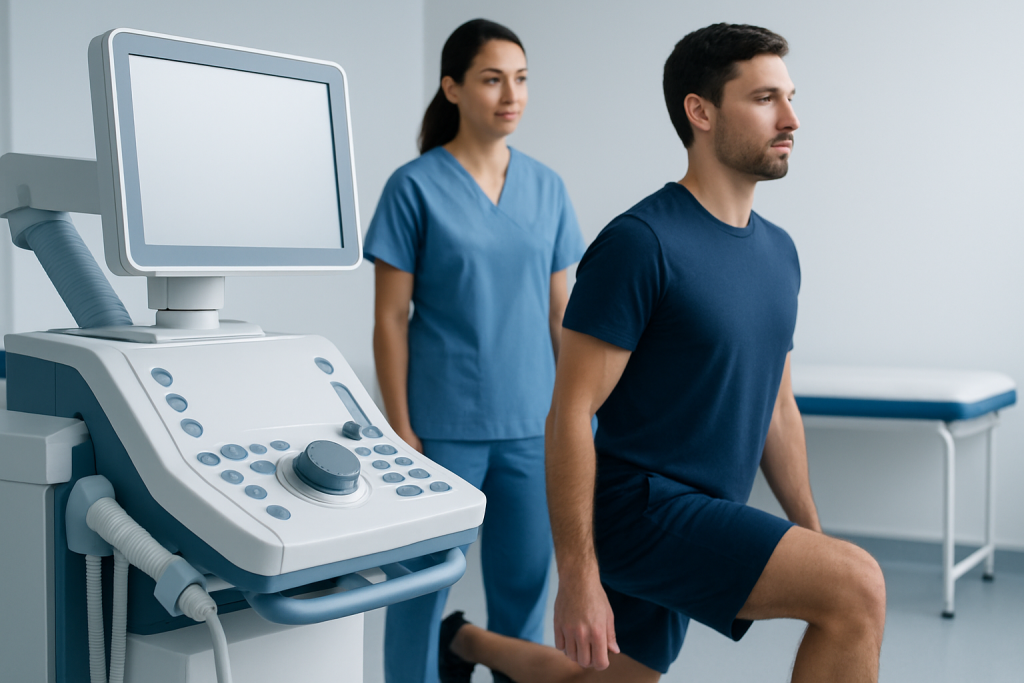
Although it appears simple, the split squat asks several systems to work together. The front thigh and glute muscles provide most of the force, while the calf and smaller stabilizing muscles help keep the foot steady. The trunk muscles also contribute by preventing the body from tipping forward or twisting excessively.
Compared with a standard squat, the split squat places more emphasis on one side at a time. That can help reveal strength differences between legs and give the weaker side a chance to catch up. For athletes, this may support better force production during running, cutting, kicking, or jumping. For non-athletes, it may improve confidence in day-to-day movements that demand balance.
Because the movement is versatile, it is often included in warm-ups, conditioning sessions, and rehab programs. It can be used as a primary strength exercise or as a controlled bridge between basic squatting patterns and more demanding unilateral work.
How to perform it with good form

A stable split squat begins with a comfortable stance. One foot is placed forward and the other back, like the start of a gentle lunge. The feet should be far enough apart that the body can descend vertically without the front heel lifting or the torso collapsing forward. A person can keep the hands on the hips, hold light weights later, or use a wall or rail for balance if needed.
As the body lowers, the front knee should track in line with the front foot rather than cave inward. The weight stays mostly over the middle of the front foot and heel, and the back knee moves toward the floor in a controlled way. The person then presses through the front leg to return to standing, avoiding a sudden push or bounce at the bottom.
A few practical cues often help: keep the chest tall, maintain a steady gaze, and move slowly enough to notice alignment. If the movement feels unstable, the stance can be widened slightly or the range reduced. Good form is usually more important than depth, speed, or load.
- Start with bodyweight and a short range if balance is limited.
- Keep the front knee roughly over the second or third toe.
- Let the back heel rise naturally; it does not need to stay flat.
- Stop the descent if pain, pinching, or loss of control appears.
Common mistakes and why they matter
One frequent error is taking a stance that is too narrow or too short. When the feet are crowded, the knee may drift too far forward, the heel may lift, or the torso may lean excessively. This can make the movement feel awkward and may increase stress on the joints instead of distributing the work smoothly through the hips and legs.
Another common problem is allowing the front knee to collapse inward. This movement pattern can reduce control and place unnecessary strain on the knee and hip. Rushing through repetitions can create a similar issue, since the body has less time to stabilize and correct alignment.
Some people also arch the lower back or twist the torso to compensate for limited hip mobility or weak core control. Others try to force a very deep range before they are ready. A smaller, cleaner repetition is usually a better starting point than a larger movement that is difficult to manage.
Benefits and practical uses
When performed consistently and safely, split squats can support lower-body strength, balance, and movement confidence. The exercise is particularly useful because it trains one leg at a time while still allowing a person to feel grounded and in control. That combination can be helpful for people who find full squats, jumping, or unstable surfaces too demanding at first.
Clinicians and trainers may use split squats to address side-to-side differences, improve hip and knee mechanics, or reintroduce loaded leg work after a period of inactivity. In sports settings, they can also be paired with other movements that emphasize stepping, landing, and changing direction. In everyday fitness, they can make routine tasks feel easier and less tiring.
Some travelers and international patients ask about exercises they can continue safely while recovering away from home. In those situations, the split squat may be part of a simple home program because it does not require much equipment. Still, the right version depends on the person’s injury history, surgery status, and the advice of their treating clinician.
Causes & risk factors for pain during split squats
The split squat itself does not usually cause problems when technique and load are appropriate. Discomfort tends to appear when the exercise exceeds a person’s current mobility, strength, or tissue tolerance. Limited ankle movement, tight hip flexors, weak glutes, or poor trunk control can all make the position harder to manage.
People with existing knee pain, hip irritation, back pain, or a recent lower-limb injury may be more sensitive to the demands of the exercise. A history of ligament injury, meniscus problems, tendon irritation, or surgery can also affect how the movement should be modified. In these cases, the exercise may still be useful, but the setup and progression should be individualized.
Risk often rises when a person increases resistance too quickly, adds depth before building control, or trains through pain without understanding the source. A careful assessment can help determine whether the issue is mainly technique-related, flexibility-related, or a sign that another approach is needed.
Diagnosis and professional assessment
If split squats cause persistent pain or a sense of instability, a clinician may evaluate the hips, knees, ankles, and lower back to identify the source. The assessment often includes questions about when the pain started, what movements worsen it, and whether symptoms appear during exercise, after exercise, or during daily activities. A movement screen may also be used to observe posture, balance, range of motion, and joint alignment.
In some cases, imaging such as X-ray, ultrasound, or MRI may be considered, especially if there is a history of trauma, swelling, locking, catching, or failure to improve with conservative care. Not every painful exercise needs a scan, however. Many problems can be understood through a careful physical examination and a detailed history.
For patients traveling from another country, it can be helpful to bring prior records, surgery notes, or rehabilitation plans. That information helps a new clinician understand what has already been tried and how to adapt the exercise safely. Clear communication about symptoms, goals, and time limits can make follow-up planning more practical.
Treatment options, prevention, and self-care
If split squats are uncomfortable, treatment usually begins with modification rather than complete avoidance. A clinician may suggest a shorter stance, a smaller range of motion, slower tempo, support from a stable surface, or a temporary reduction in resistance. In rehabilitation, split squats may be paired with exercises for the glutes, quadriceps, calves, and core to improve overall control.
Prevention starts with a warm-up that prepares the hips, knees, and ankles for movement. Gradual progression is important: bodyweight practice first, then additional load only when form remains steady. Rest days, recovery, and attention to footwear and training surfaces can also matter, especially for people returning to exercise after illness, travel, or a long break.
Self-care includes noticing early warning signs. Mild muscle effort is expected, but sharp pain, swelling, clicking with pain, giving way, or lingering soreness after each session should not be ignored. A patient-friendly rule is to keep the exercise challenging but manageable, and to adjust it before symptoms become a setback.
At Acibadem Health Point, multidisciplinary specialists and JCI-accredited hospitals can help diagnose and treat musculoskeletal conditions for international patients, including movement-related knee or hip concerns that affect exercises like the split squat.
Frequently asked questions
Is the split squat better than a regular squat?
Neither exercise is automatically better; they train the body in different ways. The split squat places more emphasis on one leg at a time, which can be useful for balance and correcting side-to-side differences. A clinician or trainer may choose one based on a person’s goals, mobility, and comfort.
Should the front knee go past the toes?
A small amount of forward knee movement can be normal, depending on stance length and body structure. The more important point is that the knee tracks in line with the foot and the movement feels controlled. If there is pain or the heel lifts too early, the stance may need adjustment.
What if the split squat hurts my knee?
Pain is a signal to slow down and reassess the setup. The stance, depth, speed, or load may be too demanding, or there may be an underlying knee issue that needs evaluation. If pain persists, a healthcare professional should review the problem before training continues.
Can beginners do split squats safely?
Yes, many beginners can, especially when they start with bodyweight, a stable stance, and a smaller range of motion. Using a wall or chair for balance can help build confidence. Progress usually works best when the person can complete repetitions with steady alignment and no sharp pain.
Are split squats useful after injury or surgery?
They can be, but only when they fit the recovery stage and the surgeon or rehabilitation team agrees. Some people need a modified version first, while others should wait until strength and mobility have improved. The safest approach is to follow an individualized plan rather than copy a generic workout.
How often should someone do split squats?
That depends on the person’s training level, recovery, and overall program. Some people include them a few times per week, while others use them less often as part of rehabilitation or maintenance. Frequency and volume should be adjusted so the exercise supports progress rather than causing lingering irritation.
References
- American Academy of Orthopaedic Surgeons
- Mayo Clinic
- National Institute of Arthritis and Musculoskeletal and Skin Diseases
- National Strength and Conditioning Association
This article is for general information only and is not a substitute for professional medical advice. Please consult a qualified doctor about your individual situation.
Joint and spine care in Turkey — expert assessment & treatment
JCI-accredited · board-certified surgeons · reply within 24h
Add us as a Preferred Source to see more of our trusted health content across Google Search, AI Overviews and Discover.
More from the Health Library



Related Specialists

Fzt. Elif Tokgöz Nizam
Physical Medicine & Rehabilitation
Fzt. Gizem Aydın
Physical Medicine & Rehabilitation
Dr. Safiye Sayilir
Physical Medicine & Rehabilitation
Dr. Özgün Barış Çolak
Physical Medicine & Rehabilitation