Patent Foramen Ovale

Key Takeaways
- Patent foramen ovale is a common heart finding that often causes no symptoms.
- A PFO is usually discovered during testing for another reason, such as a stroke evaluation.
- Diagnosis may involve echocardiography, sometimes with a bubble study.
- Treatment depends on symptoms, clot risk, and whether the PFO may be contributing to a medical event.
- Many people with PFO do not need closure and do well with follow-up and general heart-healthy care.
Patent foramen ovale (PFO) is a small opening between the upper chambers of the heart that usually closes after birth, but in some people it remains open. Many people never know they have it, yet in certain situations it can be linked with stroke or other concerns that deserve careful evaluation.
Overview
Patent foramen ovale, often shortened to PFO, is a small flap-like opening between the right and left upper chambers of the heart. Before birth, this opening is normal and helps blood bypass the lungs, which are not yet in use. After birth, it typically closes as the circulation changes, but in some adults the flap remains open.
For many people, a PFO is simply an incidental finding and never causes trouble. It becomes clinically important when doctors are trying to understand a stroke, a transient ischemic attack, unexplained low oxygen levels, or other situations where blood may cross from one side of the heart to the other.
For international patients, the practical question is often not just “Is there a PFO?” but “Does this opening explain the event, and what level of treatment makes sense?” That answer depends on age, symptoms, other medical conditions, and the results of targeted cardiac and neurological testing.
Symptoms
A PFO itself usually does not produce obvious symptoms. Many people live their entire lives without knowing it is present, and the finding may surface only during imaging done for another reason.
When symptoms do occur, they are often related to a complication rather than the opening itself. The most important concern is a stroke or a transient ischemic attack, which can cause sudden weakness, numbness, speech changes, vision loss, balance problems, or facial droop. Some people may also experience migraine-like headaches, though the relationship between PFO and migraine is not fully straightforward.
Less commonly, a PFO can contribute to oxygen levels dropping in certain positions or situations, especially if blood is passing from the right side of the heart to the left without going through the lungs. Because these symptoms can overlap with many other conditions, medical evaluation is essential rather than assuming the PFO is the cause.
Causes & Risk Factors

The cause of a PFO is developmental rather than lifestyle-related. In the fetus, the foramen ovale is a normal passageway that allows blood to move around the lungs. After birth, the flap usually seals, but in some people it remains partially or fully open.
Having a PFO does not automatically mean a person is at high risk for complications. Risk becomes more relevant when a blood clot from the veins could potentially travel through the opening and reach the brain or another organ. This mechanism, called paradoxical embolism, is one reason a PFO may be investigated after an otherwise unexplained stroke.
- Risk of concern is higher in selected patients with cryptogenic stroke, meaning a stroke without another clear cause.
- Situations that increase clot formation, such as prolonged immobility, recent surgery, or certain clotting disorders, may matter in context.
- Some people have an additional anatomical feature, such as an atrial septal aneurysm, which may influence decision-making.
- Age, blood pressure, diabetes, smoking, and other vascular risk factors also shape the overall picture.
Doctors consider the whole person, not just the PFO image. That broader approach is particularly important for patients traveling for care, because the best plan should account for past records, previous imaging, current medications, and the likelihood of follow-up after the trip home.
Diagnosis
Diagnosis usually begins with a medical history and an examination focused on whether a PFO could explain a prior event. If someone has had a stroke-like episode, the evaluation often also looks for other possible causes, such as rhythm problems, artery disease, or clotting disorders.
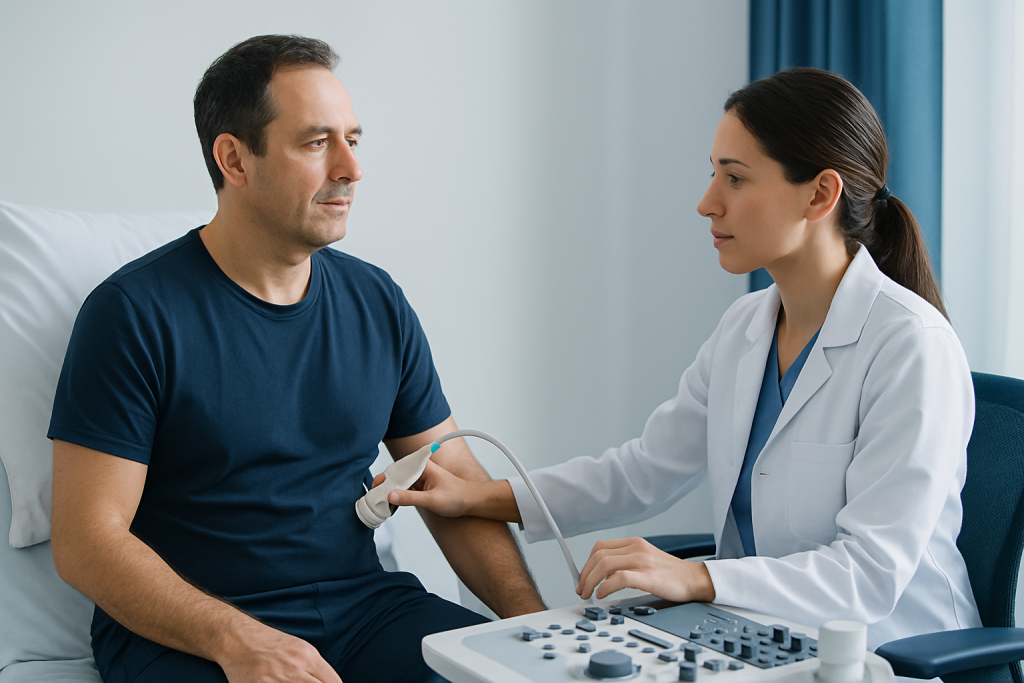
Transthoracic echocardiography, a heart ultrasound performed from the chest, is commonly used first. In some cases, a bubble study is added, where tiny saline bubbles are injected into a vein to see whether they cross from the right side of the heart to the left. Transesophageal echocardiography, which uses a probe in the esophagus, can offer a more detailed view when needed.
Additional tests may include an electrocardiogram, rhythm monitoring, brain imaging, or blood work. The goal is not only to identify a PFO, but to determine whether it is likely to be clinically meaningful.
Treatment Options
Treatment is individualized. If a PFO is found incidentally and there is no history suggesting a related complication, no procedure may be needed. In those cases, doctors may simply recommend routine follow-up and management of general cardiovascular risk factors.
When a PFO is suspected to have contributed to a stroke in a carefully selected patient, treatment may include antiplatelet therapy or, in some situations, anticoagulation if there is another reason to use it. For some adults, percutaneous PFO closure is considered. This is a minimally invasive catheter-based procedure in which a device is placed to close the opening from inside the heart.
Not every person with a PFO is a candidate for closure. Doctors weigh the likelihood that the PFO caused the event, the patient’s age, other causes of stroke, bleeding risk, and the practical ability to take medications and attend follow-up visits. For international patients, these considerations matter because closure is only one part of care; aftercare, travel timing, and communication with local doctors at home should be planned carefully.
Prevention & Self-care
There is no way to prevent a congenital PFO from existing, because it forms early in life. Still, people can reduce the chance of complications by addressing factors that raise clot or stroke risk.
General self-care focuses on cardiovascular health: staying active as advised, avoiding smoking, keeping blood pressure and cholesterol under control, managing diabetes if present, and taking prescribed medications consistently. People with a history of stroke or clotting should ask their doctor about travel precautions, hydration, movement during long journeys, and when to seek urgent care.
- Bring a complete list of medications and prior test results to appointments.
- Ask whether any blood thinners or antiplatelet medicines should be continued or adjusted before travel or procedures.
- After a closure procedure, follow the recommended activity limits and follow-up imaging schedule.
- Report new neurological symptoms immediately, even if they resolve quickly.
For patients who receive care abroad, a clear discharge plan is especially helpful. It should explain warning signs, medication instructions, and how local follow-up will be coordinated once the patient returns home.
When to See a Doctor
Medical assessment is important if there are sudden symptoms of stroke or TIA, such as one-sided weakness, speech difficulty, facial droop, sudden confusion, or vision changes. These symptoms require urgent emergency care, even if they improve within minutes.
It is also wise to discuss a possible PFO with a cardiologist or neurologist if it was found on imaging, especially after an unexplained stroke, recurrent migraine with unusual features, or a low-oxygen problem that has not been clarified. A specialist can help decide whether the finding is incidental or clinically significant.
People considering treatment outside their home country should choose a center that can review prior imaging, explain options in plain language, and arrange follow-up. At Acibadem Health Point, multidisciplinary specialists and JCI-accredited hospitals diagnose and treat patent foramen ovale for international patients as part of a coordinated care pathway.
Living With a PFO
Most people with a patent foramen ovale live normally and never require a procedure. The main task is to understand whether the opening is a quiet anatomical finding or a clue that helps explain another medical event.
That distinction can reduce anxiety. A PFO is not the same as heart failure or a major structural defect, and it does not automatically mean future problems will occur. With the right evaluation, many patients can move forward with confidence and a clear plan.
When care is coordinated across countries, the most helpful outcome is a simple one: a diagnosis that is explained clearly, treatment chosen for the right reasons, and follow-up that remains manageable after the journey home.
Frequently asked questions
What is patent foramen ovale in simple terms?
Patent foramen ovale is a small flap-like opening between the upper chambers of the heart that did not fully close after birth. Many people have no symptoms and never need treatment. It is often found only during tests done for another reason.
Can a PFO cause a stroke?
In some people, yes. A PFO can allow a blood clot to pass from the right side of the heart to the left and then travel to the brain, but this is not the cause of every stroke. Doctors look for other explanations before deciding whether the PFO is important.
How is a PFO diagnosed?
Doctors commonly use echocardiography, sometimes with a bubble study, to see whether blood crosses through the opening. More detailed imaging, rhythm tests, or brain studies may also be needed depending on the situation. The aim is to understand both the PFO and the bigger clinical picture.
Does every PFO need to be closed?
No. Many PFOs are harmless and do not require any procedure. Closure is usually considered only in selected patients, especially when the PFO may be linked to a cryptogenic stroke or another specific problem.
Is PFO closure a surgery?
PFO closure is usually done through a catheter placed in a vein, not through open-heart surgery. A device is guided to the heart to seal the opening from inside. Recovery is often shorter than with open surgery, but follow-up is still important.
Can someone travel after a PFO diagnosis or treatment?
Often yes, but timing depends on the clinical situation and whether a procedure was performed. Patients should ask their doctor when it is safe to fly, what medications to continue, and how follow-up will be handled after returning home. A written plan is especially useful for international travelers.
References
- American Heart Association
- Mayo Clinic
- National Heart, Lung, and Blood Institute
- Society for Cardiovascular Angiography and Interventions
- European Society of Cardiology
This article is for general information only and is not a substitute for professional medical advice. Please consult a qualified doctor about your individual situation.