Kidney Stone Treatment Abroad: When You Can Wait, When You Cannot

Key Takeaways
- Some kidney stones pass on their own, especially when they are small and symptoms are controlled.
- Fever, infection, one kidney, pregnancy, persistent vomiting, or blocked urine flow are reasons to seek urgent care.
- Imaging and urine tests help doctors decide whether observation, medication, or a procedure is best.
- Treatment abroad can be practical when the diagnosis is clear and follow-up logistics are planned in advance.
- Recovery is usually smoother when patients know what symptoms are expected and when to contact a doctor.
Medically reviewed by the Acıbadem clinical team — June 13, 2026
Kidney stones can sometimes be managed with hydration, pain control, and close observation, but certain symptoms mean care should not wait. For patients considering treatment abroad, understanding urgency, travel safety, and follow-up planning helps make the experience safer and less stressful.
Overview
Kidney stones can turn an otherwise ordinary trip into a medical decision with real timing questions. Some stones are small enough to pass without a procedure, while others block urine flow, cause ongoing pain, or trigger infection and need prompt treatment. For people considering care abroad, the central issue is not just where the stone will be treated, but how urgently it needs attention and what level of monitoring is required.
Kidney stones are hard deposits that form in the kidneys and may move into the ureter, the tube that carries urine to the bladder. When a stone moves, it can cause sharp pain, nausea, blood in the urine, and a strong sense that something is wrong. Many patients want to know whether they can wait for a scheduled consultation after travel or should seek care immediately, and the answer depends on symptoms, stone size and location, and whether the kidneys are draining properly.
In international care settings, decisions are usually made in stages: confirm the diagnosis, look for signs of blockage or infection, estimate the chance of spontaneous passage, and choose the least invasive safe option. That approach helps avoid unnecessary procedures while also reducing the risk of delay when a stone is unlikely to pass on its own.
Symptoms

The pain of a kidney stone is often described as severe and wave-like. It commonly starts in the side or back and may move toward the lower abdomen or groin as the stone shifts. The pain can come and go rather than staying constant, which is one reason it can feel unpredictable and exhausting.
Other common symptoms include nausea, vomiting, frequent urination, burning during urination, and blood in the urine. Some people notice only mild discomfort if the stone is small or not causing much blockage, while others feel intense pain even with a relatively small stone if it is lodged in the wrong place.
Symptoms that point toward urgent evaluation include:
- Fever or chills
- Difficulty passing urine or very little urine
- Persistent vomiting or inability to keep fluids down
- Severe pain that does not improve with prescribed medication
- Symptoms in a person with one kidney, a transplanted kidney, or pregnancy
It is also possible to have a kidney stone with few warning signs, especially if it is still sitting in the kidney. That is why imaging matters: pain alone does not tell the full story, and a stone that seems manageable may still be causing silent obstruction.
Causes & Risk Factors
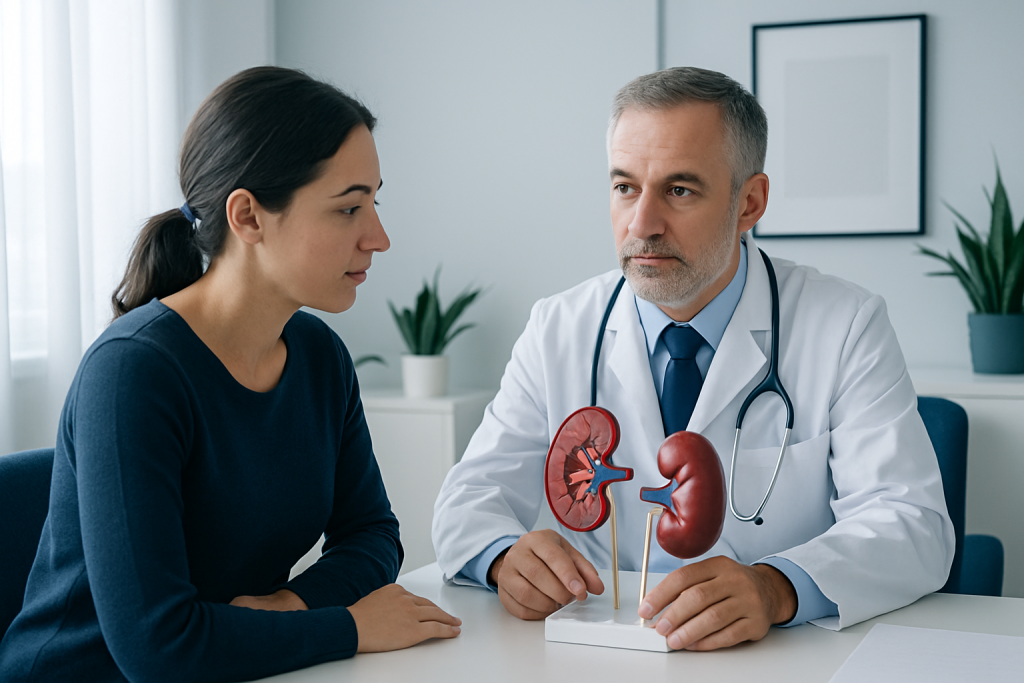
Kidney stones form when urine contains more crystal-forming substances than the fluid in the urine can dilute. Over time, those crystals can clump together and harden. The most common stone types involve calcium, but stones can also be made of uric acid, struvite, or cystine.
Several factors raise the chance of stone formation. Not drinking enough fluids is one of the most common contributors, especially in hot climates, during long flights, or when travel disrupts normal routines. A family history of stones, a personal history of prior stones, certain digestive conditions, and some medications can also increase risk.
Diet can play a role, though it is not usually the only factor. A high salt intake, frequent high-oxalate foods in some patients, and very high animal-protein intake may contribute in susceptible individuals. Recurrent urinary tract infections, urinary tract obstruction, and metabolic conditions can also affect risk and are part of the assessment before treatment decisions are made.
Diagnosis
Doctors usually begin by asking about the pain pattern, urine changes, fever, nausea, prior stone history, and any medications already taken. A physical examination helps identify whether the pain pattern fits a stone and whether there are signs of dehydration or infection. In a traveler, clinicians may also ask about the timing of the return flight, access to follow-up care, and whether symptoms began before or during the trip.
Testing commonly includes a urine test to look for blood, infection, or crystals, and blood tests to assess kidney function and signs of inflammation. Imaging is essential. Ultrasound may be used first in some settings, while a CT scan is often the clearest test for identifying the stone’s size and location, especially when treatment decisions are time-sensitive.
The most useful information is not just that a stone exists, but whether it is blocking urine flow and how likely it is to pass. A small stone in a favorable position may be watched closely, while a larger stone or one that is causing obstruction may be better treated without delay. In treatment abroad, this diagnostic step is especially important because it determines whether it is safe to wait for a planned visit or whether care should happen immediately.
Treatment Options
The right treatment depends on the stone’s size, location, symptoms, and whether infection or blockage is present. Some people can be managed conservatively with fluids, pain control, and close observation while the stone passes naturally. Others need a procedure to break up or remove the stone, or to relieve obstruction if the kidney is under pressure.
Conservative treatment is generally considered when the stone is small, the pain is manageable, the patient can drink fluids, there is no fever, and kidney function is stable. Doctors may also prescribe medication that helps the ureter relax so the stone can pass more easily. This approach requires clear instructions and a reliable plan for reevaluation if symptoms change.
Procedural options may include:
- Shock wave lithotripsy: uses focused energy to break the stone into smaller pieces that can pass more easily.
- Ureteroscopy: a thin scope is passed through the urinary tract to remove or fragment the stone.
- Stent placement: a small tube may be inserted to keep urine flowing if the ureter is blocked.
- Percutaneous procedures: used for larger or more complex stones in selected cases.
When infection is present with a blocked kidney, treatment becomes urgent rather than elective. In that situation, the first step is usually to drain the kidney and treat the infection, rather than to focus immediately on complete stone removal. For patients traveling for care, this is one of the main reasons not to delay assessment: an apparently ordinary stone can become unsafe if fever or sepsis develops.
Patients planning treatment abroad often benefit from a pre-arrival review of imaging, lab results, and symptom history. That helps the team decide whether the stone can wait for a scheduled procedure or whether the patient should be admitted promptly on arrival. Acibadem Health Point’s multidisciplinary specialists and JCI-accredited hospitals diagnose and treat kidney stones for international patients, which can simplify coordination across consultation, procedure, and follow-up.
When You Can Wait
Waiting is sometimes reasonable, but only when the situation is genuinely low risk. A small stone, controlled pain, no fever, normal kidney function, and the ability to drink fluids may allow a short period of observation. In many cases, doctors will recommend follow-up imaging or review within a defined time window rather than open-ended waiting.
Waiting is usually safer when the patient understands exactly what should trigger a change in plan. If pain suddenly becomes much worse, urine output drops, vomiting begins, or fever appears, the stone may no longer be suitable for observation. The same is true if the person has a history of repeated stone episodes but this one feels different from previous episodes.
For people considering treatment abroad, “wait” should never mean “hope for the best.” It should mean that a qualified clinician has already reviewed the case, confirmed that the stone is likely to pass or remain stable, and given a clear backup plan. That is especially important if travel is involved, because an untreated stone can become disruptive in transit or after arrival in another country.
When You Cannot Wait
Some kidney stone situations call for urgent medical attention because the risk is no longer just pain, but kidney damage or infection spreading through the body. Fever, chills, confusion, severe weakness, or a blocked kidney with worsening illness are red flags that should be assessed immediately. Persistent vomiting can also become urgent because it makes hydration and pain control much harder.
Do not wait for a planned flight or a routine appointment if the pain is severe and unrelenting, if urine output is very low, or if there is a known stone with infection. People with one kidney, a kidney transplant, pregnancy, or known kidney disease should be assessed quickly because the margin for delay is smaller. In these situations, international travel should generally pause until a clinician confirms that it is safe.
Urgent care is also warranted when the diagnosis is uncertain. Not every severe flank pain episode is a kidney stone, and conditions such as appendicitis, ovarian problems, gallbladder disease, or aortic emergencies can mimic stone pain. A careful medical evaluation protects patients from both under-treatment and misdiagnosis.
Prevention & Self-care
After the immediate episode is addressed, prevention becomes the longer-term goal. Drinking enough fluids throughout the day is one of the most practical ways to reduce stone risk, though individual fluid targets should be discussed with a doctor if the patient has heart, kidney, or liver disease. Travel days often require extra attention because flights, climate changes, and busy schedules can all reduce fluid intake.
Self-care during recovery usually focuses on pain control as directed, staying hydrated if allowed, and monitoring urine appearance and symptoms. A clinician may recommend dietary adjustments depending on the stone type, such as moderating salt or addressing high oxalate intake in selected patients. People with recurrent stones may also need a metabolic workup to look for treatable causes.
Helpful habits often include:
- Carrying a water bottle and drinking regularly rather than waiting for thirst
- Following any medication plan exactly as prescribed
- Keeping a record of stone episodes, imaging, and stone analysis results
- Arranging follow-up after travel, especially after a procedure or stent placement
Patients who receive treatment abroad should leave with clear instructions about warning signs, the expected recovery timeline, and how to contact the care team from home. That continuity matters as much as the procedure itself, because stones sometimes require later review, repeat imaging, or removal of a temporary stent.
When to See a Doctor
A doctor should be consulted promptly for any suspected kidney stone, especially if the patient has never had one before. Early evaluation helps confirm the diagnosis and rule out other causes of pain. It also allows the team to decide whether it is appropriate to watch the stone or whether intervention is safer.
Immediate medical attention is needed for fever, shaking chills, uncontrolled pain, dehydration, vomiting, inability to urinate, or a stone in someone with one kidney, pregnancy, or kidney transplant history. If the patient is abroad or preparing to travel, these signs should override travel plans and trigger urgent local assessment. The safest choice is usually the one that protects kidney function and prevents infection from worsening.
For non-urgent cases, patients can still benefit from specialist advice before travel so the next steps are clear. A well-planned consultation can determine whether waiting at home, scheduling treatment abroad, or arranging follow-up after a procedure makes the most sense. If symptoms are persistent or the stone has not passed as expected, the patient should return for reassessment rather than continuing to wait indefinitely.
Frequently asked questions
Can a kidney stone go away without surgery?
Yes, some kidney stones pass on their own, especially when they are small and not causing major blockage or infection. Doctors usually decide this based on symptoms, imaging, and kidney function rather than size alone.
How do doctors decide whether I can wait?
They look at the stone’s size and location, the severity of pain, whether urine is blocked, and whether there are signs of infection. If the situation is stable and the patient can drink fluids and keep follow-up, a short period of observation may be appropriate.
Is fever with a kidney stone an emergency?
Fever can be a warning sign of infection, and infection plus a blocked kidney is urgent. It should be assessed promptly rather than watched at home or delayed until after travel.
What treatment is most common abroad?
That depends on the stone. Some patients need shock wave lithotripsy, while others are better suited to ureteroscopy or temporary drainage with a stent before definitive treatment.
Can I travel if I still have a kidney stone?
Sometimes, but only if a doctor has confirmed that the stone is low risk and travel is safe. Travel should usually be postponed if there is fever, uncontrolled pain, vomiting, or reduced urine output.
Will I need follow-up after treatment?
Often, yes. Follow-up may include checking that the stone has cleared, confirming kidney drainage, reviewing stone analysis, and discussing prevention so future episodes are less likely.
References
- National Institute of Diabetes and Digestive and Kidney Diseases
- American Urological Association
- European Association of Urology
- NHS
- Mayo Clinic
This article is for general information only and is not a substitute for professional medical advice. Please consult a qualified doctor about your individual situation.
More from the Health Library

Vasectomy Reversal Abroad: When Timing, Prior Surgery, and Partner Factors Change the Odds

Vasectomy Reversal Abroad: When Timing, Prior Surgery, and Partner Factors Change the Odds