Astigmatism: Symptoms, Causes and Treatment

Key Takeaways
- Astigmatism is usually caused by an irregular cornea or lens shape.
- It may lead to blurred, stretched, or ghosted vision, plus eyestrain or headaches.
- An eye exam can measure astigmatism and check whether it is stable or changing.
- Glasses, contact lenses, and some procedures can improve vision depending on the individual case.
- Regular follow-up helps ensure the correction remains comfortable and effective.
Medically reviewed by the Acıbadem clinical team — August 19, 2026
Astigmatism is a common vision condition that happens when the eye’s shape prevents light from focusing evenly on the retina. It can blur or distort vision at any distance, but it is usually manageable with proper evaluation and the right correction.
Overview
Astigmatism is a refractive error, which means the eye does not bend light in a perfectly even way. Instead of focusing at one clear point on the retina, light is spread across more than one plane, so images may look blurred or slightly distorted. Many people have some degree of astigmatism, and it often appears together with nearsightedness or farsightedness.
The condition usually develops because the cornea—the clear front surface of the eye—is shaped more like a football than a smooth sphere. In some people, the lens inside the eye contributes as well. Astigmatism is not an illness in the usual sense, and it is not contagious; it is a shape-related optical issue that can often be corrected successfully.
For international patients thinking about eye care abroad, astigmatism is often straightforward to evaluate during a comprehensive consultation. A good assessment can clarify not only how much correction is needed, but also whether there are signs of another eye condition that deserves attention before travel or treatment planning.
Symptoms
Astigmatism can be subtle at first, especially when the degree is mild. Some people assume they simply need to “try harder” to focus, or they adapt by squinting without realizing it. Others notice that vision is never quite crisp, even with one eye closed or when looking at familiar objects.
Common symptoms include blurred or distorted vision, trouble seeing fine details, eyestrain, and headaches. Some people notice more difficulty at night, especially with glare around lights, or they may feel that words on a page seem to “shadow” or double slightly. Children may not always describe the problem clearly, but they might rub their eyes, avoid reading, or sit very close to screens.
Symptoms do not always match the degree of astigmatism exactly. A small amount can feel very bothersome in one person and barely noticeable in another, depending on visual demands, other eye conditions, and how long the eyes have been compensating.
Causes & Risk Factors

The most common cause of astigmatism is an irregularly curved cornea. A healthy cornea is evenly rounded, but in astigmatism the curve varies from one direction to another, so light is focused unevenly. Less commonly, the lens inside the eye has a similar uneven shape and adds to the blur.
Astigmatism can be present from childhood and may change gradually over time. It may also follow eye injury, certain eye surgeries, or conditions that affect the cornea’s structure. In a small number of cases, corneal diseases such as keratoconus can cause more complex or progressive astigmatism and need specialist evaluation.
Risk factors are not always avoidable, because many cases are inherited or develop naturally. A family history of astigmatism, a personal history of eye disease, or past trauma to the eye can increase the likelihood. Because of this, eye exams are important even when the symptoms seem mild or are easy to dismiss.
Diagnosis
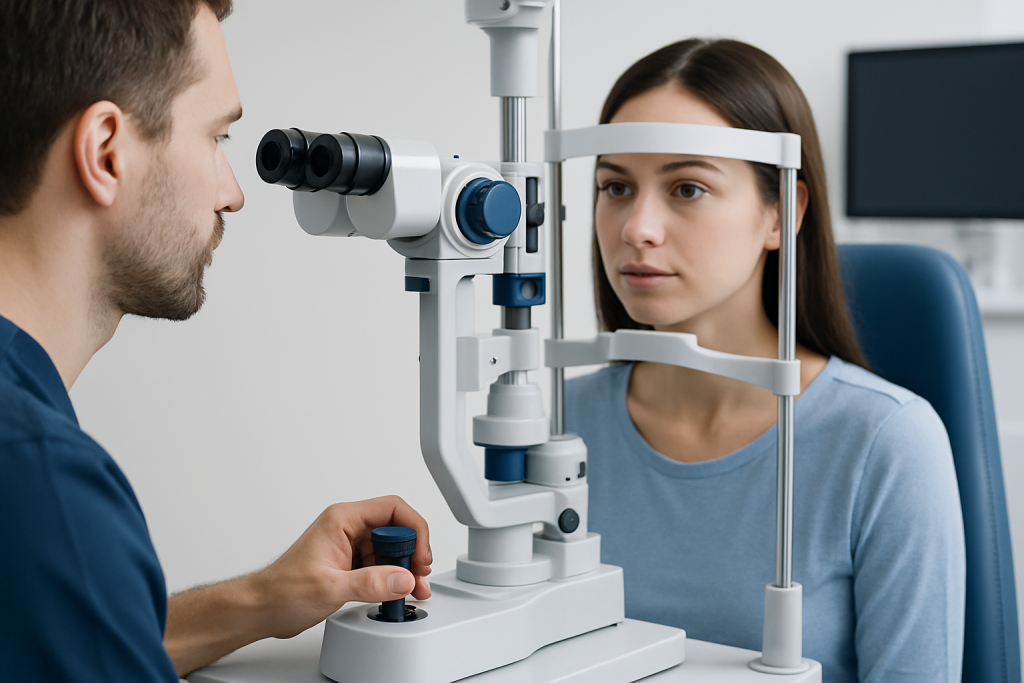
Astigmatism is diagnosed through a routine eye examination. The process usually includes checking visual acuity, measuring how light focuses in the eye, and testing how the cornea and lens bend light. These measurements help determine whether the blur comes from astigmatism alone or from a combination of refractive errors.
Depending on the findings, the eye specialist may use instruments that map the cornea’s surface or measure the eye’s optical system in more detail. This is especially helpful if symptoms are changing, if the person is considering contact lenses or a procedure, or if there is concern about a corneal condition that needs closer monitoring.
For patients traveling from another country, diagnosis often includes a practical conversation as well as a technical one: how much reading, screen time, night driving, or sports vision matters in daily life. That context helps the care team choose the most suitable correction and set expectations for follow-up after returning home.
Treatment Options
Astigmatism is commonly corrected with glasses or contact lenses. Glasses use lenses designed to compensate for the uneven focusing power of the eye, while contact lenses sit directly on the eye and can offer sharper vision for some people. The most suitable option depends on the level of astigmatism, comfort, eye health, and lifestyle needs.
Some people may be candidates for refractive procedures that reshape the cornea or reduce dependence on glasses or contacts. Whether a procedure is appropriate depends on several factors, including age, prescription stability, corneal thickness and shape, and overall eye health. A specialist evaluation is essential before considering any surgical or laser-based approach.
If astigmatism is linked to another eye condition, treatment focuses on both the vision correction and the underlying cause. In these situations, the goal is not only clearer sight but also protecting long-term eye health. Patients who are exploring care abroad often benefit from a coordinated plan that includes pre-procedure testing, a clear recovery schedule, and follow-up instructions that can be shared with their home eye doctor.
Prevention & Self-care
Astigmatism itself cannot usually be prevented, especially when it is inherited or part of natural eye development. Still, people can protect their eyes and make correction work better by keeping up with routine eye exams and using the prescribed glasses or contact lenses consistently.
Good visual habits can also reduce strain. Taking breaks from prolonged screen use, keeping reading material at a comfortable distance, and making sure lighting is adequate may help reduce fatigue. For contact lens wearers, careful hygiene matters, since healthy lens use helps prevent irritation and infection.
It is also sensible to seek prompt attention after an eye injury or if vision changes noticeably. Sudden blur, pain, light sensitivity, or a new distortion pattern should not be ignored, because these symptoms may point to something beyond ordinary astigmatism.
- Wear any prescribed correction as advised.
- Schedule regular eye checkups, especially if vision changes.
- Follow contact lens cleaning and replacement instructions carefully.
- Use protective eyewear for sports or work hazards.
When to See a Doctor
An eye examination is worthwhile whenever vision is no longer clear, comfortable, or predictable. People often seek help when they notice squinting, headaches with visual tasks, or difficulty seeing road signs, but it is just as important to check in if a child is struggling at school or avoiding close work.
Medical advice should be sought sooner if vision changes are sudden, if one eye seems different from the other, or if there is pain, redness, flashes of light, or a curtain-like shadow over vision. These signs may indicate a different eye problem that needs prompt attention.
For those considering treatment outside their home country, the most useful time to speak with a specialist is before travel, not after. That allows enough time for testing, discussing realistic outcomes, and planning whether glasses, contacts, or a procedure makes the most sense. Acibadem Health Point’s multidisciplinary specialists and JCI-accredited hospitals diagnose and treat astigmatism for international patients in a coordinated setting.
Frequently asked questions
What exactly is astigmatism?
Astigmatism is a vision condition caused by an uneven curvature of the cornea or lens. This uneven shape makes light focus in more than one direction, which can blur or distort vision.
Can astigmatism get worse over time?
It can change gradually in some people, though many cases stay fairly stable. Regular eye exams help track whether the prescription needs updating or whether another eye condition may be developing.
Do glasses always fix astigmatism?
Glasses often correct astigmatism very well, but the best choice depends on the individual prescription and eye health. Some people see better with contact lenses or, in selected cases, a procedure recommended by an eye specialist.
Is astigmatism the same as being nearsighted or farsighted?
No, but it can occur along with either of those conditions. Nearsightedness and farsightedness affect how clearly the eye sees at different distances, while astigmatism affects how evenly light is focused.
Can children have astigmatism?
Yes, children can have astigmatism from an early age. Because they may not explain blurry vision clearly, routine eye checks are important if they squint, rub their eyes, or have trouble reading.
When should someone be concerned that it is not just astigmatism?
If vision changes suddenly, or if there is pain, redness, flashes, floaters, or a shadow in vision, a doctor should evaluate the eye promptly. Those symptoms can suggest a different condition that needs attention.
References
- American Academy of Ophthalmology
- National Eye Institute
- Mayo Clinic
- World Health Organization
This article is for general information only and is not a substitute for professional medical advice. Please consult a qualified doctor about your individual situation.
Explore treatments in Turkey — costs, top hospitals & a free quote
JCI-accredited · board-certified surgeons · reply within 24h
Add us as a Preferred Source to see more of our trusted health content across Google Search, AI Overviews and Discover.