When Is an Exercise Stress Test Enough, and When Do You Need More?

Key Takeaways
- An exercise stress test shows how the heart performs during exertion, but it cannot detect every heart problem.
- A normal test may be reassuring, yet ongoing symptoms or higher risk can still call for more imaging or specialized tests.
- More testing is often considered when the exercise test is unclear, abnormal, or does not match the person’s symptoms.
- The best test depends on the clinical question, not only on the test itself.
- People with chest pain, shortness of breath, or fainting symptoms should discuss results promptly with a qualified doctor.
Medically reviewed by the Acıbadem clinical team — June 13, 2026
An exercise stress test can reveal how the heart responds to physical effort, but it does not answer every question. The right next step depends on symptoms, risk factors, and how clear the results are.
Overview
An exercise stress test is often the first tool used when a doctor wants to see how the heart behaves under physical demand. The person walks on a treadmill or pedals a stationary bike while the care team monitors the heartbeat, blood pressure, and symptoms. In many situations, that simple setup provides useful clues about blood flow to the heart, rhythm changes, exercise capacity, and how the body responds to strain.
But “useful” is not the same as “complete.” Some heart problems show up clearly during exercise, while others stay hidden unless imaging or more specialized testing is added. That is why the real question is rarely whether the test is good or bad; it is whether it is enough for the specific concern being investigated.
For someone traveling for cardiac evaluation, this distinction matters even more. A short, efficient test may be all that is needed in one case, while another patient may benefit from a same-day plan that includes stress imaging, CT scanning, or a longer diagnostic pathway before returning home.
What an exercise stress test can tell doctors
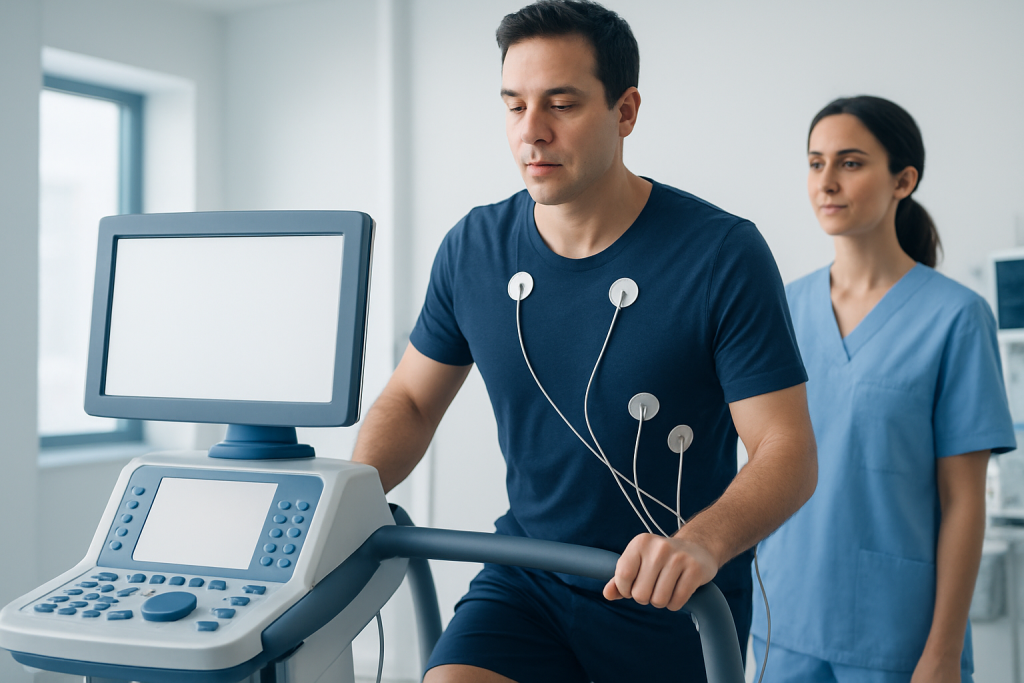
An exercise stress test helps assess how well the heart tolerates activity. During the test, doctors can look for symptoms such as chest discomfort, shortness of breath, dizziness, or unusual fatigue. They also observe whether the heart rhythm becomes irregular, whether the blood pressure rises appropriately, and whether the person can reach a safe and meaningful level of exertion.
This test is especially helpful when the goal is to understand function. For example, it can help estimate exercise tolerance, suggest whether symptoms may be related to reduced blood flow, and sometimes guide decisions about returning to activity after a cardiac concern. It can also provide reassurance when the result is normal and the symptoms are low risk.
A normal exercise stress test, however, does not automatically mean that every heart-related problem has been ruled out. Some conditions are intermittent, some are too subtle to appear without imaging, and some do not affect the test in a predictable way. That is why doctors interpret the result alongside age, medical history, medications, and the reason the test was ordered in the first place.
When the exercise test may be enough

In some situations, the exercise stress test gives a clear answer on its own. This is more likely when the person can exercise adequately, the ECG tracing is easy to interpret, and the symptoms are mild or have a low likelihood of being caused by serious heart disease. A straightforward test can also be enough when the purpose is to assess fitness, monitor recovery, or evaluate a known, stable condition.
It may also be sufficient when the result is clearly normal, the person reaches a good workload, and the symptoms do not appear during the test. In that setting, a doctor may decide that no additional cardiac testing is needed right away. Instead, the focus shifts to risk-factor management, lifestyle guidance, and observation over time.
In practical terms, doctors often consider the test “enough” when the answer will not change much with further testing. If the findings match the symptoms and the person’s overall risk profile, more scans may not add useful information. A careful conversation afterward is important, especially for international patients who need a clear plan before traveling back home.
Signs that more testing may be needed
Further evaluation is commonly recommended when the stress test is abnormal, borderline, or technically limited. If the person stops early because of fatigue, leg pain, breathing difficulty, or another non-cardiac reason, the test may not have pushed the heart enough to be truly informative. Likewise, if the ECG is hard to interpret at rest, the results may be less reliable.
More testing is also worth considering when symptoms continue despite a normal result. Chest pressure that occurs at rest, repeated exertional shortness of breath, fainting, palpitations, or new exercise intolerance may need a deeper look. A test can be normal and still miss coronary disease, valve disease, structural abnormalities, or rhythm problems that happen only at certain times.
Doctors may also look beyond the exercise test when the person has a higher baseline risk, such as diabetes, kidney disease, smoking history, strong family history, or prior heart disease. In these cases, the question is not simply “Is there a problem now?” but “Have we gathered enough detail to make a safe plan?”
Common next-step tests and why they are used
When an exercise stress test does not give a complete picture, doctors may add another test that answers a more specific question. Stress echocardiography uses ultrasound to watch how the heart muscle moves during stress. Nuclear perfusion imaging looks at blood flow patterns. Coronary CT angiography provides detailed pictures of the coronary arteries and can help identify plaque or narrowing.
Sometimes the next step is not another image but a different type of monitoring. Ambulatory ECG monitoring, such as a Holter or patch monitor, can capture intermittent rhythm changes that a short exercise test may miss. Blood tests, an echocardiogram at rest, or even cardiac MRI may be chosen when the concern is structural heart disease, inflammation, or scarring.
The choice depends on the clinical question. A doctor may want to know whether the problem is blocked arteries, an arrhythmia, a valve issue, or something else entirely. Each test has strengths and limitations, so the most helpful one is the test that answers the unanswered part of the story.
- Stress echocardiography: useful for wall-motion and valve assessment
- Nuclear perfusion imaging: helps evaluate blood flow under stress
- Coronary CT angiography: shows coronary anatomy and plaque
- Holter or patch monitoring: captures intermittent rhythm problems
- Resting echocardiogram or cardiac MRI: evaluates structure and function in more detail
How doctors decide between one test and several
There is no universal rule that says every person with chest symptoms needs the same pathway. Doctors weigh the quality of the exercise test, the nature of the symptoms, the person’s risk factors, and whether the result will change treatment. In some cases, the safest and simplest approach is to start with an exercise test and then decide. In others, a more detailed study is better from the beginning.
For example, a person who can exercise well and has a low-risk symptom pattern may need only the treadmill test and follow-up advice. Another person with diabetes, a strong family history, and persistent exertional chest discomfort may need stress imaging or coronary CT even if the treadmill result looks acceptable. A person with frequent palpitations may need rhythm monitoring rather than more ischemia testing.
This stepwise approach can be reassuring for patients. It avoids unnecessary procedures while still making room for deeper investigation when the first answer does not fully fit the clinical picture. For people seeking care from another country, a good cardiology team will often explain not only the result, but also why the next test is or is not worth doing before travel plans resume.
Preparing for results, recovery, and follow-up
After a stress test, the next step is usually a review of the findings and what they mean in everyday terms. A person may be told that the test was normal, inconclusive, mildly abnormal, or concerning enough to justify another study. The most important part is not the label itself, but how it fits with the person’s symptoms and risk profile.
Recovery after the test is usually simple, but the emotional side can be less straightforward. Some people feel relieved by a reassuring result; others feel frustrated if the answer is still incomplete. A clear follow-up plan helps reduce uncertainty. That plan may include medication review, exercise guidance, cholesterol and blood pressure control, or scheduling a second test before the person returns home.
For international patients, this is where coordinated care matters. If additional testing is likely, it is often helpful to have it planned promptly so that results are available within the same care episode. Acibadem Health Point’s multidisciplinary specialists and JCI-accredited hospitals diagnose and treat cardiac conditions for international patients in a coordinated setting, which can make follow-up easier to organize across borders.
When to seek medical advice
Chest pain, pressure, or tightness that happens with activity should always be discussed with a doctor, especially if it is new, worsening, or different from past symptoms. Shortness of breath that seems out of proportion to exertion, fainting, or palpitations that come with dizziness also deserves medical attention. Even if a stress test was normal, persistent symptoms may need another look.
Anyone who receives an abnormal or unclear stress test result should ask what it means, whether it changes risk, and whether another test is appropriate. A clear answer may come from the first study, but it should never be assumed. The most useful next step is the one that fits the whole picture, not just the treadmill tracing.
If symptoms are severe, sudden, or occurring at rest, urgent evaluation is important. For ongoing but stable concerns, a timely cardiology appointment can help determine whether the exercise stress test was enough or whether another test would provide better guidance.
A practical way to think about it
An exercise stress test is often a strong first step, but it is not the final word for every patient. It is enough when it answers the question being asked, matches the symptom pattern, and gives doctors enough confidence to move forward safely. It is not enough when the result is unclear, the symptoms continue, or a more detailed look is needed at blood flow, heart structure, or rhythm.
The goal is not to collect the most tests; it is to choose the right ones. A thoughtful cardiology team will use the exercise test as part of a broader assessment and decide whether imaging, monitoring, or another pathway makes better sense. That approach is usually the most efficient, the most reassuring, and the most medically sound.
Frequently asked questions
What does an exercise stress test actually measure?
It measures how the heart responds to physical effort by tracking the ECG, blood pressure, heart rate, and symptoms during exercise. Doctors use it to look for signs of reduced blood flow, rhythm changes, and exercise tolerance. It is a functional test, so it shows performance under stress rather than detailed pictures of the heart.
Can a normal stress test still miss heart disease?
Yes, it can. Some conditions do not show up clearly on a standard treadmill test, especially if the person could not exercise long enough or if symptoms happen only at certain times. That is why doctors sometimes add imaging or other tests when the story does not fully match the result.
Why would a doctor order a stress echo or nuclear test instead of another treadmill test?
These tests add images, which can show how the heart muscle moves or how blood flows during stress. They are often used when the plain exercise test is hard to interpret or when more detail is needed. The choice depends on what the doctor is trying to find out.
If my stress test is abnormal, does that mean I have blocked arteries?
Not necessarily. An abnormal result can be caused by several different problems, including reduced blood flow, rhythm issues, blood pressure responses, or sometimes technical factors. Your doctor will interpret the result together with your symptoms and may recommend another test to clarify it.
When should I ask for more testing after a stress test?
More testing is worth discussing if symptoms continue, the test was inconclusive, or the result does not fit your overall risk profile. It is also reasonable to ask if you have a history of heart disease or other risk factors that make a more detailed evaluation useful. A cardiologist can help decide whether another test would change management.
Do I need to stop exercising after a stress test?
Most people can return to normal activity shortly after the test unless their doctor gives different instructions. If the test brought on chest pain, dizziness, or other concerning symptoms, follow-up guidance matters more than the workout itself. Your care team should explain any limits based on the result.
References
- American Heart Association
- American College of Cardiology
- Mayo Clinic
- National Heart, Lung, and Blood Institute
- European Society of Cardiology
This article is for general information only and is not a substitute for professional medical advice. Please consult a qualified doctor about your individual situation.