Newborn Jaundice: Which Cases Need More Than Watchful Waiting

Key Takeaways
- Most newborn jaundice is related to a temporary rise in bilirubin and improves as the baby feeds and the liver matures.
- Jaundice that appears in the first 24 hours, worsens quickly, or lasts longer than expected deserves medical assessment.
- Poor feeding, sleepiness, high-pitched crying, dark urine, or pale stools can be warning signs.
- Treatment may include more frequent feeding, bilirubin testing, phototherapy, and, in selected cases, other hospital-based care.
- Parents traveling for care can ask for a clear follow-up plan, since bilirubin levels may need repeat checks after discharge.
Medically reviewed by the Acıbadem clinical team — June 13, 2026
Newborn jaundice is common, and in many babies it fades with feeding and time. The important question is not whether jaundice is present, but whether it is following a safe pattern or needs closer evaluation and treatment.
Overview
Newborn jaundice is the yellow tint that can appear in a baby’s skin and the whites of the eyes when bilirubin builds up in the blood. Bilirubin is a normal pigment made when red blood cells break down; newborns often produce it more quickly than their still-maturing liver can clear it.
For many babies, this is a brief and harmless phase. The challenge for families is deciding when a newborn is simply working through a common adjustment and when the yellowing is a clue that the baby needs more than watchful waiting.
That decision is especially important after going home from the hospital or after traveling for birth care. A baby may look well at first, then need a bilirubin check a day or two later, so a sensible follow-up plan matters just as much as the first exam.
Symptoms and what parents may notice
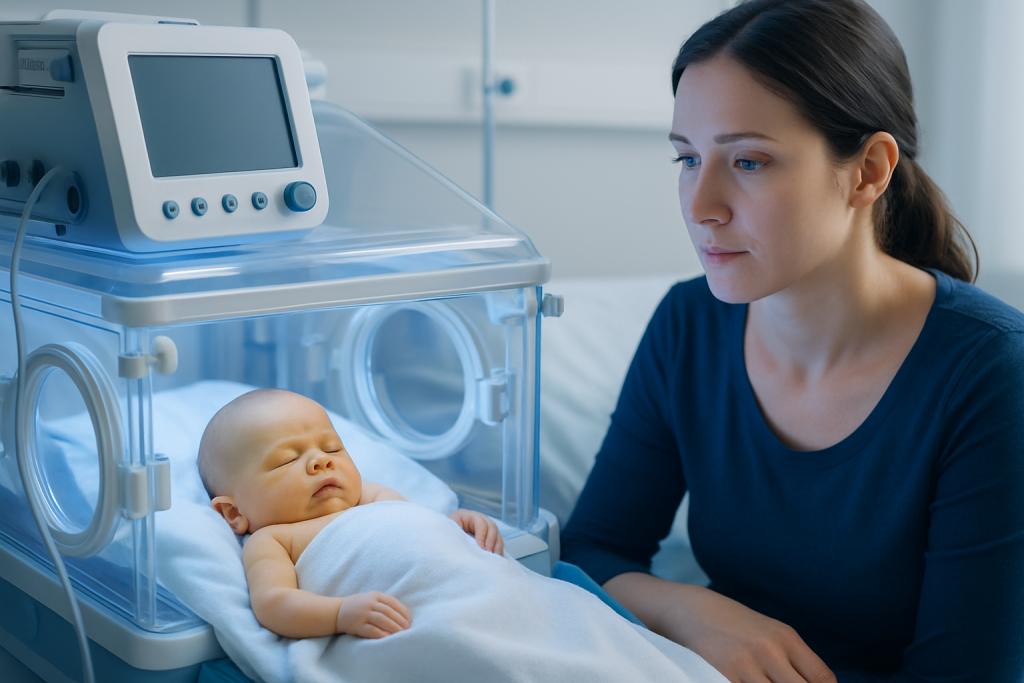
Jaundice usually starts on the face and can spread downward to the chest, abdomen, arms, and legs as bilirubin levels rise. In some babies, the yellow tone is easiest to see in natural light or by gently pressing a finger on the skin and looking for a yellow cast as the color returns.
Jaundice itself is a sign, not a disease. What makes it more concerning is the pattern around it: a baby who is difficult to wake, not feeding well, losing too much weight, or seeming weaker than expected should be assessed sooner rather than later.
- Yellowing that appears in the first 24 hours after birth
- Rapidly deepening yellow color
- Sleepiness that interferes with feeding
- Fewer wet diapers than expected
- Dark urine or very pale stools
- Arching, unusual crying, or limpness
Some babies also have jaundice that lingers. If yellowing is still present after the first two weeks in a term baby, or later than expected in a premature baby, a clinician may want to look beyond normal newborn jaundice and check for other causes.
Causes and risk factors

The most common reason for newborn jaundice is physiologic jaundice, a normal transition in which the baby’s body is still learning to process bilirubin efficiently. This form usually becomes noticeable after the first day or two and peaks around the time many families are settling back home.
Other babies develop jaundice because bilirubin is produced faster than usual or because the body is not moving it through the system effectively. Feeding problems, dehydration, bruising from birth, blood group incompatibility, prematurity, and certain inherited or liver-related conditions can all raise the chance that jaundice will need closer follow-up.
Risk can also be higher when a baby is born early, has a sibling who needed treatment for jaundice, or has ancestry linked with some inherited red blood cell conditions. These factors do not mean a problem is present, but they do help clinicians decide how carefully bilirubin should be monitored.
In the international-patient setting, history can be especially important. A family arriving from another country may not have complete birth records, so clinicians often rely on the baby’s appearance, feeding pattern, gestational age, and bilirubin measurements to decide the safest next step.
How doctors diagnose it
Diagnosis usually starts with a physical exam and questions about feeding, diaper output, birth history, and the timing of the yellowing. Because skin color alone cannot show how high bilirubin is, a clinician may use a quick skin device or a blood test to measure the level more accurately.
What matters most is not a single number in isolation, but how that number fits the baby’s age in hours, gestational age, and any other risk factors. A bilirubin level that is acceptable for one newborn may require treatment in another.
If jaundice appears early, rises quickly, or lasts longer than expected, additional testing may be ordered to look for blood type incompatibility, anemia, infection, liver problems, or other less common causes. This is one reason follow-up after discharge is so valuable: a baby can look stable at first and still need a repeat check.
For families traveling for treatment, it helps to ask for a written plan that includes when to return, what signs should prompt urgent review, and how bilirubin will be rechecked. That kind of clarity can reduce uncertainty once the family is back at the hotel, home, or a temporary stay nearby.
Treatment options
Not every jaundiced newborn needs active treatment. Many babies improve with more frequent feeding, which supports hydration and helps the body pass bilirubin through the stool. In these cases, clinicians may recommend close observation and a repeat bilirubin measurement instead of immediate therapy.
When treatment is needed, phototherapy is the most common approach. The baby is placed under a special light that helps change bilirubin into a form the body can eliminate more easily. It is a well-established treatment used in hospitals and, in some situations, at home with appropriate medical supervision.
In more unusual or serious cases, treatment may also address the cause of the bilirubin rise. That could include managing dehydration, treating an infection, or, when bilirubin is dangerously high, using more intensive hospital care such as an exchange transfusion.
Parents often want to know whether treatment is urgent. The practical answer is that urgency depends on the baby’s age, the bilirubin level, and how the baby is behaving. A newborn who is feeding poorly or becoming harder to wake needs prompt assessment even before the yellow color looks dramatic.
Prevention and self-care
Parents cannot prevent every case of newborn jaundice, but they can help reduce the chance that a mild case becomes a bigger one. Early and effective feeding is one of the most helpful steps, whether the baby is breastfed, formula-fed, or receiving both.
Watching diaper counts, keeping newborn follow-up appointments, and asking when bilirubin should be rechecked can make a real difference. Families should also avoid giving home remedies, herbal products, or sunlight exposure as a substitute for medical guidance, because those approaches are not reliable or safe enough to manage newborn jaundice.
- Feed as advised by the baby’s care team, especially in the first days after birth
- Track wet and dirty diapers
- Attend the recommended follow-up visit after discharge
- Seek help early if feeding is painful or difficult
- Ask for interpreter support if instructions are not fully clear
For families who have traveled for delivery or neonatal care, a practical self-care step is organizing discharge papers, bilirubin results, and contact numbers in one place. If treatment was started abroad, the home clinician will usually want to know exactly what was done and when the last bilirubin check was taken.
When to see a doctor
Parents should contact a doctor promptly if jaundice appears in the first day of life, spreads quickly, or is paired with poor feeding, marked sleepiness, or fewer wet diapers than expected. These are not signs to wait and see for several more days.
Medical review is also important if the baby has a fever, seems unusually floppy or difficult to wake, has dark urine, or passes pale stools. Those findings can point to a problem beyond routine newborn jaundice and deserve timely evaluation.
Even when the baby seems comfortable, persistent yellowing after the expected newborn period should be discussed with a clinician. A careful review can distinguish normal adjustment from conditions that benefit from testing and targeted care.
Acibadem Health Point’s multidisciplinary specialists and JCI-accredited hospitals diagnose and treat newborn jaundice for international patients, with attention to safe follow-up and continuity of care after discharge.
A practical note for families waiting for the color to fade
Watchful waiting is appropriate for many newborns, but it works best when it is structured rather than vague. That means knowing what the feeding plan is, when the next bilirubin check should happen, and which symptoms should trigger a phone call or visit.
Families do not need to guess whether they are “overreacting.” Newborn jaundice is common, but a timely assessment can quickly show whether the baby simply needs support with feeding or whether treatment should begin.
The safest path is usually the calmest one: observe the baby closely, keep the follow-up appointment, and ask questions until the plan is clear. For a newborn, clarity is care.
Frequently asked questions
Is jaundice always normal in a newborn?
No. Many newborns have a mild, temporary rise in bilirubin, but jaundice can also be a sign that the baby needs testing or treatment. Timing, feeding, and the baby’s overall behavior help determine whether it is routine or needs attention.
Can breastfeeding cause jaundice?
Breastfeeding itself is not the problem, but early Endoscopy May Be Needed" class="ahp-ilk">feeding difficulties can contribute to jaundice because bilirubin is cleared through stool. Support with latch, milk transfer, and feeding frequency often helps.
How is phototherapy given?
The baby lies under special blue light while the eyes are protected. The team monitors temperature, hydration, and bilirubin levels, and feeding usually continues during treatment.
Does jaundice mean my baby has liver disease?
Not usually. Most newborn jaundice is related to normal newborn adaptation, but prolonged jaundice or jaundice with pale stools or dark urine may lead doctors to look more closely at the liver and bile ducts.
Should I use sunlight at home to treat jaundice?
No, sunlight is not a safe or dependable treatment. If treatment is needed, a clinician can advise on phototherapy or other appropriate care.
What if we have already left the hospital?
Follow the discharge instructions and contact the baby’s clinician if jaundice is worsening or feeding is not going well. A repeat bilirubin check is often the safest next step when there is any uncertainty.
Frequently asked questions
Is newborn jaundice something parents should expect in every baby?
It is very common, but not every baby will have it, and not every case is harmless. The key is whether the jaundice follows the usual timing and improves as expected. A baby who looks increasingly yellow or is feeding poorly should be checked.
Why do doctors care so much about the first 24 hours?
Jaundice that starts in the first day of life is more likely to have an underlying cause than the usual newborn transition. That is why early yellowing is treated as a prompt to assess rather than to simply observe. A bilirubin test can help guide the next step.
How do parents know if feeding is good enough?
A practical sign is whether the baby is feeding regularly and producing an increasing number of wet and dirty diapers. If feeding is very sleepy, painful, or ineffective, jaundice can worsen because bilirubin is not being cleared well. The care team can help adjust the feeding plan.
Can a baby with jaundice go home from the hospital?
Yes, many babies go home safely if the bilirubin level is below the treatment threshold and follow-up is arranged. The important part is knowing when to return for another check. Families should leave with clear instructions, not just reassurance.
When is jaundice no longer considered normal newborn jaundice?
If it is lasting longer than expected, appearing very early, or coming with pale stools, dark urine, or poor growth, doctors will look for other causes. Prolonged jaundice deserves evaluation even when the baby otherwise seems well. A simple blood test can often clarify what is happening.
Is treatment always done in the hospital?
No. Mild cases may only need better feeding and observation, while phototherapy often requires a hospital or supervised home setup. The setting depends on the bilirubin level, the baby’s age, and whether there are other concerns.
References
- American Academy of Pediatrics
- World Health Organization
- NHS
- Mayo Clinic
- Centers for Disease Control and Prevention
This article is for general information only and is not a substitute for professional medical advice. Please consult a qualified doctor about your individual situation.