Medicine Ball

Key Takeaways
- Medicine balls are used for strength, rotation, balance, and coordination training.
- The right weight and exercise choice matter more than using a heavier ball.
- People with pain, dizziness, or recent injury should get guidance before starting.
- Medicine ball work can fit into rehabilitation when movements are controlled and supervised.
- Good technique and gradual progression reduce the risk of strain.
A medicine ball is a simple training tool used for strength, coordination, and controlled power work. When chosen and used well, it can support fitness goals, rehabilitation plans, and return-to-activity programs.
Overview
A medicine ball is a weighted ball used in exercise, rehabilitation, and sports conditioning. It may be soft or firm, light or moderately heavy, and is often chosen because it allows movement patterns that feel more natural than many machine-based exercises.
In rehabilitation settings, the medicine ball is valued for its versatility. It can be used for gentle core activation, upper-body strengthening, balance practice, and coordinated whole-body movements that help a person rebuild confidence in motion. For international patients who travel for care, it is also a practical tool because many exercises can later be repeated at home with minimal equipment.
Its name can sound old-fashioned, but the idea behind it is straightforward: controlled movement with resistance. That combination makes it useful for people returning to activity after injury, as well as for those looking to improve general fitness under professional guidance.
How a medicine ball is used
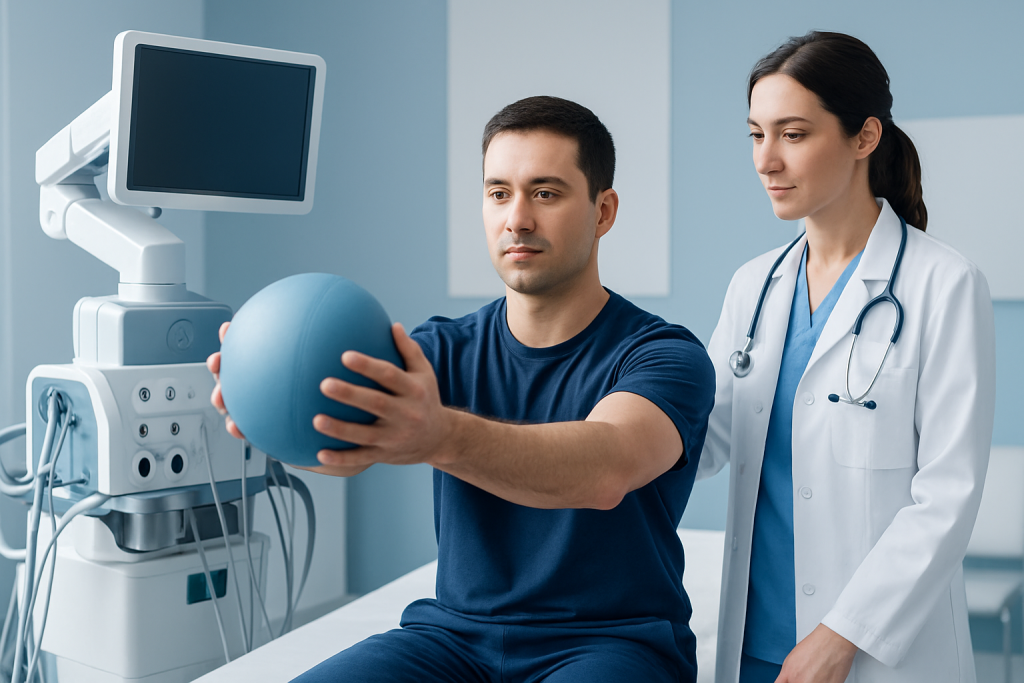
Medicine ball training is not one single exercise. It includes throws, catches, presses, lifts, twists, squats, carries, and partner drills. Some programs focus on slow, precise movements, while others use faster, more athletic patterns. The choice depends on the person’s goals, current condition, and safety needs.
In rehabilitation, the emphasis is usually on control rather than speed. A clinician may use a medicine ball to encourage trunk stability, shoulder mobility, or lower-limb coordination. Because the ball can be held close to the body or moved away from it, it changes the load on the muscles and joints in a very adjustable way.
Common uses include:
- core and trunk strengthening
- shoulder and arm conditioning
- balance and posture training
- rotation and coordination exercises
- graded return to sport or work tasks
Benefits and why people choose it

The medicine ball is popular because it trains more than one fitness quality at a time. A squat with a ball held at the chest challenges the legs and trunk together. A gentle rotational movement can ask the hips, torso, and shoulders to work in sequence. That whole-body style of training often feels functional, meaning it resembles everyday movements.
For rehabilitation, this matters. People recovering from injury rarely need isolated strength alone; they also need timing, balance, confidence, and the ability to move smoothly. Medicine ball exercises can help bridge that gap when introduced at the right stage of recovery.
Another advantage is adaptability. A program can start with a light ball, small range of motion, and a stable surface, then gradually progress to more dynamic drills. This makes the medicine ball useful for both beginners and more active patients, provided the plan is matched to the person’s condition.
Safety concerns and who should be cautious
Although medicine balls are simple, they still add load and movement demands. Using too much weight, moving too quickly, or working through pain can strain the back, shoulders, wrists, or knees. For that reason, correct technique is more important than intensity.
Extra caution is sensible for people with recent fractures, acute sprains, spinal pain, uncontrolled balance problems, recent surgery, or symptoms such as chest pain, fainting, or shortness of breath during exercise. People with neurological or joint conditions may also need a customized plan so that the exercises support, rather than irritate, the body.
If a person is traveling for treatment, it is helpful to ask the care team which exercises are appropriate before leaving the hospital or clinic. A written home plan can reduce confusion and make it easier to continue safely after returning home.
How clinicians decide whether it is appropriate
A clinician usually starts by looking at the person’s goals, symptoms, movement quality, and medical history. The question is not simply whether medicine ball training is “good” or “bad,” but whether it is suitable now, and if so, at what level.
In a rehabilitation assessment, the specialist may observe posture, joint range of motion, strength, coordination, and tolerance for weight-bearing. They may also ask about pain patterns, previous injuries, and activities the person needs to return to, such as lifting at work, overhead reaching, or sport-specific movements.
For some patients, the medicine ball is introduced early as a light control tool. For others, it comes later, after basic mobility and stability have improved. A staged approach is usually the safest way to get benefit without provoking setbacks.
Typical exercise options
Medicine ball exercises can be gentle or demanding. The same piece of equipment may be used for a seated press in one person and a dynamic throw in another. This flexibility is one reason it appears in both fitness and rehabilitation programs.
Examples of commonly used movements include:
- seated or standing chest press
- wall ball squat
- overhead reach with controlled return
- Russian twist or other rotational drill
- medicine ball carry for posture and trunk endurance
- gentle toss-and-catch work for coordination
Exercise choice should reflect the person’s posture, balance, and joint comfort. A movement that looks simple may be too advanced if it requires sudden rotation or a deep squat. In rehabilitation, small details such as stance width, ball size, and range of motion can make a major difference.
Prevention and self-care
Safe use begins with the right starting point. A lighter ball is usually better for learning technique, and a stable floor, clear space, and proper footwear can lower the chance of slips or compensations. If an exercise feels awkward, it is often wiser to reduce the range of motion or slow the pace rather than force the movement.
People often benefit from a few practical habits: warm up first, breathe steadily, keep the neck relaxed, and stop before form deteriorates. Mild muscle fatigue can be expected, but sharp pain, joint catching, dizziness, or numbness should be taken seriously and discussed with a professional.
For patients continuing care across borders, aftercare instructions matter. If the medicine ball is part of an at-home plan, it helps to know exactly how often to do it, which movements to avoid, and what symptoms would mean the program should be paused until reviewed by the doctor or therapist.
When to see a doctor
Medical advice is appropriate if a person has ongoing pain, swelling, weakness, instability, or recurring injury during exercise. It is also wise to seek assessment if a movement that used to feel easy suddenly becomes difficult, or if symptoms increase after starting a new training plan.
A doctor, physiotherapist, or rehabilitation specialist can determine whether the problem is simply a training issue or a sign of a condition that needs further evaluation. This is especially important after surgery, after a fall, or when symptoms involve the spine, shoulder, hip, or knee.
For international patients, an organized evaluation can be especially helpful because it allows diagnosis, treatment planning, and follow-up instructions to be aligned before travel ends. Acibadem Health Point’s multidisciplinary specialists and JCI-accredited hospitals can diagnose and treat this condition for international patients within a coordinated care pathway.
Frequently asked questions
What is a medicine ball used for?
A medicine ball is used for strength, coordination, balance, and functional movement training. It can also be part of rehabilitation when a clinician wants controlled resistance in a simple, adaptable form.
Is a medicine ball good for beginners?
Yes, if the exercise and ball weight are chosen carefully. Beginners usually do better with light resistance, slow pacing, and close attention to form.
Can medicine ball exercises help with rehab after injury?
They can, but only when they match the stage of recovery. In rehabilitation, the exercises should be selected to support healing and should not increase pain or instability.
What size medicine ball should someone choose?
The best choice depends on the exercise, strength level, and any joint or back concerns. In general, starting lighter is safer because technique is easier to control.
Should medicine ball training cause pain?
No, it should not cause sharp or worsening pain. Mild muscle effort is expected, but pain, dizziness, numbness, or joint swelling should prompt a pause and medical review.
Can a person use a medicine ball at home after hospital treatment?
Often yes, if the care team has approved the movements and provided clear instructions. A home plan works best when the person knows which exercises to do, how often, and what symptoms mean they should stop.
References
- World Health Organization
- American College of Sports Medicine
- National Institute of Arthritis and Musculoskeletal and Skin Diseases
- Mayo Clinic
- NHS
This article is for general information only and is not a substitute for professional medical advice. Please consult a qualified doctor about your individual situation.
More from the Health Library



Related Specialists

Prof. Dr. Tolga Tüzüner
Orthopedic Surgery & Traumatology
Dr. Alp Er Tunga Bölükbaşı
Orthopedic Surgery & Traumatology
Assoc. Prof. Dr. Bora Özveren
Urology
Prof. Dr. Gündüz Tezeren
Orthopedic Surgery & Traumatology