ICL vs. Laser Vision Correction: Which Option Fits Higher Prescriptions?

Key Takeaways
- ICL places a lens inside the eye and is often considered for stronger prescriptions or thinner corneas.
- Laser vision correction reshapes the cornea and may be best when the cornea is thick enough and the prescription falls within a safe range.
- A complete eye evaluation is needed because prescription strength is only one part of the decision.
- Recovery, follow-up, and lifestyle needs differ between the two procedures.
- A qualified ophthalmologist can explain which option better matches the patient’s anatomy and expectations.
Medically reviewed by the Acıbadem clinical team — June 13, 2026
For people with higher prescriptions, the choice between ICL and laser vision correction depends on corneal thickness, eye shape, and long-term visual goals. Both options can reduce dependence on glasses or contacts, but they suit different eyes and different correction ranges.
Overview
When a person has a higher prescription, the conversation about vision correction becomes more nuanced than simply asking whether LASIK is “better.” The real question is which procedure fits the eye safely and predictably. For some patients, corneal laser surgery is a strong option. For others, an implantable collamer lens, often called ICL, may offer a more suitable path.
ICL and laser vision correction can both reduce dependence on glasses or contact lenses, but they work in very different ways. Laser procedures change the shape of the cornea, while ICL adds a soft, removable lens inside the eye without removing corneal tissue. That difference matters more as prescriptions get stronger, because the cornea, lens, and overall eye structure all influence whether a treatment is a good match.
For international patients deciding whether to travel for treatment, the assessment is especially important. A careful preoperative exam may involve measurements that go beyond a standard vision test, including corneal thickness, pupil size, eye pressure, and the health of the retina. Those details help the surgeon choose the safest and most durable option.
In practical terms, high prescription patients are often choosing between preserving corneal tissue with a lens-based procedure or reshaping the cornea with laser surgery when anatomy allows it. Neither option is automatically right or wrong. The best choice usually comes from matching the technology to the eye rather than the number on the glasses prescription alone.
How ICL and laser vision correction differ
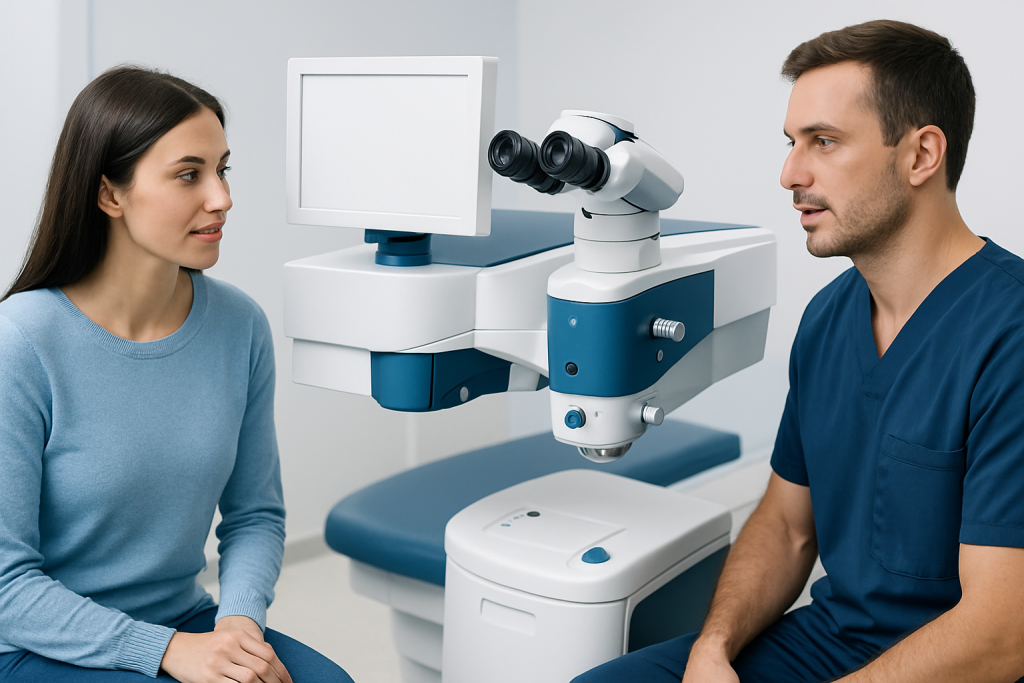
Laser vision correction includes procedures such as LASIK, PRK, and similar corneal-based techniques. These treatments use an excimer or similar laser to alter the cornea so light focuses more accurately on the retina. Because the cornea is being reshaped, the procedure depends on having enough healthy tissue and a corneal profile that can support the planned correction.
ICL takes a different approach. The surgeon places a biocompatible lens behind the iris and in front of the natural lens. This lens works with the eye’s existing structures to bend incoming light in a better way. Since the cornea is not permanently thinned or reshaped, ICL is often discussed for patients with stronger nearsightedness or corneas that are not ideal for laser surgery.
Patients sometimes think of ICL as a “backup” option, but that description can be misleading. In the right candidate, it is not second-best; it is simply the better anatomical fit. Likewise, laser correction can be an excellent solution for a person with a moderate or even higher prescription if the eye measurements are favorable and the surgeon expects a stable result.
A useful way to compare the two is to think about where the correction happens. Laser surgery changes the front surface of the eye. ICL adds optical power inside the eye. That single difference explains many of the trade-offs in suitability, recovery, and future flexibility.
Symptoms and signs that vision correction may be needed

People considering either procedure usually notice the everyday signs of refractive error: blurred distance vision, trouble reading road signs, squinting, headaches after visual tasks, or difficulty seeing clearly without glasses or contacts. High myopia may also cause a person to feel especially dependent on corrective lenses for driving, work, or sports.
Some people seek an alternative because contact lenses become uncomfortable or inconvenient. Others have had repeated changes in prescription and want a more stable visual solution. In international-patient settings, the decision is often influenced by travel, work demands, and the desire to reduce the long-term burden of carrying and replacing glasses or contact lenses across countries.
It is worth noting that the presence of a strong prescription alone does not determine candidacy. A patient may have excellent vision correction needs on paper yet still be unsuitable for a given procedure because of corneal shape, dry eye, eye pressure concerns, or other ocular findings. That is why symptoms start the conversation, but anatomy makes the final decision.
Causes and risk factors: what makes one option a better fit
Higher prescriptions often reflect the way an eye focuses light, not a disease in itself. Myopia, hyperopia, and astigmatism can all reach levels where standard laser correction becomes less predictable or less desirable. In those cases, the surgeon has to consider how much tissue would need to be removed and whether the cornea would remain strong and stable afterward.
Several factors may push the decision toward ICL rather than laser surgery. These include thinner corneas, high myopia, large correction needs, irregular corneal measurements, or a history that makes the eye less ideal for corneal reshaping. Some patients also have dry eye symptoms, and because laser surgery can temporarily worsen dryness, lens-based options may be discussed more seriously.
On the other hand, not everyone with a stronger prescription is an ICL candidate. The eye must have enough internal space, healthy anatomy, and no conditions that would make lens implantation unsafe. A patient’s age, cataract risk, and retinal health may also influence the conversation, especially in people with high myopia who should be monitored carefully over time.
Risk is not only about the prescription number. It is also about how the eye behaves as a system. A thorough evaluation helps the physician see whether the safest route is to remove less tissue, avoid corneal alteration altogether, or recommend another solution entirely.
Diagnosis and preoperative evaluation
The evaluation for ICL versus laser vision correction is more detailed than a typical glasses check. It usually begins with a full refraction and then moves into measurements of corneal thickness and curvature, pupil size, tear film quality, eye pressure, and the overall health of the front and back of the eye. For ICL, the surgeon also needs exact measurements of the space inside the eye and the relationship between the lens and nearby structures.
Topography or tomography of the cornea is often especially important. These tests help detect subtle irregularities that could make laser correction less suitable or less predictable. If the patient has had contact lens use, they may be advised to stop wearing lenses for a period before testing so the measurements are more accurate.
Patients traveling from abroad may need this workup organized efficiently, but it should never be rushed. A good preoperative visit answers a simple question: which procedure is safest and most likely to deliver the desired vision in this particular eye? If the answer is unclear, additional testing or a different treatment plan may be recommended.
Before surgery, the physician should also review medication use, prior eye injuries or surgeries, autoimmune conditions, pregnancy status when relevant, and any family history of retinal disease or glaucoma. Those details help reduce surprises and support a plan that is realistic for both recovery and follow-up after the patient returns home.
Treatment options: when each approach is usually favored
Laser vision correction is often considered when a patient has a prescription within an appropriate range, a cornea of sufficient thickness, and no major surface irregularities. It can be appealing because it treats the cornea directly and does not leave a permanent lens implant inside the eye. Recovery is often straightforward, though the exact experience depends on the specific technique used.
ICL is frequently discussed for higher myopia, for people who are not ideal laser candidates, or for those who want to preserve corneal tissue. Because the lens is removable, some patients value the flexibility this offers. In the right candidate, ICL can provide sharp distance vision and avoid some of the tissue-related limitations that come with laser correction.
The trade-offs are important. Laser surgery changes the eye’s surface architecture, which may affect dryness or night vision symptoms in some patients. ICL involves an implant inside the eye, so the surgeon and patient must think carefully about intraocular risks, long-term follow-up, and lens position. The best option is the one that balances vision goals with safety, not the one that sounds simpler at first glance.
Sometimes neither procedure is the best answer. A patient may need a different refractive plan, treatment of dry eye first, or cataract evaluation if age and lens changes are contributing to blurred vision. Good ophthalmic care includes knowing when to proceed and when to pause.
Recovery, follow-up, and prevention of complications
After laser vision correction, many people notice visual improvement quickly, although full stabilization can take longer. After ICL, vision may also improve rapidly, but the eye needs follow-up visits to confirm that the lens is positioned well and that pressure, clarity, and healing are progressing normally. In both cases, the early recovery period matters.
Patients are usually advised to avoid eye rubbing, follow the prescribed drop regimen, and attend all follow-up appointments. Temporary light sensitivity, mild discomfort, or fluctuating vision can happen and are not unusual, but persistent pain, marked redness, worsening vision, or significant pressure symptoms should be reported promptly.
For international patients, planning follow-up before travel is especially helpful. The surgeon should explain what can be monitored locally after the patient returns home and which signs should prompt an immediate eye review. Clear instructions reduce anxiety and make recovery feel manageable even across borders.
Long-term eye health also depends on routine care. People with high myopia may need periodic retinal exams even after successful vision correction, because the underlying eye structure still deserves monitoring. Vision correction does not remove the need for eye care later in life.
When to see a doctor
A person should seek an ophthalmology consultation if they are considering surgery for a strong prescription, if contact lenses are becoming harder to tolerate, or if they want to know whether their corneas and eye anatomy make them a candidate for laser correction or ICL. The best time to ask is before making travel plans or setting expectations around a particular procedure.
Medical review is also important if vision has changed recently, one eye sees differently from the other, dry eye symptoms are frequent, or there is a history of corneal disease, eye injury, glaucoma, retinal problems, or prior surgery. These details may alter the treatment plan.
Anyone experiencing sudden vision loss, flashes of light, a curtain-like shadow, significant eye pain, or major redness should seek urgent eye care rather than waiting for a routine refractive consultation. Those symptoms may point to a problem that needs prompt attention unrelated to elective vision correction.
Acibadem Health Point can help international patients navigate evaluation, treatment planning, and follow-up for refractive surgery with multidisciplinary specialists in JCI-accredited hospitals, when appropriate for the individual case. A qualified ophthalmologist can explain whether ICL, laser vision correction, or another approach is the safest choice.
Frequently asked questions
Is ICL better than LASIK for high prescriptions?
Not always. ICL is often considered when prescriptions are high or the cornea is not ideal for laser surgery, but LASIK or another laser procedure may still be appropriate for some people. The best choice depends on the eye’s measurements, not the prescription alone.
Can laser vision correction treat very strong myopia?
It may, but only if the cornea is thick and regular enough to allow a safe correction. When the prescription is very strong, surgeons may prefer ICL because it avoids removing corneal tissue. A full examination is needed before deciding.
Is ICL permanent?
ICL is designed to remain in place long term, but it can be removed or replaced if needed. That flexibility is one reason some patients like it. Even so, it still requires regular eye follow-up after surgery.
Which option has a faster recovery?
Many patients recover quickly after both procedures, but the pattern can differ. Laser correction may bring rapid surface healing, while ICL often involves fast visual improvement with follow-up to confirm lens position and eye pressure. The surgeon will explain what to expect for the chosen procedure.
Can dry eye affect the choice between ICL and laser surgery?
Yes. Dry eye can make laser surgery less comfortable or less predictable, so it is important to assess and treat it first. ICL may be discussed more often when dryness is a concern, though other eye factors still matter.
Do these procedures prevent future eye problems related to high myopia?
They correct vision, but they do not remove the underlying risks that can come with high myopia, such as retinal issues. Regular eye examinations remain important after either procedure. Vision correction and eye health monitoring are separate parts of care.
References
- American Academy of Ophthalmology
- National Eye Institute
- World Health Organization
- European Society of Cataract and Refractive Surgeons
- Mayo Clinic
This article is for general information only and is not a substitute for professional medical advice. Please consult a qualified doctor about your individual situation.