Beginning Skin Cancer on Nose: Signs, Diagnosis, and Care
Beginning skin cancer on the nose may appear as a persistent sore, a pearly or scaly bump, a changing dark spot, or an area that repeatedly bleeds or crusts. Early assessment by a dermatologist is important because prompt diagnosis usually allows effective treatment while preserving as much healthy skin and nasal function as possible.
Beginning Skin Cancer on the Nose: An Overview
Beginning skin cancer on the nose can be subtle. It may look like a small pimple that remains for weeks, a shiny bump, a dry patch, a scab that returns after healing, or a mole that is changing in color, size, or shape. Because the nose receives frequent sun exposure and has limited loose skin for reconstruction, a new or persistent lesion deserves timely professional assessment.
The most common skin cancers on the nose are basal cell carcinoma and squamous cell carcinoma. Both are usually related to cumulative ultraviolet (UV) exposure and are often highly treatable when recognized early. Melanoma can also develop on the nose or other facial skin; although less common, it may spread if untreated and should be evaluated promptly.
Not every rough, red, or raised spot is cancer. Acne, rosacea, eczema, harmless growths, infections, and actinic keratoses can resemble skin cancer. A dermatologist can examine the area closely and decide whether monitoring, treatment, or biopsy is appropriate.
What Does Early-Stage Skin Cancer Look Like on the Face?
Early-stage skin cancer on the face does not have one single appearance. Basal cell carcinoma often appears as a pearly, skin-colored, pink, or translucent bump. Fine blood vessels may be visible on its surface, and it may form a small sore or crust that bleeds easily and does not fully heal. Some basal cell carcinomas look like a flat, scar-like pale area rather than a bump.
Squamous cell carcinoma may appear as a persistent scaly, red, thickened, tender, or crusted patch. It can begin in a precancerous form called actinic keratosis, which commonly feels rough like sandpaper. Actinic keratoses do not always progress to cancer, but they should be assessed, especially when they are recurrent, thickening, painful, or bleeding.
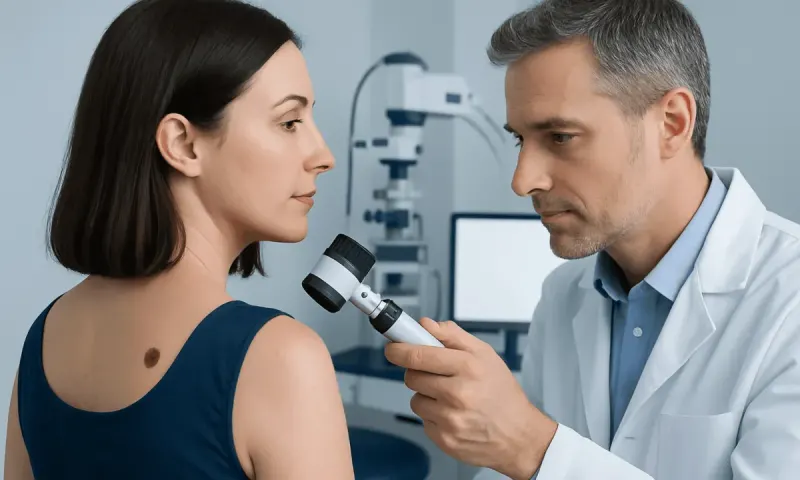
Melanoma may look like a new dark mark or a changing existing mole. The ABCDE approach can be helpful: Asymmetry, irregular Borders, uneven Color, increasing Diameter, and Evolving features such as growth, itching, bleeding, or a change in appearance. On the face, melanoma can also occur as a slowly enlarging brown, gray, or black patch with irregular coloring.
- A spot that persists beyond several weeks
- A lesion that repeatedly crusts, bleeds, or ulcerates
- A new bump that grows gradually
- A rough patch that remains despite moisturizers or usual skin care
- A mole or pigmented patch that is new, changing, or noticeably different from others
How Serious Is Skin Cancer on the Nose?
Skin cancer on the nose should be taken seriously, but its outlook depends on the type, size, depth, location, and whether it has spread. Basal cell carcinoma is the most common type and rarely spreads to distant parts of the body. However, if left untreated, it can grow locally into nearby skin, cartilage, and deeper tissues, potentially making treatment more complex.
Squamous cell carcinoma has a greater chance of spreading than basal cell carcinoma, particularly when it is large, recurrent, deeply invasive, or occurs in higher-risk locations. Melanoma is more likely to spread than other common skin cancers, and its depth is especially important in determining outlook and treatment planning.
The nose is often considered a high-priority facial site because even small cancers can involve cosmetically and functionally important structures. This does not mean a poor outcome is expected. Rather, it supports early diagnosis and careful treatment planning by clinicians experienced in skin cancer care. More general information about skin cancer may help patients understand the different types and approaches to management.
Diagnosis: How a Suspicious Nasal Spot Is Checked
A clinician will begin by asking when the lesion appeared and whether it has changed, bled, hurt, itched, or failed to heal. They may ask about past sunburns, outdoor work or hobbies, tanning bed use, immune-suppressing medicines, prior radiation, family history, and any personal history of skin cancer.
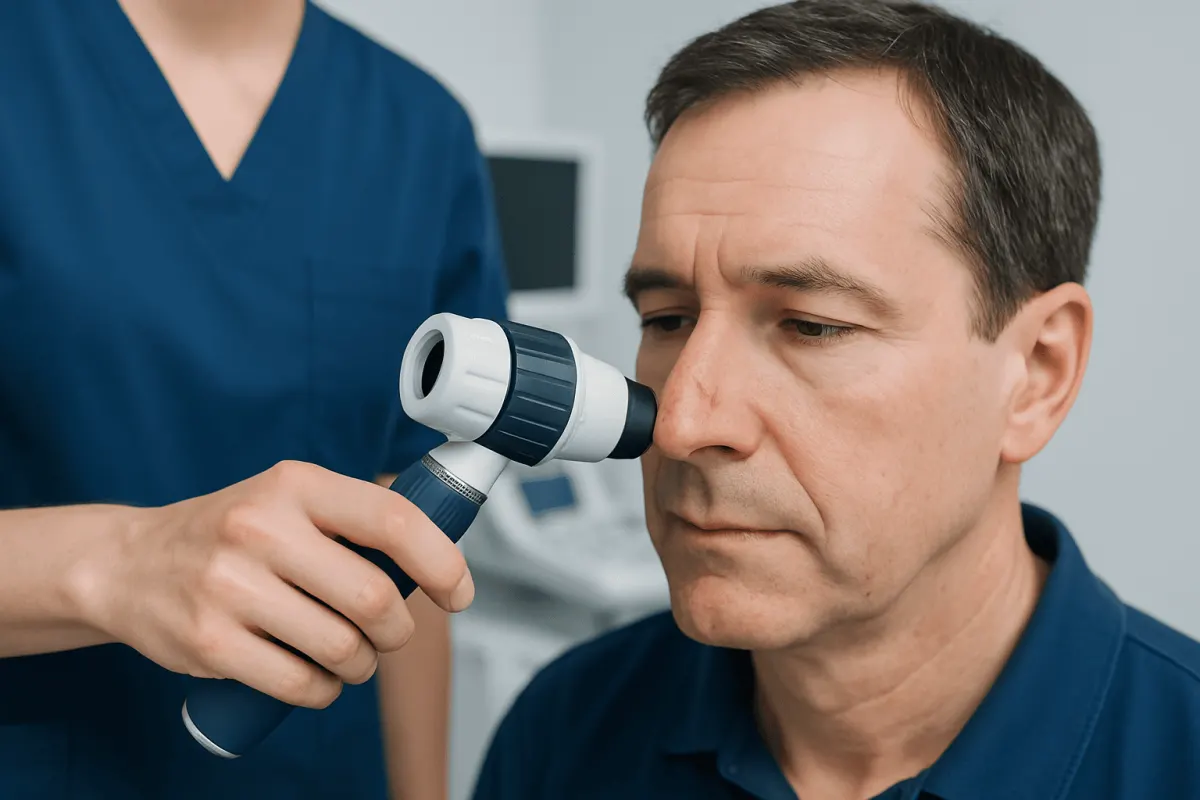
The skin examination usually includes the nose, face, scalp, ears, neck, and sometimes the rest of the body. A dermatologist may use a dermatoscope, a handheld magnifying device with light, to assess patterns in pigment and blood vessels that are not visible to the naked eye. This examination can guide decisions but cannot replace a biopsy when cancer is suspected.
A biopsy involves removing all or part of the abnormal skin under local anesthetic and sending it to a laboratory for microscopic examination. The pathology report identifies the cancer type and may describe features that influence treatment. If melanoma is diagnosed, further assessment may be recommended based on its thickness and other pathological findings.
Can Skin Cancer Be Cured If Caught Early?
Yes. Many skin cancers can be cured when caught early and treated completely. Basal cell carcinoma and squamous cell carcinoma that are diagnosed before extensive local growth are commonly managed successfully. Early melanoma also has a substantially better outlook than melanoma diagnosed after it has spread, which is why a changing pigmented lesion should not be watched indefinitely at home.
Treatment is individualized according to the diagnosis, size, location, borders, recurrence risk, overall health, and personal preferences. On the nose, doctors aim to remove the cancer fully while protecting normal skin and preserving nasal shape and breathing as much as possible.
Even after successful treatment, a person who has had skin cancer has an increased chance of developing another skin cancer in the future. Ongoing skin checks and sun protection remain important parts of long-term care.
Modern Treatment Approaches for Nasal Skin Cancer
Surgery is often the main treatment for skin cancers on the nose. Standard excision removes the visible lesion together with a margin of surrounding tissue. The removed tissue is examined to determine whether the cancer has been completely removed. Repair may be simple closure, a skin graft, or a local flap, depending on the size and location of the wound.
Mohs micrographic surgery is frequently considered for certain cancers on the nose. It removes tissue in thin layers, with each layer examined during the procedure until no cancer cells are seen at the edges. This technique can be useful when preserving healthy tissue is particularly important or when a tumor has poorly defined borders, has returned after treatment, or has higher-risk features. Appropriate Mohs micrographic surgery planning is usually coordinated by a dermatologist or surgical specialist.
Other treatments may be suitable for selected superficial or low-risk lesions. Depending on the diagnosis, these can include topical medicines, cryotherapy, curettage and electrodessication, photodynamic therapy, or radiation therapy when surgery is not suitable. Melanoma generally requires surgical removal; more advanced cases may need staging and care from a multidisciplinary oncology team, including immunotherapy or other systemic treatments when clinically indicated.
How Does Your Body Feel When You Have Melanoma?
Early melanoma often does not cause a person to feel unwell. Many people have no general symptoms at all, which is why visual changes in a mole or pigmented patch are so important. The lesion itself may occasionally itch, feel tender, become raised, bleed, or develop a crust, but these symptoms are not specific to melanoma.
Feeling tired, losing weight, having persistent pain, or noticing enlarged lymph nodes can have many possible causes and do not by themselves mean melanoma is present. These symptoms should nevertheless be discussed with a doctor, particularly when they occur alongside a changing skin lesion or after a melanoma diagnosis.
A person should not wait for physical symptoms before arranging an assessment. A new or evolving dark lesion, especially one that looks different from other spots on the skin, should be checked by a qualified clinician as soon as reasonably possible.
When to Seek Medical Care
Medical assessment is advisable for a spot on the nose that does not heal within several weeks, grows, changes color, develops an irregular border, becomes persistently scaly, or bleeds without a clear injury. It is also sensible to arrange a skin examination for a lesion that looks distinctly different from a person’s other moles or marks.
More urgent medical advice is appropriate for a rapidly changing dark lesion, an open sore that continues to bleed, a painful or enlarging growth, or a lesion associated with a new lump in the nearby neck or jaw area. These signs do not confirm cancer, but prompt evaluation helps avoid unnecessary delay.
Daily broad-spectrum sunscreen, protective hats, shade, and avoiding tanning beds can lower future UV damage. People with a previous skin cancer, significant sun exposure, a weakened immune system, or a strong family history may benefit from regular professional skin examinations. Acıbadem Health Point’s multidisciplinary specialists and JCI-accredited hospitals evaluate and treat skin cancers for international patients, with care plans based on the diagnosis and individual needs.
Frequently asked questions
01Can a pimple-like bump on the nose be skin cancer?
It can be, particularly if it persists, grows slowly, bleeds, crusts, or returns after seeming to heal. Basal cell carcinoma may resemble a pimple or small shiny bump. A dermatologist can determine the cause, sometimes with a biopsy.
02How quickly does skin cancer on the nose grow?
Growth rates vary greatly by cancer type. Basal cell carcinoma often grows slowly over months or years, while squamous cell carcinoma and melanoma can sometimes change more quickly. Any lesion that is enlarging or evolving should be assessed rather than monitored indefinitely.
03Is skin cancer on the nose always caused by sun exposure?
Sun exposure is a major risk factor because ultraviolet radiation damages skin cells over time. However, skin cancer can also be influenced by fair skin, repeated sunburns, immune suppression, age, family history, certain genetic conditions, and previous radiation exposure. It can occur in people of all skin tones.
04Will a dermatologist biopsy every suspicious spot on the nose?
Not always. Some lesions have a clearly benign appearance or may be treated and reviewed first. When the diagnosis is uncertain or cancer is suspected, a biopsy is usually the best way to confirm what the lesion is.
05Does removing skin cancer from the nose leave a scar?
Any procedure that removes skin tissue can leave some degree of scar. Surgeons choose techniques that aim to remove the cancer completely while achieving the best possible functional and cosmetic result. Healing and scar appearance vary with the lesion, treatment method, and individual skin characteristics.
06Can skin cancer return after treatment?
A treated cancer can occasionally recur, particularly if it had high-risk features or was difficult to define. People who have had one skin cancer are also more likely to develop a new, separate skin cancer. Follow-up visits, self-examination, and sun protection are therefore important.
This article is for general information only and is not a substitute for professional medical advice. Please consult a qualified doctor about your individual situation.
Oncology care in Turkey — second opinion and treatment plan
JCI-accredited · board-certified surgeons · reply within 24h
Add us as a Preferred Source to see more of our trusted health content across Google Search, AI Overviews and Discover.