When Can Infants Crawl

Key Takeaways
- Crawling often appears sometime in the second half of the first year, but the range is wide.
- Some babies use alternative movements such as belly crawling, scooting, or rolling.
- Muscle strength, tummy time, temperament, and opportunity to move all influence timing.
- A baby who is not meeting other motor milestones may need medical attention.
- Safe floor time and supervised play help support healthy motor development.
Crawling is one of several ways infants learn to move, explore, and build strength, but it does not happen at the same age for every baby. Some infants crawl on their hands and knees, while others use different movement styles or skip crawling altogether and move on to standing and walking.
Overview
Parents often ask a simple question with a less simple answer: when can infants crawl? In everyday life, crawling is one stage in a wider story of motor development. Babies first learn to lift their heads, roll, sit, reach, pivot, and bear weight on their arms and legs before they begin moving across the floor with purpose.
There is no single “correct” crawl age. Some infants begin crawling in the later months of the first year, while others move around in their own way for a while before taking their first steps. What matters most is steady progress across multiple skills, not whether a baby follows one exact pattern.
For families traveling or living abroad, these milestones can feel especially important because routine checkups may happen in different health systems and languages. A pediatrician can help place a baby’s movements in context and reassure parents when development is on track.
What crawling can look like
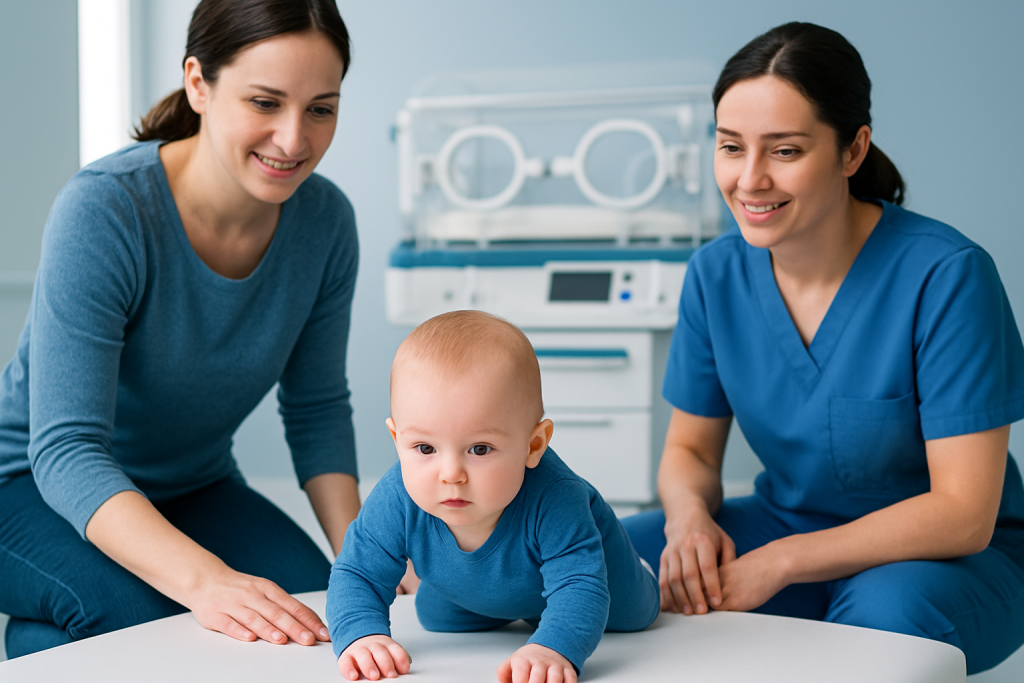
Crawling is often pictured as a baby moving on hands and knees, but infant mobility is much more varied. Some babies “army crawl” on their bellies, some scoot backward or sideways, and some roll to reach what they want. These are all forms of problem-solving movement and can be part of normal development.
Many infants also move through a short phase of rocking on hands and knees before they move forward. Others may prefer bottom-shuffling, especially if they are flexible, strong in the hips, or simply motivated by a different style of movement. The key is that the baby is making progress and using both sides of the body in active play.
- Hands-and-knees crawling
- Belly crawling or commando crawling
- Bottom shuffling or scooting
- Rolling to travel short distances
In some cases, a baby may skip crawling entirely and go on to pull up, cruise, and walk. That can still be within normal development if other milestones are being reached.
Why timing varies

Crawling depends on a blend of muscle strength, balance, coordination, curiosity, and opportunity. Babies who spend regular supervised time on the floor often have more chances to practice pushing up, pivoting, and reaching. Babies who spend most of their awake time in seats, swings, or carriers may have fewer chances to explore movement against gravity.
Temperament also plays a role. Some infants are highly motivated to move toward people or toys, while others are content to observe first and practice later. Birth history, overall tone, and individual body proportions can influence how a baby moves, too.
Prematurity may shift the timeline, so clinicians often consider corrected age rather than chronological age when evaluating developmental progress. This is one reason developmental discussions are best individualized rather than compared too rigidly between babies.
Signs a baby is preparing to crawl
Before crawling starts, many babies show a set of building blocks that suggest the body is getting ready. These early signs often appear gradually and in different combinations. Parents may notice stronger neck control, longer tummy-time tolerance, and better ability to push up on the forearms or palms.
Another common clue is movement in place before movement forward. A baby may rock back and forth, pivot in circles while on the tummy, or reach for a toy while keeping weight on one arm. These small actions are important practice for coordination and balance.
- Pushes up during tummy time
- Rolls in both directions
- Sits with growing stability
- Reaches and shifts weight while on the floor
- Shows interest in moving toward objects or people
Seen together, these signs usually mean the muscles and nervous system are learning to work as a team. A baby does not need to do everything “perfectly” before crawling begins.
How doctors assess development
Pediatricians look at the full developmental picture rather than one milestone alone. They ask how the baby moves, how the arms and legs are used, whether the baby can sit, roll, bear weight, and whether both sides of the body seem equally active. A brief examination may also assess muscle tone, reflexes, and head control.
If a family is seeking care internationally, a doctor may review growth records, birth history, and prior assessments from other countries to understand the baby’s baseline. This is especially helpful when parents have noticed a change in movement or feel unsure whether the baby is progressing normally.
Some babies simply need more time and more floor practice. Others may benefit from earlier evaluation if movement seems unusually stiff, floppy, one-sided, or consistently delayed across several milestones.
Ways to support healthy movement
The best support for crawling is often simple, consistent, and safe. Supervised tummy time gives infants a chance to strengthen the neck, shoulders, trunk, and arms. Short sessions throughout the day are usually easier for babies to tolerate than one long stretch.
Floor play with a caregiver nearby can also encourage reaching, pivoting, and crawling attempts. Toys placed just out of reach can motivate movement without forcing it. Bare feet or non-restrictive clothing may help babies feel more stable when they start pushing and sliding.
- Offer regular supervised tummy time when the baby is awake
- Place toys slightly out of reach to encourage movement
- Limit prolonged time in containers such as bouncers or car seats when not traveling
- Give the baby room to move on a safe, padded floor
These small choices matter because motor skills are learned through repetition. They also help the baby discover movement in a low-pressure way.
When a doctor should be contacted
Parents should seek medical advice if a baby seems to be missing several motor milestones, uses one side of the body much more than the other, or appears unusually stiff or floppy. It is also sensible to ask a doctor if the baby is not bearing weight on the legs, has poor head control after the expected early months, or seems to lose a skill that was previously present.
Concerns are not limited to crawling itself. A child who cannot sit, roll, or push up in age-appropriate ways may need a closer look. Developmental screening is most helpful when families bring up questions early rather than waiting for a later checkup.
For international families, accessing care while away from home can feel complicated, but a qualified pediatrician can still provide a structured evaluation and explain next steps clearly. Acibadem Health Point’s multidisciplinary specialists and JCI-accredited hospitals also diagnose and treat pediatric developmental concerns for international patients.
Frequently asked questions
When do most infants start crawling?
Many babies begin crawling during the second half of the first year, but there is a wide normal range. Some start earlier, some later, and some use another movement pattern before walking. Progress across several motor skills matters more than a specific crawl date.
Is it normal if my baby never crawls on hands and knees?
Yes, it can be normal. Some infants belly-crawl, scoot, roll, or skip crawling and move on to standing and walking. A doctor should check the baby if other motor milestones also seem delayed or asymmetric.
Does tummy time really help with crawling?
Yes, supervised tummy time helps build the neck, shoulder, and trunk strength needed for floor mobility. It also gives babies practice lifting the head, pushing up, and shifting weight. The goal is regular short sessions when the baby is awake and supervised.
Should I be worried if my baby crawls backward first?
Backward crawling is common and usually reflects a baby learning to control weight shifts and arm strength. It often happens before forward crawling. By itself, it is not usually a concern.
Can too much time in a car seat or swing affect crawling?
Long periods in containers can reduce the time a baby spends practicing on the floor. Short, necessary use is fine, but awake playtime on a safe floor gives more chances to move and explore. Balance is the main idea, not perfection.
When should developmental concerns be checked by a doctor?
A doctor should evaluate the baby if there is clear delay in multiple motor skills, one-sided movement, loss of a skill, or unusual stiffness or floppiness. Parents do not need to wait if something feels off. Early assessment can be reassuring and, when needed, guide support.
References
- American Academy of Pediatrics
- Centers for Disease Control and Prevention
- World Health Organization
- NHS
This article is for general information only and is not a substitute for professional medical advice. Please consult a qualified doctor about your individual situation.