Spectacles For Myopia

Key Takeaways
- Myopia makes distant objects look blurry, while close vision usually stays clearer.
- Spectacles for myopia use concave lenses to help light focus properly on the retina.
- An accurate eye examination is essential because prescriptions can change over time.
- Lens materials, coatings, and frame fit can affect comfort and daily use.
- Children, students, and adults may need different follow-up plans depending on visual demands.
Spectacles for myopia are the most common way to correct short-sightedness and improve clear distance vision. This article explains how they work, how prescriptions are assessed, and what patients can expect when choosing and using them.
Overview
Myopia, also called short-sightedness, is a common refractive error that makes distant objects appear blurred. Spectacles for myopia are designed to redirect incoming light so it focuses correctly on the retina, helping the person see more clearly at distance.
For many people, glasses are the simplest and most reliable first-line correction. They are non-invasive, easy to adjust, and can be replaced as vision changes. That makes them especially practical for children, students, drivers, and adults who want a straightforward way to improve everyday vision.
In international care settings, patients often arrive with questions that go beyond the prescription itself: which lens type is best, how soon they will adapt, and whether their vision needs should change after travel, work, or long screen hours. A good eye evaluation addresses all of these points, not just the number on the prescription chart.
Symptoms
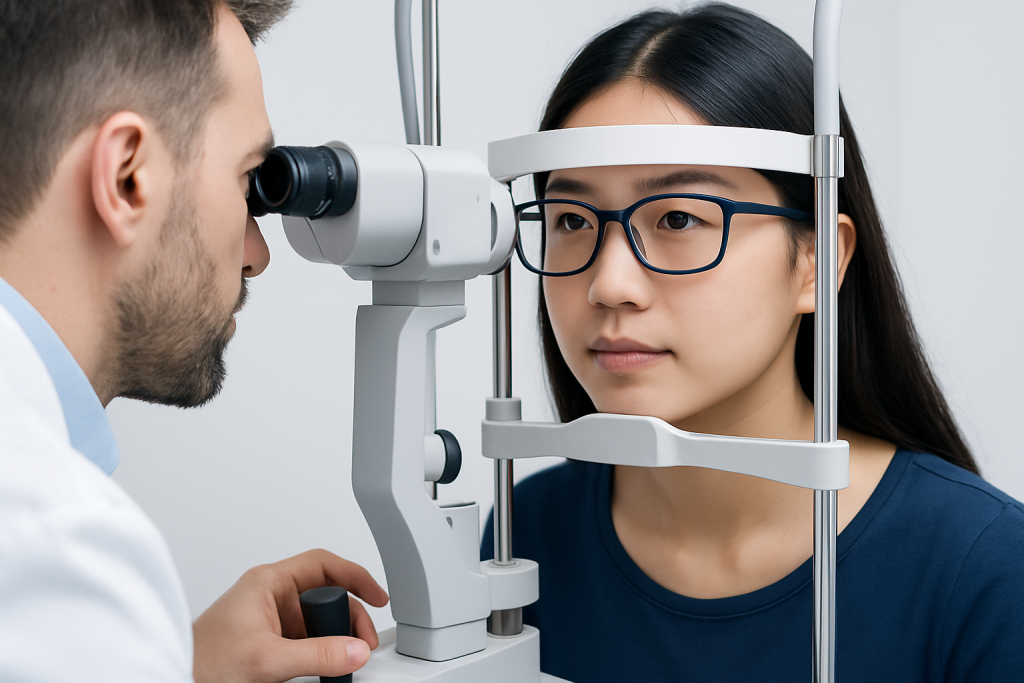
The most familiar sign of myopia is blurred distance vision. A person may notice that street signs, classroom boards, television screens, or faces across a room are not as sharp as expected.
Some people compensate by squinting, leaning forward, or sitting very close to screens. Others may experience headaches, eye strain, or tired eyes after reading, driving, or switching between near and far tasks. These symptoms do not confirm myopia on their own, but they often suggest that an eye examination is due.
- Difficulty seeing road signs or subtitles clearly
- Squinting to sharpen distant objects
- Eyestrain after prolonged visual tasks
- Headaches linked to visual effort
- Needing to hold books or devices very close
In children, symptoms can be easier to miss because they may not know that their vision is blurry. Teachers or parents may notice reduced attention, a tendency to move closer to the front of the class, or difficulty copying from a board.
Causes & Risk Factors
Myopia usually develops when the eye is slightly longer than average or when the cornea is too curved for incoming light to focus at the right point. Instead of meeting on the retina, light focuses in front of it, which makes distant images look out of focus.
Family history is a well-recognized risk factor. If one or both parents are myopic, the chance of a child developing myopia is higher. Environmental factors also matter, especially limited time outdoors during childhood and sustained close-up work such as reading or device use.
Myopia can begin in childhood and progress through the school years. In some people it remains mild and stable; in others it increases more quickly. Because prescriptions can change, regular eye checks are important even when someone already owns glasses that seem to work well.
Diagnosis
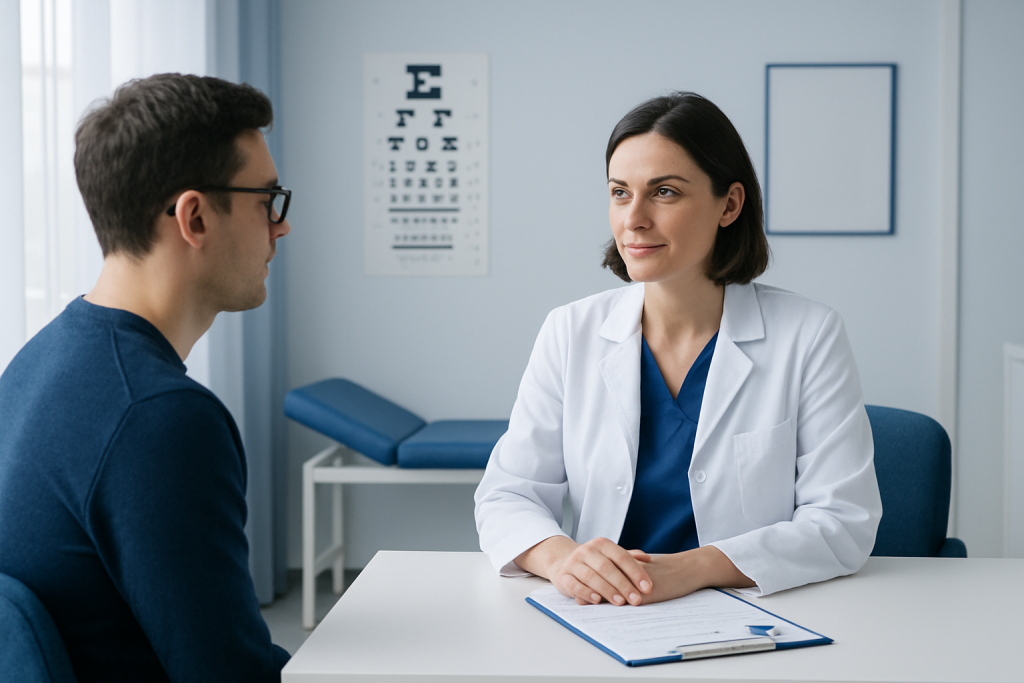
Diagnosing myopia starts with a comprehensive eye examination. An eye care professional checks how well the person sees at different distances and measures the refractive error that causes blur.
The process may include a visual acuity test, refraction testing, and examination of the front and back of the eye. In children, eye drops may sometimes be used to relax focusing muscles so the prescription can be measured more accurately. This is especially helpful when the goal is to understand whether the child truly has myopia or is temporarily over-focusing during the test.
For patients traveling internationally, it is useful to bring any previous prescriptions, old glasses, or records of past eye exams. These details help the clinician compare changes over time and choose a lens correction that fits current needs rather than relying on outdated information.
Treatment Options
Spectacles for myopia are commonly prescribed as single-vision lenses, which correct distance vision across the full lens surface. For many people, this is all that is needed. The exact lens power is individualized, because even small differences can affect comfort and clarity.
Lens material and design also matter. Some patients prefer thinner, lighter lenses, especially if their prescription is stronger. Anti-reflective coatings can reduce glare, while scratch-resistant coatings may help lenses last longer. For people who spend many hours on digital devices, the clinician may also discuss whether separate glasses for screen use or reading would be helpful.
Other treatment approaches may be considered in selected cases, depending on age, lifestyle, and the degree of myopia. These can include contact lenses or, for adults who are suitable candidates, refractive surgery. Still, glasses remain the most accessible option for many patients because they are simple to use and easy to update as vision changes.
When a prescription is fitted correctly, adaptation is usually straightforward. Some people notice a brief adjustment period, especially if the prescription is new or has changed significantly. If the glasses cause persistent blur, distortion, or discomfort, the frame fit or lens power may need review.
Prevention & Self-care
Glasses correct myopia, but they do not cure it. Self-care focuses on protecting vision, supporting comfort, and reducing strain during everyday activities. Good habits can be particularly important for children and people whose work involves frequent close-up tasks.
Time outdoors is often encouraged for children, as part of a broader eye-health routine. During long reading or computer sessions, regular visual breaks can help reduce eye fatigue. A balanced routine with adequate lighting, a sensible reading distance, and screen positioning that feels comfortable can make spectacles easier to use.
- Wear the prescribed glasses consistently if they are meant for full-time use
- Keep lenses clean with appropriate cloths and solution
- Store glasses in a protective case when not in use
- Schedule routine eye checks, especially for growing children
- Use good lighting for reading and detailed work
Patients who travel for eye care may find it helpful to obtain an extra copy of the prescription before leaving, along with guidance on follow-up timing. If glasses are broken or lost while abroad, having this information can make replacement easier and reduce disruption to daily life.
When to See a Doctor
An eye examination is appropriate whenever distance vision becomes blurred, headaches seem linked to visual effort, or a child appears to be struggling to see clearly. It is also sensible to seek review if existing glasses no longer feel effective, because myopia can progress over time.
Prompt assessment is especially useful if vision changes are sudden, if one eye sees differently from the other, or if blurred vision comes with pain, flashes, floaters, or other new symptoms. These features deserve medical attention, as they may point to conditions beyond routine myopia.
For international patients, coordinated care can simplify the process from diagnosis to lens selection and follow-up. Acibadem Health Point’s multidisciplinary specialists and JCI-accredited hospitals diagnose and treat myopia for international patients, while helping them plan the next steps with clarity and continuity.
Even when myopia is straightforward, regular follow-up matters. A well-timed review helps ensure that the prescription remains accurate and that the person is using the most comfortable and appropriate correction for daily life.
Frequently asked questions
How do spectacles for myopia work?
They use concave lenses to spread incoming light slightly before it enters the eye. This helps the light focus on the retina instead of in front of it, which improves distance vision.
Will my myopia prescription stay the same forever?
Not necessarily. Myopia can change over time, especially during childhood, adolescence, and early adulthood, so regular eye checks are important.
Are stronger lenses always better for myopia?
No. The best prescription is the one that matches the eye’s current refractive error and is comfortable to wear. An over-strong lens can cause strain or adaptation problems.
Can children wear glasses all day?
Yes, if the prescription is intended for full-time wear. Consistent use often helps children function better at school and during daily activities, but the eye doctor will advise based on the individual case.
Do glasses for myopia stop the condition from getting worse?
They correct vision, but they do not usually stop myopia from progressing. In some children, the doctor may discuss additional strategies to help monitor or manage progression.
What if the glasses feel strange at first?
A short adjustment period can happen, particularly with a new prescription or a significant change. If discomfort, dizziness, or blur continues, the glasses should be checked by the eye care team.
References
- American Academy of Ophthalmology
- National Eye Institute
- World Health Organization
- Mayo Clinic
- NHS
This article is for general information only and is not a substitute for professional medical advice. Please consult a qualified doctor about your individual situation.