

Cartilage Repair for Active Patients: When It Is Worth Pursuing

Key Takeaways
- Cartilage does not heal as quickly as muscle or skin, so treatment choices depend on the size, depth, and location of the injury.
- Repair or restoration may be more worthwhile for active patients when symptoms are persistent and the joint is mechanically unstable or repeatedly swollen.
- Diagnosis usually combines a physical examination, imaging, and a careful review of activity goals and previous treatments.
- Not every cartilage injury needs surgery; many people improve with rehabilitation, activity changes, and symptom control.
- Return to sport or higher-level activity often requires a gradual, structured rehabilitation plan rather than a fast restart.
- A qualified orthopedic specialist can help decide whether cartilage repair, cartilage restoration, or non-surgical care is the better fit.
Medically reviewed by the Acıbadem clinical team — June 13, 2026
Cartilage injuries can be frustrating for active people because pain, swelling, and catching often interfere with training, work, and daily movement. This article explains when cartilage repair may be worth considering, what treatment involves, and how recovery is planned with long-term joint health in mind.
Overview
Cartilage is the smooth, resilient tissue that helps joints glide without friction. In active patients, it is easy to think of cartilage only when something goes wrong: a knee that swells after a run, an ankle that aches after a pivot, or a shoulder that feels unpredictable during overhead motion. When cartilage is injured, the question is often not simply what is it? but is repair actually worth it?
The answer depends on how the injury behaves, how much it affects movement, and what kind of activity the person wants to return to. For some people, a carefully selected cartilage procedure can reduce pain and improve function. For others, rehabilitation, symptom management, and load modification are the smarter first steps. The goal is not to chase every surgical option, but to match treatment to the joint, the damage, and the patient’s real-life demands.
This is especially important for people traveling for care or planning treatment around work, family, or athletic seasons. Cartilage repair is rarely a one-visit fix; it is part of a longer recovery plan that may include imaging, consultation, surgery when appropriate, and structured follow-up after returning home.
Symptoms

Cartilage injuries do not always announce themselves with a dramatic event. Some begin after a twist or fall, while others develop gradually as a joint is overloaded over time. In active patients, the early clues may be subtle: a knee that feels sore after stairs, a hip that clicks with pain, or an ankle that no longer tolerates cutting and jumping the way it used to.
Common symptoms can include:
- Joint pain during activity or after exercise
- Swelling that comes and goes
- Stiffness, especially after rest
- Clicking, catching, or a feeling that the joint is “stuck”
- Reduced range of motion
- Difficulty trusting the joint during sport or daily movement
Some people can still walk, train lightly, or continue daily life, which is one reason cartilage problems may be underestimated. Yet ongoing swelling, pain with impact, or mechanical symptoms often signal that the joint deserves closer evaluation rather than repeated “pushing through.”
Causes & Risk Factors
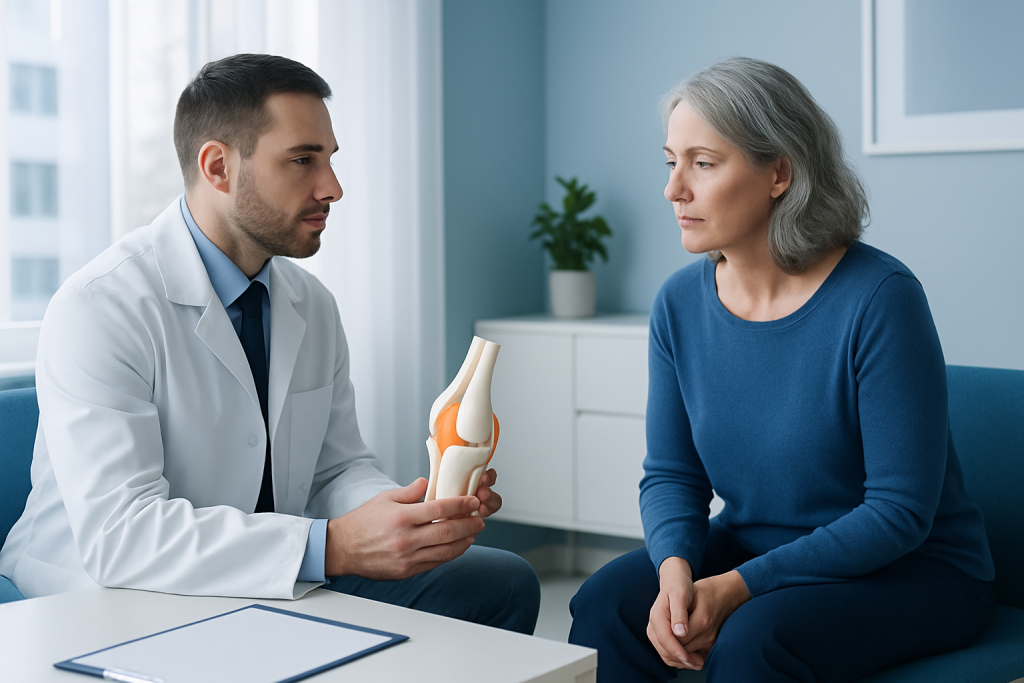
Cartilage can be injured by one clear event or by repeated stress over time. A single pivot, landing, or collision may damage the smooth surface inside a joint, while long-term overload can gradually wear it down. In active patients, both patterns are common, and they may overlap with ligament injuries, meniscus tears, or joint alignment issues.
Risk factors often include:
- Sports with jumping, cutting, twisting, or frequent impact
- Previous knee, ankle, or shoulder injuries
- Joint instability from ligament damage
- Abnormal alignment or uneven joint loading
- High training volume without adequate recovery
- Age-related wear, especially when activity continues at a high level
Body weight, muscle imbalance, and poor movement mechanics can also increase stress on a damaged joint. For international patients seeking care, a specialist may look not only at the cartilage lesion itself, but also at the full movement chain around it, because repair is less likely to succeed if the original load problem is left unaddressed.
Diagnosis
Diagnosis starts with a detailed history. A doctor will want to know when symptoms began, which movements provoke them, whether swelling appears after activity, and what has already been tried. This conversation matters because cartilage decisions are not based on imaging alone; they are based on symptoms, function, and future goals.
A physical examination helps assess tenderness, joint motion, swelling, stability, and alignment. Imaging is often used to clarify the extent of the problem. X-rays can show joint space and alignment, while MRI may reveal cartilage damage and related soft-tissue injuries. In some cases, arthroscopy may be considered when the diagnosis remains uncertain or treatment is already planned.
The practical question for the specialist is whether the lesion is likely to improve with non-surgical care, or whether the pattern of damage makes restoration more reasonable. Size, depth, location, age, activity level, and the condition of surrounding structures all influence this decision. A good evaluation should also account for travel timing and recovery logistics, especially when the patient will continue rehabilitation after leaving the treating center.
Treatment Options
Cartilage treatment exists on a spectrum. Not every patient needs surgery, and not every surgical case needs the same technique. For active patients, the main goal is to preserve joint health while restoring enough function to meet daily and sporting demands.
Non-surgical care may include activity modification, structured rehabilitation, anti-inflammatory measures when appropriate, bracing in selected cases, and treatment of contributing problems such as poor mechanics or muscle weakness. These approaches can be very effective for smaller, less disruptive injuries or for patients whose symptoms improve with unloading and conditioning.
When symptoms persist or the lesion is suitable for restoration, surgical options may be discussed. Depending on the joint and defect, this may include procedures that stimulate new tissue growth, transfer healthy cartilage or bone-cartilage tissue, or implant cells or grafts in selected cases. The most appropriate option depends on whether the injury is focal or more widespread, whether the joint is stable, and whether surrounding structures also need correction.
For active people, it is important to understand that “repair” does not always mean returning the original cartilage exactly as it was. Some procedures aim to replace or regenerate tissue in a way that improves pain and function, but the recovery can be long and the return to high-impact sport may be gradual. A realistic surgical plan should include post-procedure rehabilitation, activity milestones, and a clear discussion of what kinds of sport or work the joint can safely tolerate afterward.
When It Is Worth Pursuing
Cartilage repair becomes more compelling when the problem is no longer just uncomfortable, but limiting in a meaningful and repeated way. For active patients, that often means pain or swelling keeps returning despite reasonable rehabilitation, or the joint gives way, locks, or fails under the demands of sport and work.
It may be worth pursuing when:
- The lesion is focal and well-defined rather than diffuse joint wear
- Symptoms persist after a solid trial of non-surgical care
- There is recurrent swelling or mechanical catching
- The patient has clear goals for returning to higher-level activity
- Alignment or instability can also be addressed to support the repair
The decision is less favorable when arthritis is widespread, when the joint has multiple advanced problems, or when expectations are not aligned with the slow pace of recovery. In those situations, symptom control and rehabilitation may offer a better balance of benefit and burden. The best choice is usually the one that fits the anatomy, the timeline, and the patient’s definition of “worth it,” not just the existence of a surgical technique.
Prevention & Self-care
Even when cartilage injury has already occurred, everyday habits can reduce stress on the joint and support recovery. Rehabilitation is usually the backbone of self-care because stronger muscles help absorb load that would otherwise be transferred to cartilage. In practice, that means working on strength, balance, control, and gradual return to impact rather than relying on rest alone.
Helpful self-care strategies include:
- Following a structured rehabilitation program instead of increasing activity by feel alone
- Using cross-training to stay active while reducing joint impact
- Paying attention to swelling as a sign that load may need adjustment
- Maintaining healthy body weight when possible to reduce joint stress
- Warming up well and rebuilding sport-specific movement gradually
- Addressing footwear, technique, and training errors that overload the joint
For patients recovering away from the treating hospital, consistency matters more than intensity. A written home program, virtual follow-up when available, and coordination with a local physiotherapist can help keep recovery on track. The safest plan is usually the one that protects the joint on good days as well as on frustrating ones.
When to See a Doctor
Anyone with joint pain that keeps returning, swelling after activity, or a sensation of catching or locking should be evaluated by an orthopedic specialist or sports medicine doctor. Cartilage injuries are easier to manage when they are identified before the joint becomes more irritated or unstable. Early assessment also helps distinguish cartilage damage from meniscus, ligament, tendon, or bone-related problems.
Medical review is especially important if the joint cannot bear weight normally, motion is becoming limited, or symptoms are affecting sport, work, or sleep. If there has been a recent injury with a pop, rapid swelling, or a feeling that the joint shifted, prompt assessment is sensible even if the pain seems manageable at first.
For patients considering treatment abroad, it is helpful to ask how imaging, surgical planning, rehabilitation, and follow-up will be coordinated across countries. At Acibadem Health Point, multidisciplinary specialists and JCI-accredited hospitals support diagnosis and treatment planning for international patients, with recovery organized around the practical reality of returning home afterward.
Frequently asked questions
Does every cartilage injury need surgery?
No. Many cartilage injuries are managed without surgery, especially when symptoms are mild, the defect is small, or the joint improves with rehabilitation and activity modification. Surgery is usually considered when pain, swelling, or mechanical symptoms continue despite appropriate non-surgical care.
Why is cartilage harder to heal than other tissues?
Cartilage has a limited blood supply, so it does not repair itself as efficiently as muscle or skin. That is why treatment decisions often depend on the size, location, and depth of the injury, as well as the condition of the surrounding joint.
How long does recovery take after cartilage repair?
Recovery varies widely by procedure and joint, and it is often measured in months rather than weeks. A specialist will usually guide the patient through gradual milestones before higher-impact activity is resumed.
Can active patients return to sports after cartilage treatment?
Many can, but the timeline and the level of sport depend on the damage and the treatment chosen. Return to play is usually gradual and should be based on strength, movement control, symptoms, and the doctor’s clearance.
What if the joint feels better after rest but hurts again when training restarts?
That pattern can suggest the joint is not tolerating the current load, even if symptoms settle temporarily. It is a good reason to seek a medical assessment so the cause can be identified and the training plan adjusted.
Is cartilage repair always the best option for younger active patients?
Not automatically. Younger age can make restoration more appealing, but the final decision still depends on the joint, the lesion, alignment, stability, and the patient’s goals. A careful evaluation helps avoid procedures that are unlikely to match the problem.
References
- American Academy of Orthopaedic Surgeons
- Mayo Clinic
- National Institute of Arthritis and Musculoskeletal and Skin Diseases
- American Orthopaedic Society for Sports Medicine
- British Orthopaedic Association
This article is for general information only and is not a substitute for professional medical advice. Please consult a qualified doctor about your individual situation.
More from the Health Library



Related Specialists

Dr. Safiye Sayilir
Physical Medicine & Rehabilitation
Dr. Özgün Barış Çolak
Physical Medicine & Rehabilitation
Prof. Dr. Meltem Vural
Physical Medicine & Rehabilitation
Prof. Dr. Meral Bayramoğlu
Physical Medicine & Rehabilitation