Cable Dumbbell Curls

Key Takeaways
- Cable dumbbell curls train the biceps through a controlled range of motion and can support arm strength and function.
- Good posture, steady tempo, and wrist alignment matter more than lifting heavy weight.
- People recovering from arm, shoulder, or elbow problems should ask a clinician or physiotherapist before adding curls.
- Pain, sharp pulling, or increasing swelling during or after exercise are signs to stop and reassess.
- Progress should be gradual, with attention to symmetry, recovery time, and overall movement quality.
Cable dumbbell curls are a simple strength exercise that can help improve biceps conditioning, grip control, and arm function when done with proper technique. They may be useful in general fitness or rehabilitation plans, especially when progression and shoulder-elbow comfort matter.
Overview
Cable dumbbell curls are a resistance exercise used to strengthen the front of the upper arm, especially the biceps brachii. The movement is straightforward: the elbow bends against resistance, then returns under control. What makes the exercise useful is not only the curl itself, but the consistent tension and the ability to fine-tune resistance for different training or rehabilitation goals.
For many people, curls are part of a broader plan to restore upper-limb strength after a period of inactivity, an overuse injury, or a general deconditioning phase. They may also be included in gym programs to improve arm endurance and support everyday tasks such as lifting bags, carrying luggage, or reaching overhead. In an international care setting, this kind of exercise is often introduced alongside assessment, technique coaching, and follow-up planning so a patient can continue safely after returning home.
Despite its simplicity, the curl is most effective when the movement is deliberate. Fast swinging, excessive load, and poor shoulder positioning can reduce the benefit and increase strain. A clinician or physiotherapist can help determine whether cable dumbbell curls are appropriate, and how they fit with the person’s overall mobility, posture, and recovery stage.
How the Exercise Works
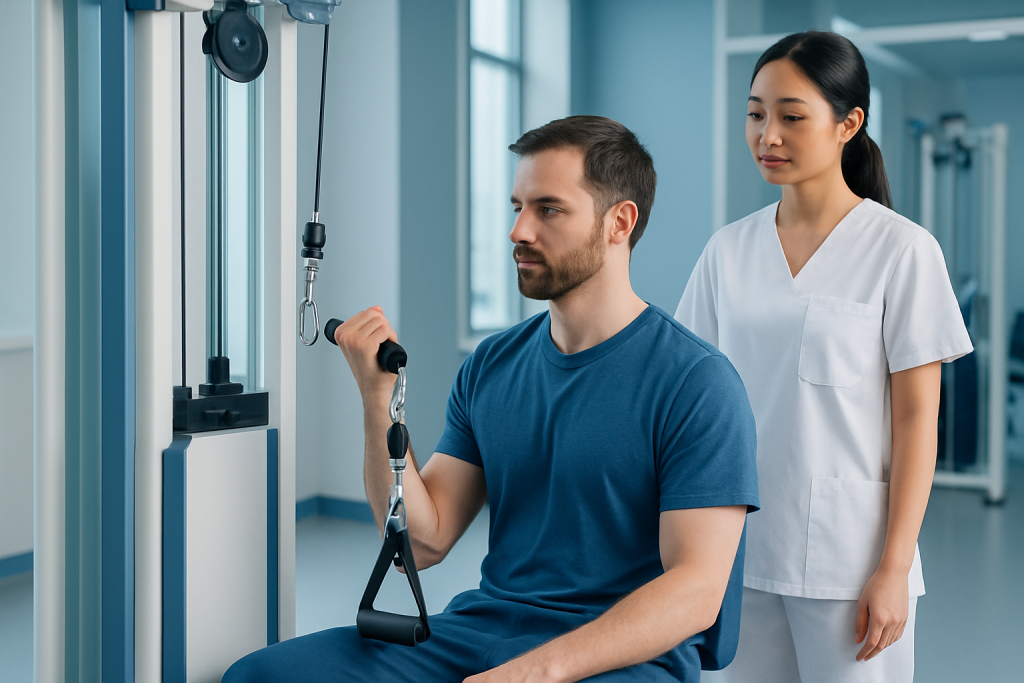
The biceps help bend the elbow and assist with rotating the forearm. During a curl, the muscle works concentrically as the weight is lifted and eccentrically as it is lowered. That controlled lowering phase is often where useful strength gains and movement control are built.
Cable-based resistance creates a steady load through much of the motion, which can make the exercise feel smoother than a free weight alone. In practice, this can help the person keep better form, especially if one arm is weaker than the other or if the goal is to train with more consistent tension. The “dumbbell” part of the phrase is sometimes used broadly by patients, but the main idea is controlled elbow flexion against resistance.
This exercise may be adapted for people working on posture, shoulder stability, or arm coordination. Small changes in grip, stance, or cable height can shift how the movement feels. A rehabilitation professional may select a variation that reduces stress on the wrist, elbow, or shoulder while still challenging the target muscles.
Benefits and Common Uses

Cable dumbbell curls can improve biceps strength, but their value is broader than appearance or arm size. Stronger elbow flexion supports many daily movements, and training the biceps in a controlled way can help restore confidence in using the arm after injury or inactivity.
They are commonly used in general fitness programs, athletic conditioning, and rehabilitation settings. In rehabilitation, the exercise may be introduced when the elbow and shoulder tolerate light resistance and when the person can move without compensation such as trunk swinging or shrugging. For some patients, the ability to exercise one arm at a time is particularly helpful because it allows side-to-side comparison and targeted work on the weaker limb.
- Supports arm strength for daily activities
- Helps improve control during elbow bending and lowering
- Can be adapted for different fitness or recovery levels
- Useful for side-to-side strength assessment
- May fit into a structured post-injury conditioning plan
Symptoms, Problems, and Technique Mistakes to Watch For
During a well-performed curl, the person should feel effort in the front of the upper arm, not sharp pain in the shoulder, elbow, or wrist. Mild muscle fatigue is normal. A pulling sensation at the front of the elbow, clicking, or discomfort that worsens with each repetition deserves attention.
Technique often breaks down when the resistance is too heavy. Common errors include leaning back, swinging the torso, letting the elbow drift far forward, or bending the wrist excessively. These compensations can move the work away from the biceps and onto the lower back, shoulder, or forearm. They may also make the exercise less useful for recovery, because the movement pattern becomes less precise.
People with a history of tendon irritation, elbow pain, shoulder impingement, or recent surgery should be especially attentive to how the exercise feels during and after training. A good rule is that the movement should feel controlled and repeatable. If form changes early in the set, the load is probably too high or the recovery stage is not ready for this exercise yet.
Causes & Risk Factors
Problems with cable dumbbell curls usually come from load, technique, or underlying joint sensitivity rather than from the exercise itself. The biceps and nearby tendons are more likely to become irritated when the person increases resistance too quickly, performs too many repetitions, or adds the exercise on top of other heavy pulling movements.
Risk can also be higher when shoulder mechanics are not stable. If the shoulder blade does not move well or the upper arm is held awkwardly, the elbow and wrist may have to compensate. People who spend long hours at a desk, use repetitive hand tools, or are returning to sport after a break may also notice that the forearm and elbow tire sooner than expected.
Other factors include previous tendon injury, arthritis in the elbow or wrist, neurological weakness, and poor recovery between sessions. In a rehabilitation plan, these issues are not reasons to avoid strength work altogether; they are reasons to progress carefully and match the exercise to the person’s current capacity.
Diagnosis and Clinical Assessment
There is no medical diagnosis required to perform cable dumbbell curls, but a professional assessment can be important when pain, weakness, or asymmetry is present. A clinician or physiotherapist may review the shoulder, elbow, wrist, and neck, because symptoms in one area can originate elsewhere. They may also ask when the discomfort began, what movements aggravate it, and whether the problem is new or recurring.
Assessment often includes observing posture and how the arm moves during a curl-like motion. The examiner may check range of motion, resistance tolerance, grip strength, and any swelling or tenderness. If the concern suggests tendon injury, nerve irritation, or another musculoskeletal problem, imaging or further testing may be considered, depending on the clinical picture.
For international patients, this assessment can be especially useful before travel or during a treatment visit, because it helps determine whether the person can exercise independently, needs supervised therapy, or should avoid certain motions temporarily. Clear instructions for home follow-up are often as important as the examination itself.
Treatment Options
When curls cause discomfort, treatment depends on the reason. If the issue is simple overload, reducing resistance, improving form, and allowing more recovery time may be enough. If there is tendon irritation or joint pain, a clinician may recommend a temporary pause from curls and a phased return using lighter resistance, fewer repetitions, or a different grip.
Rehabilitation commonly combines exercise modification with other strategies such as mobility work, postural training, and attention to the shoulder and forearm muscles that support the elbow. In some cases, ice or other comfort measures may be suggested for short-term symptom relief, but these should be individualized. Persistent pain should be evaluated rather than pushed through.
In more complex cases, treatment may involve a structured physiotherapy program, medication guidance from a doctor, or investigation of a separate condition such as tendon injury or nerve compression. When care is coordinated across specialties, the plan may include diagnostics, rehabilitation, and a follow-up schedule that helps the patient continue safely once they are back home.
Prevention & Self-care
Good self-care starts before the first repetition. A brief warm-up, comfortable stance, and a resistance level that allows clean movement all help reduce strain. The elbow should usually stay close to the body unless a clinician has advised a specific variation, and the wrist should remain in a neutral position rather than bending backward.
Progress should be gradual. Increasing either weight or volume too quickly is a common reason people develop elbow or forearm discomfort. It is often better to leave a few repetitions “in reserve” than to train to the point where the shoulder lifts, the trunk sways, or the tempo becomes jerky. Rest days matter, especially if the person is recovering from another upper-limb condition.
- Start with a load that allows smooth, pain-free repetitions
- Move slowly enough to control both lifting and lowering
- Keep the shoulder relaxed and the torso still
- Stop if pain becomes sharp, progressive, or one-sided in a concerning way
- Review technique regularly, especially after travel, illness, or a training break
If a patient is exercising while away from home, it can help to keep written instructions from the treating team and confirm the plan before changing equipment or routines. Acibadem Health Point’s multidisciplinary specialists and JCI-accredited hospitals diagnose and treat musculoskeletal conditions for international patients with coordinated follow-up planning.
When to See a Doctor
Medical advice is appropriate if pain lasts beyond a few days, keeps returning, or starts to limit daily use of the arm. It is also important to seek review if there is visible swelling, bruising, weakness, numbness, a loss of range of motion, or a sudden popping sensation during exercise. These symptoms do not always mean something serious, but they do deserve assessment.
Anyone recovering from shoulder, elbow, wrist, or neck problems should ask before adding curls to a program, especially if they are training on their own or following advice found online. A clinician can decide whether the exercise is suitable now, should be modified, or should wait until a later stage of recovery.
Timely assessment is also sensible when pain appears after a change in technique, a new machine setup, or a rapid increase in training volume. A clear diagnosis is the safest way to choose the right exercise progression, rather than guessing and hoping the symptoms settle on their own.
Frequently asked questions
Are cable dumbbell curls good for beginners?
They can be, if the resistance is light and the technique is simple. Beginners often benefit from slow, controlled repetitions and a focus on posture rather than heavier loads. A trainer or physiotherapist can help make sure the exercise matches current strength and mobility.
Should the elbow stay fixed during a curl?
The elbow should usually stay close to the body and move only enough to allow a natural curl. If it drifts forward a lot, the shoulder may start doing too much work. Small, controlled movement is usually more effective and easier on the joints.
What if the wrist hurts during the exercise?
Wrist pain may mean the grip is too tight, the load is too heavy, or the wrist is bending out of alignment. It can also reflect a separate wrist problem that needs evaluation. Reducing resistance and checking form is a good first step, but ongoing pain should be reviewed by a clinician.
Can this exercise help after an elbow injury?
It may help, but only at the right stage of healing and with proper guidance. After an elbow injury, the arm may need a period of rest, mobility work, and gradual reloading before curls are appropriate. A physiotherapist can help decide when to begin and how to progress safely.
How many repetitions should a person do?
That depends on the goal, current strength, and any medical issues. In rehabilitation, the target is often controlled movement rather than high volume or maximal effort. A qualified professional should give individualized guidance instead of relying on a fixed number.
Is soreness normal after cable dumbbell curls?
Mild muscle soreness can happen, especially when someone is new to the exercise or increases the load. It should gradually improve and not interfere significantly with daily activity. Sharp pain, swelling, or soreness that worsens with each session is not typical and should be checked.
References
- American College of Sports Medicine
- National Institute of Arthritis and Musculoskeletal and Skin Diseases
- Physiopedia
- Mayo Clinic
- NHS
This article is for general information only and is not a substitute for professional medical advice. Please consult a qualified doctor about your individual situation.