Cowlick Hair: Causes, Styling, and Treatment Options

Cowlick hair is a common, harmless pattern in which hair grows in a spiral or changes direction, often making an area difficult to style. Most people manage it with haircutting and styling techniques, while selected patients may discuss hair transplantation when a cowlick is especially noticeable or occurs in an area affected by hair loss.
Cowlick Hair: What It Is and What Can Be Done
Cowlick hair is a natural hair-growth pattern in which follicles point in different directions around a central area, creating a swirl, lift, or stubborn section that does not lie flat easily. It is harmless and does not usually require treatment. For people who dislike how it looks, practical styling methods, an adjusted haircut, and, in selected situations, a hair-restoration procedure may improve its appearance.
The best approach depends on the cowlick’s location, the hair’s texture and density, and whether thinning hair is also present. A cowlick at the crown can look more visible when surrounding hair becomes finer, whereas a front cowlick may affect how a fringe or hairline sits. A dermatologist or experienced hair-restoration clinician can help distinguish a normal growth pattern from hair loss or a scalp condition.
The term “cowlick” comes from the swirling pattern that can resemble hair licked by a cow. It may occur in one or more locations and can be more obvious in short, straight, fine, or thinning hair. It is not caused by brushing habits, shampooing, or sleeping position.
Why Cowlicks Form and Where They Occur
Each hair follicle grows at a particular angle and direction in the scalp. In a cowlick, follicles are arranged in a circular or spiral pattern, so neighboring hairs naturally move away from a central point. This pattern is established as the scalp develops and is largely influenced by genetics. It may become easier or harder to see over time, but the underlying direction of the follicles does not change on its own.
The crown, near the top-back of the head, is the most familiar location. Other common sites include the front hairline, temples, fringe area, and nape. A crown whorl can sometimes be mistaken for thinning because scalp may be visible at the center of the swirl, especially under bright overhead light or when hair is wet.
A cowlick itself does not cause hair loss. However, androgenetic hair loss can reduce density around a pre-existing cowlick, making the scalp more visible. When this is suspected, a clinician may evaluate for hair loss and discuss whether medical treatment, procedural treatment, or observation is appropriate.
Symptoms, Appearance and Hair-Loss Assessment

A cowlick usually causes no physical symptoms. Its main feature is hair that separates, stands up, bends in an unexpected direction, or resists a preferred style. At the crown, hair may radiate from a central point. At the front, it may push a fringe upward, sideways, or away from the face.
It is helpful to consider whether the appearance has been stable for years or has changed recently. A stable swirl with normal hair density is usually simply a cowlick. Gradual widening of the visible scalp, finer hairs around the whirl, a receding hairline, or increased shedding may instead suggest an additional hair-loss process.
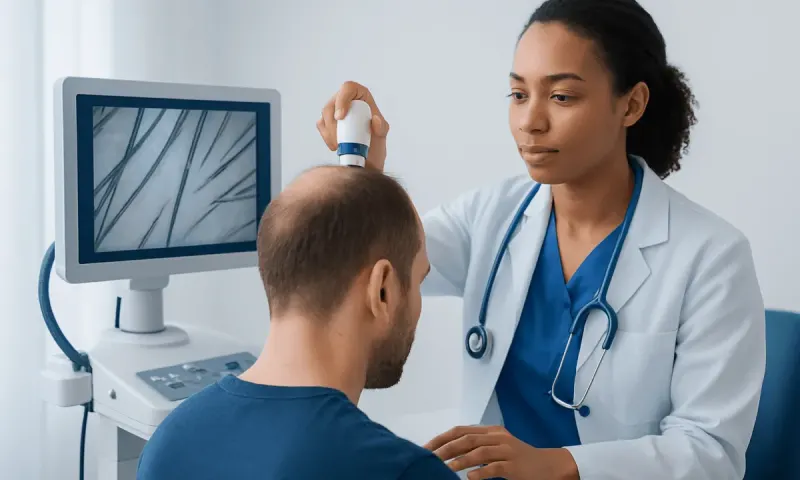
Hair professionals and clinicians assess the pattern in dry hair, with the hair parted in different directions, and often compare it with older photographs. Dermoscopy, a magnified examination of the scalp and follicles, can be useful if there is uncertainty. Blood tests are not routinely needed for a normal cowlick but may be considered when diffuse shedding or other symptoms suggest a possible medical cause.
- A longstanding, symptom-free swirl is typically benign.
- Itching, scale, redness, pain, or broken hairs point toward a scalp issue rather than a simple cowlick.
- Rapid or patchy hair loss should be assessed rather than treated as a styling concern.
Non-Surgical Ways to Manage Cowlick Hair
For most people, the simplest and most effective option is a haircut designed around the growth pattern rather than against it. A skilled stylist may keep a crown cowlick slightly longer so its weight helps it lie down, or shorter so it blends into the surrounding hair. The best length differs from person to person; very short hair can make a swirl more defined, while too much length may allow it to separate.
Styling works best when hair is shaped while damp. Blow-drying the cowlick in the desired direction, then briefly drying it in the opposite direction before finishing the style, may help reposition the hair. A round brush, diffuser, or concentrator nozzle can assist. Light mousse, cream, paste, or flexible-hold products may provide control without making fine hair look stiff.
Changing the part line, choosing a textured style, or allowing the natural direction of growth to become part of the haircut can also make a cowlick less noticeable. These measures do not change follicle direction permanently, but they can create a reliable day-to-day result. Repeated harsh heat, strong chemical processing, or excessive traction should be avoided because these can damage the hair shaft.
Cowlick Hair Procedures: Hair Transplantation and Planning
A procedure is not necessary for a typical cowlick. Hair transplantation may be discussed when a prominent cowlick coexists with reduced density, when it disrupts the appearance of a reconstructed hairline, or when a person has a specific cosmetic concern that cannot be managed satisfactorily with styling. The goal is generally to improve coverage and visual balance, not to eliminate the natural whorl entirely.
In a hair transplant, healthy follicles are taken from a donor area, usually the back or sides of the scalp, and placed into areas needing more density. The surgeon plans the placement angles, direction, and distribution carefully so transplanted hairs follow the natural spiral of the crown or the direction of the front hairline. This is particularly important because an unnatural direction can make a cowlick more visible rather than less so.
Procedures may use follicular unit extraction or follicular unit transplantation, depending on the person’s scalp, donor hair, goals, and clinical recommendation. Hair transplantation is most appropriate for individuals with adequate donor supply and stable or appropriately managed hair loss. It does not stop future thinning in untreated hair, so a long-term plan should be discussed before surgery.
Before proceeding, the clinician should review medical history, medications, scalp health, family history of hair loss, and realistic goals. Patients should understand that transplant design is individualized and that a natural-looking result depends on both surgical technique and the characteristics of existing hair.
Recovery and Expected Results After a Procedure
After hair transplantation, mild tenderness, swelling, tightness, or discomfort can occur for a short period. Small crusts form around graft sites and usually clear as healing progresses. The clinical team provides individualized washing instructions, activity guidance, and advice about protecting the scalp from friction, direct sun exposure, and trauma during early healing.
Transplanted hairs commonly shed within the first several weeks. This can be expected and does not necessarily mean the follicles have failed. The follicles remain beneath the skin and later enter a new growth phase. Visible new growth is gradual, and the cosmetic result continues to develop over several months as hairs lengthen and gain density.
Results vary according to donor-hair quality, the degree of existing hair loss, graft survival, hair texture, and how closely a patient follows aftercare instructions. A crown swirl may still retain its natural directional pattern after transplantation; the intended improvement is usually better coverage and a softer transition with surrounding hair. Follow-up visits allow the team to review healing and discuss whether medical hair-loss treatment may help protect non-transplanted hair.
When to Seek Medical Care
A person should arrange a medical assessment if a familiar cowlick suddenly appears wider, if hair is shedding more than usual, or if there are distinct bare patches. These changes may be related to conditions that need separate evaluation, including inflammatory scalp disorders, nutritional issues, hormonal changes, medication effects, or forms of alopecia.
Prompt care is also advisable for scalp pain, persistent itching, burning, redness, scaling, pus, sores, or scarring. These are not typical features of a simple cowlick. Early assessment can help identify treatable scalp disease and reduce the risk of ongoing hair damage.
People considering a procedure should seek consultation with a qualified dermatologist or hair-restoration surgeon rather than relying on online images alone. Acıbadem Health Point’s multidisciplinary specialists and JCI-accredited hospitals assess hair and scalp concerns and provide individualized treatment planning for international patients.
Frequently asked questions
01Can a cowlick be removed permanently?
A natural cowlick cannot usually be removed permanently because it reflects the direction in which the hair follicles grow. Haircuts and styling can make it easier to manage. In selected people with thinning hair or a specific cosmetic concern, hair transplantation may improve coverage, but it does not erase the underlying growth pattern.
02Is cowlick hair a sign of baldness?
No. A cowlick is commonly present from childhood and is not, by itself, a sign of baldness. However, thinning around a crown cowlick can make it appear more pronounced, so a new change in density is worth discussing with a clinician.
03What haircut is best for cowlick hair?
The most suitable haircut depends on the cowlick’s location, hair texture, and desired style. Some people benefit from a little added length and weight, while others find a shorter, textured cut blends the area better. A stylist can assess hair while it is dry and recommend an approach that works with its natural direction.
04Does a hair transplant work for a crown cowlick?
A hair transplant can improve the appearance of a crown cowlick when low hair density is part of the concern and there is sufficient donor hair. The surgeon must place grafts in a pattern that follows the natural whorl. It is not usually recommended for a normal cowlick with healthy, full surrounding hair.
05How long does recovery take after a cowlick hair transplant?
Early scalp healing usually occurs over the first days to weeks, although the exact timetable differs between people and techniques. The transplanted hairs may shed before new growth begins. Noticeable growth develops gradually over several months, and the final cosmetic appearance takes longer to mature.
06Can hair products make a cowlick worse?
Hair products do not change the cowlick itself, but very heavy products can weigh hair down unevenly or make the separated pattern more obvious. Products with flexible hold may help guide the hair without creating stiffness. Frequent harsh heat or chemical processing can damage hair and should be minimized.
This article is for general information only and is not a substitute for professional medical advice. Please consult a qualified doctor about your individual situation.
Hair transplant in Turkey — costs, graft counts & a free assessment
JCI-accredited · board-certified surgeons · reply within 24h
Add us as a Preferred Source to see more of our trusted health content across Google Search, AI Overviews and Discover.