Can a Home PSA Prostate Test Be Trusted?
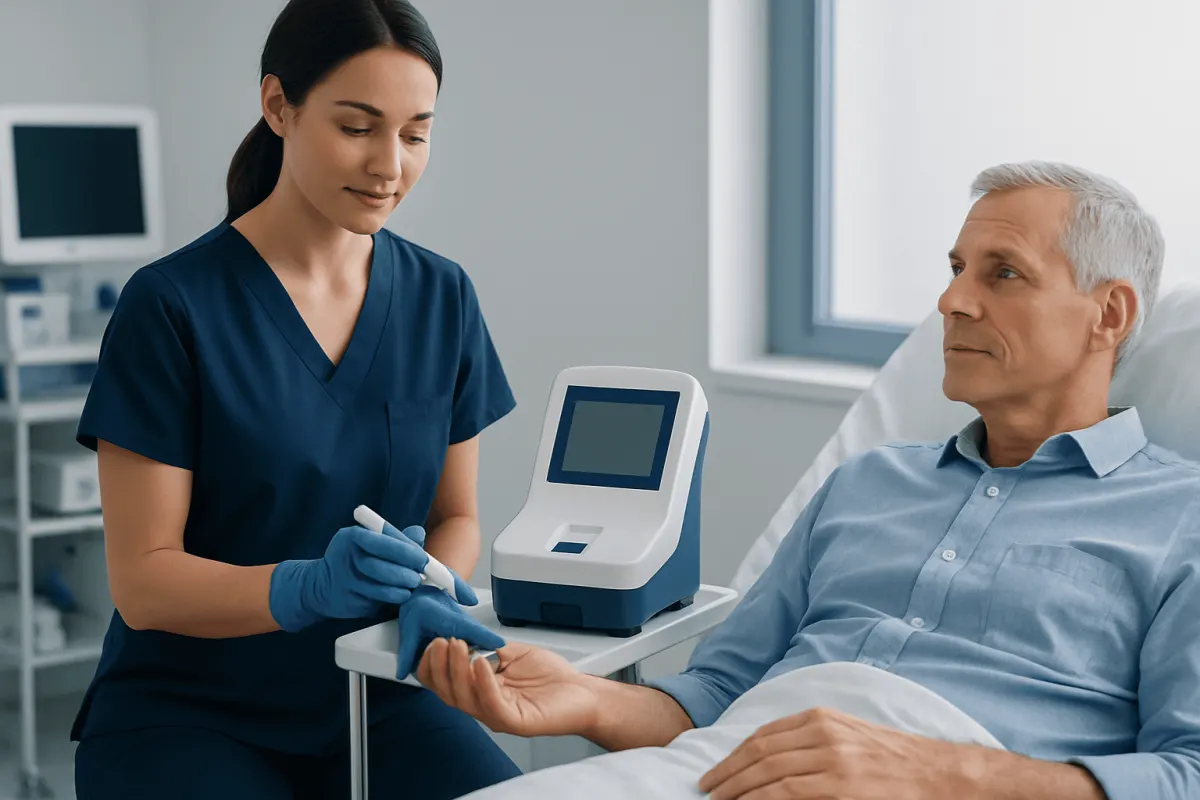
A home PSA prostate test usually uses a finger-prick blood sample to measure prostate-specific antigen (PSA), a protein made by prostate tissue. It can be a convenient screening option, but it cannot diagnose prostate cancer and any raised, changing, or unexpected result should be discussed with a qualified clinician.
Home PSA Prostate Test: What It Measures
A home PSA prostate test measures the level of prostate-specific antigen (PSA) in blood. PSA is a protein produced mainly by cells in the prostate, a small gland below the bladder that contributes fluid to semen. Most home kits use a finger-prick sample that is either tested with an at-home device or mailed to a laboratory for analysis.
The test may be useful for people who want a convenient way to start a conversation about prostate health or monitor PSA under a clinician’s guidance. However, PSA is not a cancer-specific marker. A raised result does not confirm cancer, and a low result does not completely rule it out. Results should be interpreted alongside age, symptoms, prostate size, medicines, family history, examination findings, and previous PSA measurements.
PSA screening is a personal decision. Its possible benefit is identifying some prostate cancers earlier, while its limitations include false-positive results, unnecessary worry, and follow-up tests for changes that may not be harmful. A clinician can help an individual decide whether testing is appropriate and explain the next steps after a result.
How Is a Home PSA Test Done and What Is Recovery Like?
Instructions vary by kit, so it is important to read the manufacturer’s guide carefully. In general, the person washes and warms their hands, uses the supplied lancet to prick the side of a fingertip, and collects the required drops of blood into a small tube, card, or testing device. Some tests provide an on-the-spot result, while laboratory-based kits usually provide results after the sample has been received and processed.
No recovery period is normally needed after a finger-prick PSA test. Mild brief tenderness, a tiny bruise, or a small spot of bleeding can occur. Firm pressure with clean gauze or tissue for a few minutes is usually enough. The person can normally return to usual daily activities immediately.
Home collection has practical limitations. An insufficient sample, delayed postage, incorrect storage, or contamination can affect whether a laboratory can analyse the specimen. If a test is invalid, unclear, raised, or different from a prior result, a venous blood test arranged through a healthcare professional may be recommended for confirmation.
How Accurate Is a Home PSA Test?

The accuracy of a home PSA test depends on the type of kit, the quality of the blood sample, and whether it is analysed in an accredited laboratory. Laboratory mail-in tests may provide a quantitative PSA measurement, whereas some rapid home tests may report only whether the result is above a selected threshold. These different approaches are not interchangeable.
Even when the laboratory measurement is technically accurate, PSA itself has important limits as a screening test. PSA may increase because of benign prostate enlargement, prostate inflammation, urinary infection, urinary retention, recent ejaculation, cycling, or medical procedures involving the prostate or urinary tract. Conversely, some prostate cancers do not produce a high PSA level.
For these reasons, home testing should not be used to diagnose or exclude prostate cancer. A clinician may repeat the PSA test under standard conditions, review the PSA trend over time, check for infection, perform a digital rectal examination when appropriate, or discuss imaging such as prostate MRI. Evaluation may also consider conditions such as prostate cancer and non-cancerous prostate enlargement.
What Is an Average PSA Score for a 70 Year Old?
There is no single “average” PSA score that determines whether a 70-year-old person is healthy or has prostate cancer. PSA commonly rises with age because the prostate often enlarges over time. Laboratories and clinical guidelines may use different reference ranges, so the result should always be read using the range shown on the report and interpreted by a clinician.
Age-adjusted reference ranges are sometimes used as a general guide. One commonly cited upper reference value for men aged 70 to 79 is around 6.5 ng/mL, but this is not a universal cut-off and should not be used alone to decide whether further tests are needed. A PSA below that level can still warrant review if it is rising quickly or if symptoms and risk factors are present.
More than one result is often more informative than a single number. A doctor may compare the current result with previous tests, assess medications such as 5-alpha-reductase inhibitors that can lower PSA readings, and consider overall health and life expectancy when discussing screening or investigation.
How Long to Rest Before a PSA Test?
There is usually no need for bed rest before a PSA test. However, avoiding factors that may temporarily raise PSA can make the result easier to interpret. Many clinicians advise avoiding ejaculation and vigorous cycling, including prolonged stationary-bike sessions, for around 48 hours before the blood sample is taken.
It is also sensible to postpone routine PSA testing during an active urinary infection, fever, or acute prostatitis symptoms, unless a clinician advises otherwise. PSA can remain elevated for some time after inflammation or infection. A healthcare professional can advise when retesting is most appropriate after treatment or recovery.
Recent catheterisation, cystoscopy, prostate biopsy, urinary retention, or prostate surgery may affect PSA levels. A person should tell the clinician or testing provider about any recent urinary procedures, as the most suitable timing for a PSA test depends on the procedure and the clinical situation.
What Should You Not Do Before Taking a PSA Test?
Before taking a PSA test, a person should avoid ejaculation and activities that put sustained pressure on the prostate, such as long-distance or intense cycling, for about 48 hours when possible. They should also avoid taking the test during a suspected urinary infection unless they have been advised to do so, because infection can produce a temporarily raised result.
It is important not to stop prescribed medicines without medical advice. Some medicines used for benign prostate enlargement or hair loss, including finasteride and dutasteride, can lower PSA values and change how a result is interpreted. The testing provider or doctor should be told about all prescription medicines, supplements, and recent treatments.
For a home kit, the person should not collect a sample if they cannot follow the storage, timing, and return instructions. They should avoid testing immediately after a difficult finger-prick collection if the sample volume is inadequate. Using a clinical laboratory test may be more reliable when close PSA monitoring is needed.
Understanding Results and Next Steps
Home PSA results may be reported as a number, often in nanograms per millilitre (ng/mL), or as a result above or below a particular threshold. A result in the reference range is reassuring but does not provide an absolute guarantee. A result above the reference range should be viewed as a signal to arrange medical review, not as a diagnosis.
A clinician may recommend repeating PSA after avoiding temporary influencing factors, particularly if the elevation is mild or unexpected. They may also check a urine sample for infection, review urinary symptoms, discuss prostate MRI, or refer the person to a urologist. If an enlarged prostate is contributing to symptoms, assessment for benign prostatic hyperplasia may be appropriate.
Possible management depends on the cause of the PSA change. It may include monitoring, treatment for infection or urinary symptoms, further imaging, or specialist assessment. Decisions about biopsy are individualized and are generally based on PSA pattern, MRI findings, examination, medical history, and the person’s preferences.
When to Seek Medical Care
A person should arrange a non-urgent medical appointment after a raised, borderline, rapidly changing, or invalid home PSA result. Medical advice is also appropriate for new urinary symptoms, such as difficulty starting urination, a weak stream, frequent urination, needing to urinate at night, urgency, or a sensation that the bladder is not fully emptying. These symptoms are common and often have non-cancer causes, but they deserve assessment.
Prompt medical care is advisable for blood in urine or semen, persistent pelvic or bone pain, unexplained weight loss, fever with urinary symptoms, or an inability to pass urine. Sudden inability to urinate with pain or a swollen lower abdomen should be assessed urgently.
People with a father, brother, or son diagnosed with prostate cancer, especially at a younger age, and people of Black ancestry may wish to discuss PSA testing earlier or more regularly with a doctor because risk can be higher. Acıbadem Health Point’s multidisciplinary specialists and JCI-accredited hospitals can assess prostate concerns and coordinate diagnostic evaluation for international patients.
Frequently asked questions
01Can a home PSA prostate test detect prostate cancer?
No. A home PSA prostate test measures PSA in the blood, but it cannot diagnose prostate cancer. PSA may be raised for several non-cancer reasons, and some prostate cancers occur with PSA levels that are not high. An abnormal result needs clinical interpretation and, if appropriate, further testing.
02Is a finger-prick PSA test as reliable as a blood test at a clinic?
Reliability varies between products and collection methods. A properly collected sample analysed by a quality laboratory may be useful, but finger-prick collection and sample handling can introduce limitations. A clinician may request a repeat venous blood test to confirm an unexpected or raised result.
03Do I need to fast before a home PSA test?
Fasting is not usually required for a PSA test. The more important preparations are avoiding ejaculation and vigorous cycling for about 48 hours and informing the provider about medicines and recent urinary procedures. The kit instructions should always be followed.
04Can an enlarged prostate raise PSA?
Yes. Benign prostate enlargement is a common cause of raised PSA, particularly with increasing age. Inflammation, infection, and temporary irritation of the prostate can also raise the level. Further assessment helps identify the most likely reason.
05Can a urinary infection affect a PSA result?
Yes. A urinary infection or prostate inflammation can raise PSA temporarily. Testing may be postponed until symptoms have resolved and treatment is complete, depending on medical advice. A repeat PSA test may then be recommended.
06What happens if a home PSA test result is high?
The next step is usually to contact a doctor or urologist rather than assume the result means cancer. They may repeat the test, review possible temporary causes, assess symptoms, and consider urine testing, examination, or imaging. Follow-up is tailored to the result and the person’s overall risk profile.
This article is for general information only and is not a substitute for professional medical advice. Please consult a qualified doctor about your individual situation.
Oncology care in Turkey — second opinion and treatment plan
JCI-accredited · board-certified surgeons · reply within 24h
Add us as a Preferred Source to see more of our trusted health content across Google Search, AI Overviews and Discover.