Moro Reflex

Key Takeaways
- The Moro reflex is a normal involuntary startle response seen in newborns.
- It usually appears at birth and gradually disappears by early infancy as the nervous system matures.
- A weak, absent, or uneven reflex can sometimes point to an underlying issue that needs medical review.
- Doctors assess the reflex as part of a broader newborn and infant neurological examination.
- Parents can support their baby by handling them gently and seeking advice if movements seem unusual or concerning.
The Moro reflex is a normal newborn startle response that helps clinicians assess early neurological function. In most babies, it fades on its own as the nervous system matures, but unusual persistence, asymmetry, or absence should be discussed with a pediatrician.
Overview
The Moro reflex is one of the earliest movement patterns seen in a newborn. When a baby is startled by a sudden sound, a feeling of falling, or a quick change in position, the arms may fling outward, the hands may open, and then the arms draw back in. This automatic response is normal in early life and is part of how clinicians check that a baby’s nervous system is working as expected.
Parents sometimes notice the reflex most clearly during sleep, diaper changes, or while lifting the baby from a lying position. Although it can look dramatic, it is not the same as a seizure. It is a brief, involuntary response that usually settles as the baby becomes more coordinated and the brain and spinal cord mature.
For families preparing for newborn care, especially those traveling to another country for delivery or early postnatal follow-up, knowing what this reflex means can make the first weeks less stressful. It helps parents distinguish a normal developmental sign from something that deserves a pediatric check.
What the reflex looks like
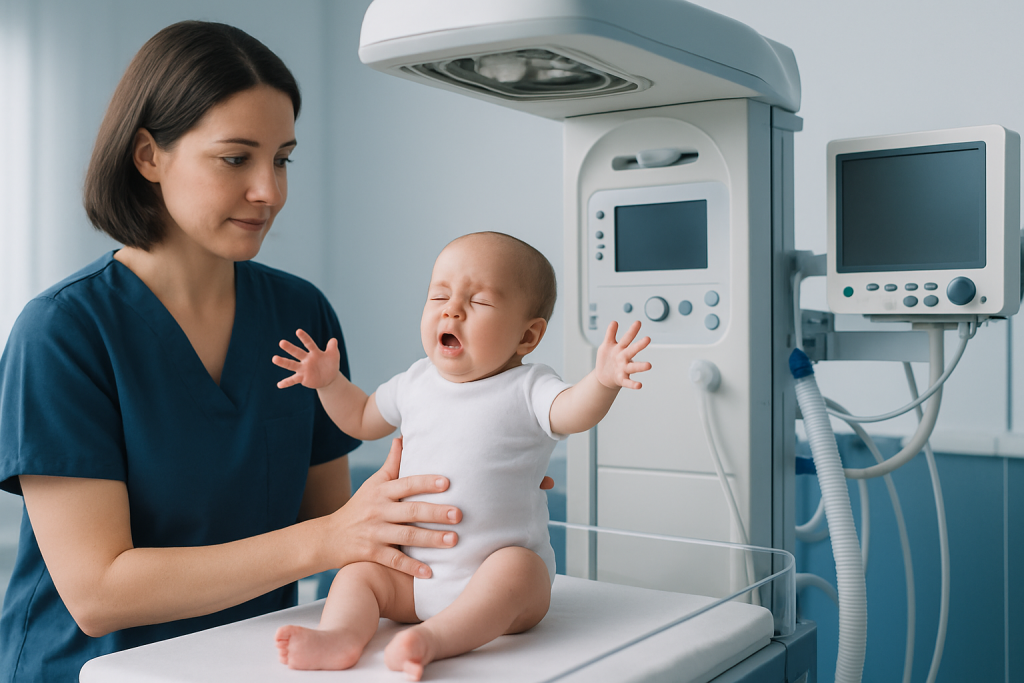
The Moro reflex often has two recognizable phases. First comes the outward movement: the baby’s arms extend away from the body, the fingers may spread, and the shoulders may arch slightly. Then comes the inward phase: the arms come back toward the body, and the baby may cry, relax, or settle again.
Not every baby shows it in exactly the same way. Some infants respond more strongly than others, and the reaction may be easier to see when a baby is tired, hungry, or startled by a sudden noise. A brief startle that ends quickly is usually considered a typical newborn pattern.
In day-to-day life, parents may notice this reflex during routine handling rather than in dramatic moments. Gentle, supported movements are part of normal care, but sudden jostling can trigger the response more easily. The reflex should still feel short-lived and symmetrical on both sides of the body.
Causes and risk factors

The Moro reflex is caused by the immaturity of a newborn’s nervous system, not by illness. It is a primitive reflex, meaning it appears automatically before a baby has full voluntary control over movement. As the brain develops, these early reflexes gradually become less visible and are replaced by purposeful actions.
There are, however, situations that make the reflex especially important to observe. A reflex that is consistently weaker on one side, absent, or unusually strong may prompt a doctor to look more closely at the baby’s muscles, nerves, bones, or birth history. Examples include shoulder injury during birth, collarbone fracture, nerve irritation, or less commonly a neurological condition.
Risk factors for concern are not the same as risk factors for the reflex itself. Rather, they are factors that may affect how the baby moves or how the reflex appears. These can include difficult delivery, prematurity, low muscle tone, or a history of restricted movement in the womb. A pediatric assessment is the safest way to separate normal variation from something that needs follow-up.
Diagnosis
Doctors usually identify the Moro reflex during a routine newborn examination. They observe how the baby responds to a change in position or a mild startle and compare both sides of the body. The finding is interpreted alongside other newborn reflexes, muscle tone, feeding, alertness, and overall growth.
If the reflex seems unusual, the next step is not a single test but a fuller clinical picture. The pediatrician may ask about the pregnancy, delivery, and any birth complications; watch for symmetry in the arms and legs; and check whether the baby seems uncomfortable when one arm is moved. In some cases, further evaluation by a pediatric neurologist, orthopedist, or another specialist may be recommended.
Parents can help by describing what they see in everyday life. Notes about when the response happens, whether it seems stronger on one side, and whether the baby uses both arms equally can be very useful. For international families, bringing hospital records, birth notes, or photos and videos from home may help doctors review the pattern more clearly across different care settings.
Treatment options
The Moro reflex itself does not need treatment because it is a normal developmental reflex. What may need care is the reason it looks abnormal. If the reflex is reduced by pain, injury, or nerve involvement, treatment focuses on the underlying issue rather than the reflex pattern alone.
Depending on the cause, management may include simple observation, pain relief, support for an injured limb, physical therapy, or specialist follow-up. If a baby was born with a fracture or a nerve injury, the care plan is usually tailored to protect healing and encourage normal movement as safely as possible. In many situations, the answer is careful monitoring over time rather than immediate intervention.
When a medical team is involved, parents are usually shown how to handle the baby gently, support both arms during lifting, and avoid sudden movements that trigger discomfort. If the family is receiving care away from home, the discharge plan should clearly explain what changes to watch for and when to return for reassessment.
Prevention and self-care
Parents cannot prevent the Moro reflex, because it is a normal part of newborn development. They can, however, create a calmer environment for a baby who startles easily. Slow, supported movements, soft lighting, and a predictable routine often help infants settle more comfortably.
Practical self-care is about handling and observation. When lifting the baby, support the head and neck, move steadily, and avoid sudden shifts in position. If the baby seems to jerk more than expected, keep in mind that many newborns are still learning to regulate their responses, and frequent brief startles are often temporary.
- Use gentle, secure support during feeding, dressing, and carrying.
- Watch for symmetry in arm movement and overall comfort.
- Track any pattern that seems persistent or one-sided.
- Bring concerns to the pediatrician rather than trying to interpret them alone.
Families recovering from delivery while far from home may find it helpful to keep a simple log of newborn behaviors, especially during the first pediatric follow-up visits. This can make it easier to discuss patterns consistently, even if care is shared between different clinicians.
When to see a doctor
A doctor should be consulted if the Moro reflex seems absent, very weak, or consistently unequal on one side. It is also worth raising concerns if the baby does not move one arm as much as the other, cries when one arm is touched, or appears unusually stiff or floppy. These signs do not always mean something serious, but they deserve a professional look.
Medical advice is especially important if the baby had a difficult birth, was premature, or has other concerning signs such as poor feeding, unusual sleepiness, or delayed movement. Parents should trust their observations; they know the baby’s day-to-day patterns better than anyone. A calm assessment is usually the best next step.
If the family is already planning newborn follow-up, that visit is an excellent time to mention the reflex and any questions about normal development. Acibadem Health Point’s multidisciplinary specialists and JCI-accredited hospitals can evaluate and treat conditions affecting newborn development for international patients, with care that aims to be clear, coordinated, and family-centered.
Outlook and developmental course
In healthy newborns, the Moro reflex gradually fades as voluntary motor control develops. As the months pass, the baby becomes less likely to react to every sudden sound or movement with the same wide, automatic response. This change is expected and reflects normal maturation rather than a loss of ability.
Because infant development does not follow an identical timetable for every child, the reflex may be seen a little longer in some babies than others. What matters most is the overall pattern: symmetry, comfort, steady growth, and age-appropriate milestones. A pediatrician can help interpret the reflex in the context of the whole child, not as a standalone finding.
For parents, the key is balanced attention. The Moro reflex is usually just one of many small clues that a newborn is adapting well to life outside the womb. When it behaves as expected, it is reassuring; when it does not, it can guide doctors toward the right next step without creating unnecessary worry.
Frequently asked questions
What is the Moro reflex in a newborn?
The Moro reflex is a normal startle response seen in newborns. A sudden noise or movement may cause the baby’s arms to extend outward and then come back in. It is part of early neurological development and usually fades over time.
How long does the Moro reflex last?
It is usually present at birth and becomes less noticeable as the baby’s nervous system matures. Many babies outgrow it during early infancy. A pediatrician can interpret the timing in the context of the child’s overall development.
Is the Moro reflex the same as a seizure?
No, it is not the same as a seizure. The Moro reflex is a brief, involuntary startle pattern that happens in response to a trigger and then stops. Seizures typically look different and require medical evaluation.
What does it mean if the reflex is only on one side?
A one-sided or uneven Moro reflex can suggest pain, injury, or a nerve or muscle problem on that side. It does not always mean something serious, but it should be checked by a doctor. The baby’s movement, comfort, and birth history all matter in the assessment.
Can parents test the Moro reflex at home?
There is no need to test it at home, and sudden movements should be avoided. The reflex is usually seen naturally during normal handling or at a routine check-up. If parents have concerns, they should mention them to a pediatrician instead of trying to reproduce the response.
When should a baby be seen urgently?
Urgent care is appropriate if the baby seems unable to move one arm, cries in pain when an arm is touched, or has other worrying symptoms such as extreme sleepiness, poor feeding, or unusual stiffness. These signs deserve prompt medical review. A calm, timely evaluation is the safest approach.
References
- American Academy of Pediatrics
- Merck Manual Professional Edition
- National Institute of Neurological Disorders and Stroke
- World Health Organization
This article is for general information only and is not a substitute for professional medical advice. Please consult a qualified doctor about your individual situation.