Why Does My Left Testicle Hurt? Common Causes

Left testicle pain can result from minor strain, infection, enlarged veins, a hernia, or pain referred from another area. However, sudden or severe pain can be a sign of testicular torsion and should be assessed urgently to protect the testicle.
Why does my left testicle hurt?
Left testicle pain can happen for several reasons, ranging from temporary irritation or a minor injury to infection, enlarged scrotal veins, or pain that travels from the groin, abdomen, or lower back. The side of the pain alone does not identify the cause. A new ache that lasts, worsens, or affects daily activities deserves assessment by a qualified clinician.
The most important concern is sudden, intense pain that begins without warning. This can occur with testicular torsion, in which the spermatic cord twists and reduces blood flow to the testicle. Torsion is a medical emergency, so anyone with sudden severe pain should seek emergency care immediately rather than waiting to see whether it improves.
Some people notice that the left testicle hurts sometimes or seemingly randomly. Intermittent symptoms may be related to activity, support from clothing, muscle tension, a varicocele, or occasionally intermittent twisting of the spermatic cord. Even pain that comes and goes should be discussed with a doctor, particularly if episodes are abrupt or increasingly frequent.
Should I be worried if my left testicle hurts?
It is reasonable to take left-sided testicular pain seriously, but it does not always mean there is a dangerous condition. Mild discomfort after exercise, a minor knock, prolonged sitting, or sexual activity may settle with rest. Still, it is not possible to safely rule out urgent causes based on symptoms alone, especially when pain is new or unexplained.
Medical assessment is particularly important if pain is severe, sudden, persistent for more than a short period, or accompanied by swelling, redness, fever, urinary symptoms, nausea, vomiting, or a change in the testicle’s position or shape. A painless lump or persistent heaviness also warrants evaluation, even though it may have a non-cancerous explanation.
Testicular cancer more often presents as a painless lump, enlargement, firmness, or a heavy feeling rather than sudden pain. Nevertheless, any new testicular change should be examined. Prompt evaluation is reassuring when the cause is benign and allows time-sensitive conditions to be treated without delay.
What causes pain in only one testicle?
One-sided testicular pain can originate in the scrotum itself or be referred from nearby structures. Epididymitis, an inflammation or infection of the coiled tube behind the testicle, often causes gradually increasing pain and tenderness on one side. It may occur with burning during urination, frequent urination, discharge, fever, or swelling. Sexually transmitted infections and urinary bacteria are possible causes, depending on age, sexual history, and health factors.
A varicocele is an enlargement of veins in the scrotum and is more common on the left because of normal differences in venous drainage. It may cause a dull ache, heaviness, or discomfort that becomes more noticeable after standing, walking, or exercising and may improve when lying down. An inguinal hernia, where tissue pushes through a weak area in the groin, can also create groin or scrotal discomfort that is worse with lifting, coughing, or straining.
Other possible explanations include a direct injury, inflammation of the testicle, fluid around the testicle, a cyst near the epididymis, or pelvic-floor and abdominal muscle strain. Kidney stones, urinary tract conditions, hip problems, and lower-back nerve irritation can sometimes produce pain felt in the testicle despite no primary scrotal disorder.
- Pain when sitting may relate to pressure, posture, pelvic muscle tension, or scrotal conditions such as a varicocele.
- Pain when walking or moving may follow a strain, injury, hernia, or inflammation that is aggravated by motion.
- Pain when touching the testicle can occur with inflammation, injury, or infection; marked tenderness needs assessment.
- Pain when coughing can suggest increased pressure from an inguinal hernia, especially with a groin bulge.
How do you get rid of pain in your left testicle?
The safest way to relieve left testicle pain is to identify and treat its cause. A clinician may recommend different care for infection, hernia, varicocele, injury, kidney stones, or pelvic muscle problems. Antibiotics are used only when a bacterial infection is diagnosed or strongly suspected; they should not be self-started or shared. Surgery may be needed urgently for torsion and may be considered for selected cases of hernia or troublesome varicocele.
For mild pain after an obvious minor injury or physical strain, supportive underwear, rest from vigorous activity, a wrapped cold pack applied briefly at intervals, and over-the-counter pain relief may help if these options are safe for the individual. Anti-inflammatory medicines are not suitable for everyone, including some people with kidney disease, ulcers, bleeding risks, or certain medication interactions, so a pharmacist or clinician can advise when needed.
Avoid repeatedly pressing or checking a painful testicle, as this can increase tenderness. Avoid heavy lifting and strenuous exercise until the cause is clearer. If symptoms do not improve promptly, recur, or are associated with swelling or urinary symptoms, medical assessment is more appropriate than continuing home care.
When a procedural cause is identified, treatment may include varicocele treatment or repair of a hernia, depending on symptoms and examination findings. Care plans should be individualized after a urological review.
What are red flags for testicular pain?
Red flags are symptoms that may indicate torsion, a serious infection, a trapped hernia, or another condition requiring urgent treatment. The clearest warning sign is severe pain that starts suddenly, including pain that occurs all of a sudden during sleep, sport, or ordinary activity. Do not drive yourself if severe pain is accompanied by faintness, vomiting, or significant distress; seek emergency help.
Urgent or emergency assessment is needed for sudden severe pain; rapid swelling; nausea or vomiting; a testicle that sits higher than usual or appears rotated; redness with fever; pain after a significant injury; or a painful groin bulge that cannot be gently reduced. These features can occur with conditions that should not be managed at home.
It is also important to arrange a prompt appointment for a new lump, hard area, noticeable enlargement, persistent heaviness, blood in the urine, discharge from the penis, or pain that continues beyond a day or two. A clinician may evaluate for conditions such as testicular torsion, infection, or other scrotal causes based on the symptoms and examination.
How is one-sided testicular pain diagnosed?
Diagnosis begins with a careful discussion of when the pain started, whether it was sudden or gradual, what makes it better or worse, recent exercise or injury, urinary symptoms, fever, sexual health, and any groin or back pain. The clinician examines the scrotum, testicles, epididymis, abdomen, and groin. This examination can identify swelling, tenderness, a hernia, or changes in testicular position.
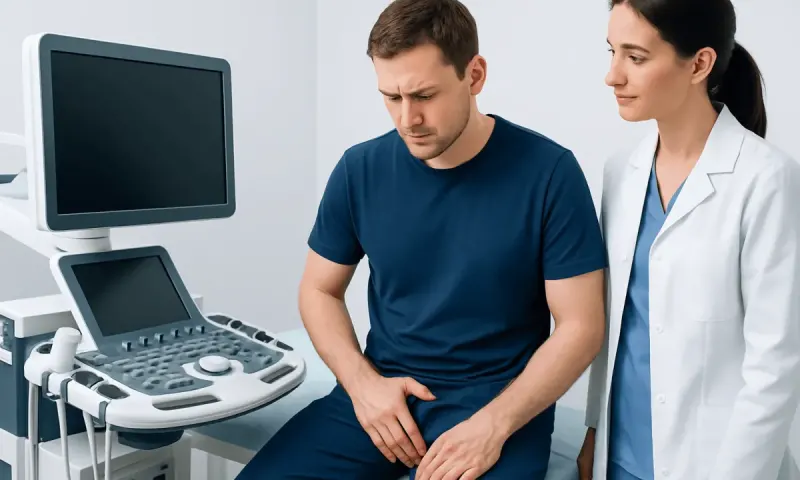
Urine testing may help identify a urinary infection, while other laboratory tests may be appropriate when an infection is suspected. A scrotal ultrasound with Doppler blood-flow assessment is commonly used when torsion, a mass, inflammation, fluid collection, or varicocele is being considered. Ultrasound is painless and does not use radiation.
When pain seems to arise outside the scrotum, further assessment may focus on the urinary tract, kidneys, muscles, spine, or hip. The test results and urgency of symptoms guide next steps. In suspected torsion, treatment should not be delayed for nonessential testing.
When to seek medical care
Emergency care is needed now for sudden severe testicle pain, especially if it is paired with nausea, vomiting, swelling, fever, or an unusual testicle position. Sudden pain can occasionally lessen if twisting temporarily resolves, but this does not make it safe to wait because torsion can recur and blood flow can become compromised again.
Contact a doctor or urology service soon for persistent or recurrent pain, tenderness with urinary symptoms, pain during sex or ejaculation, a scrotal lump, a groin bulge, or discomfort that interferes with sitting, walking, work, or sleep. This includes pain that develops when coughing, moving, or touching the area if it does not settle quickly after a minor, clear trigger.
Acıbadem Health Point’s multidisciplinary specialists and JCI-accredited hospitals can assess testicular and groin symptoms for international patients, with urology input and appropriate imaging when indicated. A timely medical review can clarify the cause and support an appropriate treatment plan.
Frequently asked questions
01Why does my left testicle hurt randomly?
Pain that seems random may reflect intermittent pressure, muscle tension, a varicocele, minor irritation, or referred pain from the groin, urinary tract, or back. It can also occur with intermittent testicular torsion, which needs urgent medical attention if episodes are sudden or severe. A clinician should evaluate recurring unexplained episodes.
02Why does my left testicle hurt when I sit?
Sitting can increase pressure on the scrotum and may make discomfort from posture, pelvic-floor muscle tension, a varicocele, or local inflammation more noticeable. Supportive clothing and changing position may help mild symptoms, but persistent pain should be assessed. Sudden or severe pain is not explained safely by sitting alone and needs urgent evaluation.
03Why does my left testicle hurt when I walk or move?
Walking and movement may aggravate a strained groin muscle, minor injury, hernia, inflammation, or scrotal swelling. A varicocele may also feel more uncomfortable after standing or activity. If movement-related pain is severe, follows trauma, or comes with swelling or nausea, seek medical care promptly.
04Why does my left testicle hurt when I touch it?
Tenderness to touch can occur after an injury or with inflammation of the epididymis or testicle. Infection may also cause swelling, warmth, fever, urinary symptoms, or discharge. Because significant tenderness can overlap with urgent conditions, a new painful or swollen testicle should be examined.
05Why does my left testicle hurt when I cough?
Coughing raises pressure inside the abdomen and can worsen discomfort from an inguinal hernia or a groin strain. A bulge in the groin or scrotum that appears with coughing strengthens the possibility of a hernia. A painful bulge that becomes firm, discolored, or cannot be pushed back gently requires urgent care.
06Can testicular pain go away on its own?
Mild discomfort from temporary pressure or a minor strain may improve with rest and support. However, pain from torsion, infection, hernia, or other conditions may need prompt treatment. It is safest not to wait for sudden, severe, worsening, or recurrent pain to resolve on its own.
This article is for general information only and is not a substitute for professional medical advice. Please consult a qualified doctor about your individual situation.
Persistent digestive symptoms? Get evaluated in Turkey
JCI-accredited · board-certified surgeons · reply within 24h
Add us as a Preferred Source to see more of our trusted health content across Google Search, AI Overviews and Discover.