What Is Cancerous Skin Tags? A Complete Medical Guide

Key Takeaways
- Most skin tags are benign, but some skin growths can look similar to early skin cancers or other lesions.
- A growth that changes quickly, bleeds, crusts, itches, or looks irregular should be checked by a clinician.
- Diagnosis may include a skin exam, dermoscopy, and sometimes a biopsy to confirm the exact type of lesion.
- Treatment depends on the diagnosis and may include simple removal, excision, or cancer-specific care.
- People traveling for care can plan for evaluation, pathology review, and follow-up visits before and after treatment.
Cancerous skin tags are not typical skin tags; a true skin tag is usually benign, while a new, changing, bleeding, or irregular growth may be a different skin lesion that needs medical evaluation. This guide explains the signs to watch for, how doctors diagnose suspicious growths, and what treatment and follow-up may involve.
Overview
The phrase cancerous skin tags is often used online, but medically it can be misleading. A classic skin tag is a small, soft, benign growth that hangs from the skin and is usually harmless. When a growth seems like a skin tag but is actually cancerous, it is more likely to be a different lesion — such as a skin cancer, a precancerous growth, or another type of benign bump that only resembles a skin tag.
That distinction matters because appearance alone is not enough to make a diagnosis. Some skin cancers can be subtle in the early stages, especially when they are small, flesh-colored, or located in an area that is easy to overlook. The safest approach is to have any new or changing growth assessed by a dermatologist or other qualified clinician rather than trying to identify it at home.
For international patients, this evaluation may be the first step in deciding whether treatment can be done locally or whether a trip for specialist assessment makes more sense. A careful in-person exam, and when needed a biopsy, usually gives the clearest answer.
Symptoms and Warning Signs
Most benign skin tags are soft, painless, and stable over time. They often appear on the neck, under the arms, in skin folds, or under the breasts, and they tend to move slightly when touched. By contrast, a lesion that raises concern for cancer is more likely to show change rather than remain quietly the same.
Warning signs that deserve prompt medical review include:
- Rapid growth or a noticeable change in shape
- Bleeding without clear injury
- Crusting, ulceration, or a sore that does not heal
- Irregular borders or mixed colors
- Persistent itching, tenderness, or pain
- A firm, fixed, or unusually pigmented growth
It is also important to remember that some skin cancers do not look dramatic at first. A small pink bump, a scaly patch, or a lesion that resembles a harmless tag may still need closer inspection if it is new or changing. People with many moles, significant sun exposure, or a past history of skin cancer should be especially attentive to changes.
Causes and Risk Factors

True skin tags are associated with friction, aging, and sometimes metabolic factors such as insulin resistance, but they are not cancer. When people search for “cancerous skin tags,” they are usually asking whether a skin tag can turn into cancer or whether a cancer can masquerade as a tag. In general, skin tags themselves do not become cancerous; the concern is misidentification.
Several factors can increase the chance that a suspicious growth is something other than a simple skin tag. These include chronic sun exposure, a personal or family history of skin cancer, fair skin that burns easily, a weakened immune system, and older age. Lesions that arise in sun-exposed areas or that continue to change over time deserve special attention.
Some noncancerous conditions can also mimic a skin tag, such as warts, seborrheic keratoses, and certain moles. Because the possibilities are broad, a careful clinical assessment is more reliable than self-diagnosis or online image matching.
Diagnosis
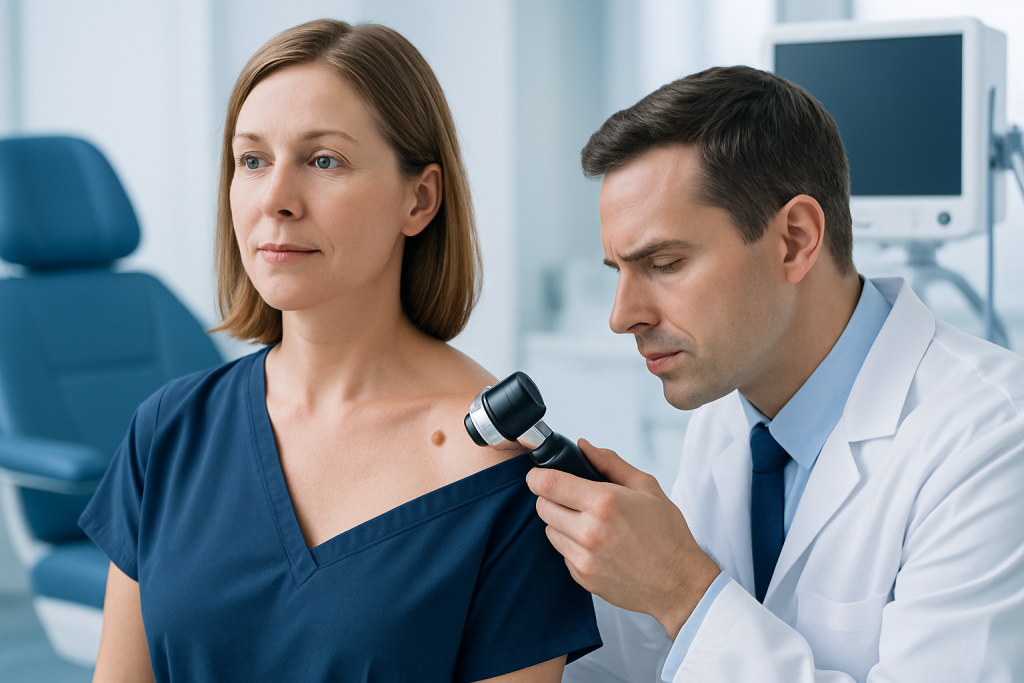
Diagnosis usually begins with a hands-on skin examination. A clinician will look at the growth’s size, color, surface, location, and whether it is attached by a narrow stalk or has a broader base. They may also ask how long it has been present, whether it has changed, and whether it has ever bled or become painful.
Dermatoscopy, also called dermoscopy, is often used to see surface and subsurface patterns that are not visible to the naked eye. This can help distinguish a benign skin tag from a lesion that needs removal or biopsy. If the growth looks atypical, if the diagnosis is uncertain, or if there are warning signs, a biopsy may be recommended.
A biopsy is the most reliable way to confirm the diagnosis because the tissue is examined under a microscope. For patients traveling from another country, this step may influence the whole care plan, since treatment decisions often depend on pathology results. In some cases, a clinician may remove the entire lesion at the same visit and send it for analysis.
Treatment Options
Treatment depends entirely on what the lesion is. A harmless skin tag may be removed for comfort, irritation, or cosmetic reasons using methods such as snip excision, freezing, cautery, or ligation. These are usually minor outpatient procedures, and the choice depends on the lesion’s size, location, and the clinician’s judgment.
If the growth is suspicious for cancer or is confirmed to be cancerous, treatment becomes condition-specific. This may involve wider surgical excision, Mohs micrographic surgery for certain skin cancers, or additional evaluation if there is concern about deeper spread. The treatment plan is individualized rather than one-size-fits-all.
Patients who are coordinating care from abroad may benefit from a treatment sequence that includes diagnosis, pathology review, procedure planning, and follow-up arranged before travel. In that setting, multidisciplinary specialists can help ensure that the lesion is fully assessed and that recovery instructions are clear before the patient returns home.
Prevention and Self-care
There is no proven way to prevent every skin growth, but there are practical steps that support early detection and skin health. Regular self-checks in good light can help a person notice new spots or changes in existing ones. It is especially useful to look at commonly missed areas such as the back, scalp, behind the ears, and the folds of the body.
Sun protection remains one of the most useful habits for lowering skin cancer risk. Wearing protective clothing, using broad-spectrum sunscreen as directed on the label, seeking shade during peak sun hours, and avoiding tanning beds all support healthier skin over time.
If a person already has a lesion that may be a skin tag, avoiding picking, twisting, or trying to remove it at home is wise. Home removal can cause bleeding, infection, scarring, or delay in diagnosing a more serious condition. Any growth that does not behave like a typical skin tag should be professionally evaluated.
When to See a Doctor
Medical review is recommended whenever a skin growth is new, changing, bleeding, painful, or visually unusual. This is especially true if the lesion does not look like the person’s other skin tags or if it sits in an area exposed to repeated sun. Even when the concern turns out to be minor, an examination can provide reassurance and prevent unnecessary worry.
People should also seek evaluation sooner if they have a personal history of skin cancer, a weakened immune system, or a lesion that has recurred after removal. If the growth is on the eyelid, genital area, face, or another sensitive location, a clinician’s assessment is particularly helpful because treatment choices may differ.
Acibadem Health Point’s multidisciplinary specialists and JCI-accredited hospitals diagnose and treat skin conditions and skin cancers for international patients, with care planning that can include pathology review and follow-up coordination. If a growth seems unusual, prompt medical assessment is the right next step rather than watchful guessing.
Living With a New Diagnosis
Hearing that a skin growth is not a simple skin tag can be unsettling, but the next steps are usually straightforward once the diagnosis is clear. Many suspicious lesions are removed completely with a minor procedure, and when a skin cancer is found early, treatment is often highly effective. The key is not to delay evaluation.
For patients who are considering treatment abroad, it helps to organize records, photographs of the lesion if available, and any prior biopsy reports before traveling. Clear communication about medications, allergies, healing time, and the need for follow-up will make the experience smoother and reduce surprises after returning home.
With prompt assessment and the right plan, most people can move from uncertainty to a clear diagnosis and practical next steps. A small skin change may not be serious, but it always deserves the respect of a proper medical look.
Frequently asked questions
01Can a skin tag turn into cancer?
A true skin tag is generally benign and does not turn into cancer. The more common issue is that a different lesion may look like a skin tag, which is why changing or unusual growths should be checked.
02What does a cancerous skin tag look like?
There is no standard medical diagnosis called a cancerous skin tag. A suspicious growth may look irregular, bleed, crust, change quickly, or have mixed colors, so it needs an in-person exam.
03Should every skin tag be removed?
No, many skin tags do not need treatment. Removal is usually considered if the tag is irritated, frequently rubbed, cosmetically bothersome, or if the diagnosis is uncertain.
04Do I need a biopsy for a suspicious skin tag?
A biopsy is sometimes needed when the diagnosis is unclear or when warning signs are present. It is the most reliable way to confirm whether a lesion is benign or cancerous.
05Can I remove a skin tag at home?
Home removal is not recommended because it can cause bleeding, infection, and scarring. It can also delay diagnosis if the growth is not actually a skin tag.
06When should I worry about a new bump on the skin?
A new bump should be assessed if it changes, bleeds, hurts, crusts, or looks different from your usual skin tags or moles. If in doubt, a dermatologist can evaluate it safely.
This article is for general information only and is not a substitute for professional medical advice. Please consult a qualified doctor about your individual situation.
Persistent digestive symptoms? Get evaluated in Turkey
JCI-accredited · board-certified surgeons · reply within 24h
Add us as a Preferred Source to see more of our trusted health content across Google Search, AI Overviews and Discover.