Unshaven FUE Hair Transplant: Candidates and Results
An unshaven Hair Transplant: Candidacy, Procedure Steps, and Recovery Timeline" class="ahp-ilk">FUE hair transplant removes and places individual follicular units while preserving much of the surrounding hair length. It may offer a more discreet early appearance for suitable candidates, but results still depend on donor supply, hair-loss pattern, surgical planning and long-term care.
Overview: What Is an Unshaven FUE Hair Transplant?
Unshaven follicular unit extraction (FUE), sometimes called no-shave FUE or long-hair FUE, is a hair transplant technique designed to preserve much of a person’s existing hair length during surgery. In standard FUE, a larger area of the donor scalp is usually trimmed short so individual follicular units can be removed. With an unshaven approach, the surgeon may trim only small, concealed sections in the donor area, leave the recipient area uncut, or selectively trim hairs depending on the treatment plan.
Follicular units are natural groupings of one to several hairs. During FUE, they are carefully extracted—most often from the back and sides of the scalp—and placed into tiny recipient sites in areas of thinning or baldness. The goal is to create a natural-looking distribution, direction and hairline while protecting the long-term donor supply.
The phrase “unshaven” can mean different things between clinics. It does not always mean that no hairs are trimmed at all. A clear preoperative discussion should explain exactly which areas may need clipping, how long the procedure may take and what can realistically be concealed immediately afterward.
Who May Be a Good Candidate?
A good candidate for unshaven FUE generally has a well-defined area of thinning, an adequate and stable donor area, and enough existing hair to make a discreet approach practical. This may include people seeking refinement of a hairline, restoration of a small crown area, filling of a scar, or added density in a limited region. Some people prefer it because they wish to return to work or social settings without a widely shaved scalp.
Suitability depends on more than hairstyle preferences. A clinician should examine hair caliber, donor density, scalp flexibility, the degree and pattern of hair loss, and the likelihood of future loss. Hair loss caused by androgenetic alopecia can continue over time, so a transplant plan should account for the possibility that surrounding non-transplanted hairs may thin later.
People with active scalp inflammation, uncontrolled medical conditions, certain bleeding risks, untreated nutritional deficiencies or unstable forms of hair loss may need assessment and treatment before surgery. Those with diffuse thinning throughout the donor region may not have enough safely usable grafts for the desired coverage.
Women and men can both be candidates, but the cause of thinning should be identified carefully. For example, diffuse hair shedding, traction-related loss and scarring alopecias may require different evaluation and treatment. A specialist may first investigate the underlying cause of hair loss before recommending transplantation.
When an Unshaven Approach May Not Be the Best Choice

Unshaven FUE can be technically more demanding than a fully shaved procedure. Longer surrounding hairs can make it harder to visualize follicles, separate grafts safely and place a large number of grafts efficiently. For extensive baldness or a session requiring many grafts, shaving a broader donor area may help the surgical team work more precisely and may shorten the procedure.
It may also be less practical for people with very short hairstyles, very curly or tightly coiled hair, marked scalp oiliness or skin conditions that make the donor area difficult to access. These factors do not automatically prevent treatment, but they can affect technique selection and the likelihood that trimmed areas can be hidden.
Importantly, a no-shave approach should not be chosen solely to avoid a temporary change in appearance. The safety of harvesting, graft quality and a conservative design should take priority over convenience. An experienced hair-restoration clinician can explain whether a partially shaved, fully shaved or unshaven plan is most appropriate for the individual.
How the Procedure Is Planned and Performed
Planning begins with a medical history, scalp examination and discussion of goals. The clinician evaluates the donor zone and estimates how many grafts can be removed without visibly over-thinning it. Hairline design is individualized and should consider facial proportions, age, current hair loss and the likely progression of future thinning. A lower or denser hairline is not always the most natural or sustainable choice.
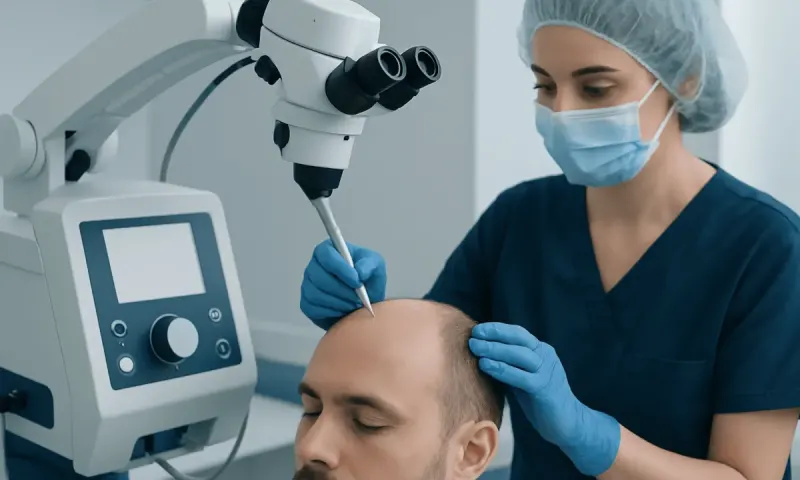
On the day of surgery, the scalp is usually cleaned and local anesthetic is used. In an unshaven procedure, selected donor follicles may be isolated through narrow trimmed strips or by working between longer hairs. A small punch instrument removes individual follicular units, which are then sorted and kept in conditions intended to protect them until placement.
The surgeon creates recipient sites at carefully selected angles and directions before the grafts are inserted. This stage strongly influences the eventual appearance, particularly at the front hairline and crown. The treatment may take several hours and, for larger plans, may be staged over more than one day.
FUE is one of several surgical options for restoring hair. The best technique depends on the person’s donor hair, scalp characteristics, desired coverage and preferences, rather than on whether one method is marketed as universally superior.
What Results Are Realistic?
Realistic results from an unshaven FUE transplant are similar to those from standard FUE when comparable graft quality, surgical planning and aftercare are used. The unshaven element mainly changes how the procedure is performed and how visible the short-term trimming may be; it does not guarantee denser growth or eliminate the normal recovery process.
Transplanted hairs often shed within the first weeks after surgery. This is a common part of the hair-growth cycle and does not necessarily mean the follicles have been lost. New growth usually begins gradually after several months, with the appearance continuing to mature over subsequent months. Curl pattern, hair shaft thickness, contrast between hair and skin, and the amount of existing hair all affect how full the result looks.
A transplant redistributes existing donor hair; it does not create new follicles or stop progressive hair loss. The available graft supply is limited, and a surgeon may recommend a conservative coverage strategy to preserve donor hair for possible future needs. Medical treatment may also be discussed to help protect existing, non-transplanted hair when appropriate.
No procedure can promise a specific density, hairline or final cosmetic outcome. A useful consultation includes discussion of likely coverage, the possibility of more than one session, potential ongoing hair loss and the difference between improving appearance and restoring the density of adolescence.
Recovery, Aftercare and Possible Side Effects
After FUE, small scabs, redness, swelling, tenderness and temporary numbness can occur in the donor or recipient areas. These effects are usually short-lived, although recovery varies. Even with long hair left in place, tiny extraction sites and crusting may be noticeable at close range during early healing. The clinic should provide written instructions tailored to the procedure.
Patients are commonly advised to avoid rubbing or picking at grafts, follow guidance for gentle washing, protect the scalp from direct sun exposure and avoid strenuous activity for the period recommended by their surgical team. Hair products, hats, exercise, swimming and coloring should be resumed only when the clinician confirms it is appropriate.
Possible complications include infection, bleeding, prolonged swelling, visible donor thinning, poor graft growth, scarring, altered sensation and an unnatural-looking growth pattern. These are not expected outcomes, but they should be discussed before consent. Contact the surgical team promptly for increasing pain, spreading redness, fever, pus-like drainage, persistent bleeding or other concerning symptoms.
For people travelling for care, it is particularly important to arrange appropriate follow-up and to allow enough time before travel if the treating team advises it. Acıbadem Health Point’s multidisciplinary specialists and JCI-accredited hospitals assess and treat hair-loss concerns for international patients.
Preparing for Consultation and Making a Safe Decision
Before deciding on unshaven FUE, individuals should ask who will perform each stage of the procedure, what method of donor assessment will be used, whether their hair loss appears stable and how future thinning will be managed. They should also disclose medications, smoking or nicotine use, allergies, prior scalp procedures and any history of abnormal scarring or bleeding.
Photographs can help document the baseline and support realistic planning, but they should be interpreted cautiously. Lighting, hair styling, hair length and camera angle can dramatically change the appearance of density. A reputable clinician should discuss both the benefits and limitations of surgery rather than promising a particular result.
Non-surgical measures may be appropriate before or alongside transplantation, depending on the diagnosis. These can include treatment of scalp disease, correction of contributing medical issues and clinician-guided therapies for pattern hair loss. A person should avoid unregulated products or treatment packages that make guaranteed claims.
- Seek assessment from a qualified clinician experienced in hair and scalp disorders.
- Ask whether the proposed graft number is compatible with long-term donor preservation.
- Discuss the expected appearance during the first weeks as well as the longer growth timeline.
- Make a follow-up plan before scheduling surgery, especially if travelling.
Frequently asked questions
01Is unshaven FUE completely shave-free?
Not always. In many cases, small areas of donor hair are trimmed and concealed beneath longer surrounding hair. The amount of trimming needed depends on the number of grafts, the hair type and the surgeon’s technique.
02Does unshaven FUE produce better results than regular FUE?
The expected biological result is not inherently better simply because hair is left longer. Natural-looking growth depends more on donor quality, graft handling, placement design, the cause of hair loss and appropriate aftercare.
03How long does it take to see growth after an unshaven FUE transplant?
The transplanted hairs may shed in the early weeks, which is commonly expected. New growth generally starts gradually after several months, and the appearance continues to develop over the following months.
04Can unshaven FUE treat a large bald area?
It can be used in selected cases, but large areas often require many grafts and may be more practical to treat with a partially or fully shaved approach. The donor supply may also limit how much coverage can be achieved in one session.
05Will a hair transplant stop future hair loss?
No. A transplant moves follicles into thinning areas but does not prevent non-transplanted hairs from continuing to thin. A clinician may discuss medical or supportive treatments to help manage ongoing pattern hair loss when appropriate.
06Is unshaven FUE suitable for women?
Some women may be suitable candidates, particularly when hair loss is localized and donor density is good. However, diffuse thinning is common in women and should be evaluated carefully to confirm that transplantation is appropriate.
This article is for general information only and is not a substitute for professional medical advice. Please consult a qualified doctor about your individual situation.
Hair transplant in Turkey — costs, graft counts & a free assessment
JCI-accredited · board-certified surgeons · reply within 24h
Add us as a Preferred Source to see more of our trusted health content across Google Search, AI Overviews and Discover.