

Shoulder Joint Articulations: Anatomy and Function
- 11 min read
- Published November 28, 2026
Key Takeaways
- The shoulder is a complex joint system, not a single hinge, and its mobility depends on several articulations working together.
- Pain, weakness, clicking, or limited range of motion can come from muscles, tendons, ligaments, cartilage, or the joint surfaces themselves.
- Diagnosis usually combines a physical examination with imaging when needed, especially if trauma, instability, or persistent symptoms are present.
- Treatment often starts with rest, activity modification, medication guidance, physiotherapy, and sometimes injections or surgery depending on the cause.
- Good posture, gradual strengthening, and protecting the shoulder during recovery can support long-term function.
- People traveling for care can benefit from coordinated orthopedic assessment, imaging, rehabilitation planning, and follow-up before returning home.
Shoulder joint articulations allow the arm to move with remarkable range, but that mobility also makes the shoulder vulnerable to pain, stiffness, and instability. Understanding how the joint is built and how it is evaluated can help patients make informed choices about care and recovery.
Overview
The shoulder is often described as the body’s most mobile joint, but that description only tells part of the story. What people call the shoulder is actually a coordinated group of articulations, soft tissues, and muscle mechanics that work together to place the arm in nearly every direction.
The main joint, the glenohumeral joint, links the ball-shaped head of the upper arm bone to the shallow socket of the shoulder blade. This design favors motion over stability, so other structures step in to keep the joint centered during reaching, lifting, pushing, and throwing. The collarbone joints, the shoulder blade’s sliding motion over the rib cage, and the surrounding tendons all contribute to smooth movement.
Because so many parts share the workload, shoulder problems are not always caused by one structure alone. A patient may feel pain in the front of the shoulder, weakness overhead, or a catching sensation, yet the source may involve the rotator cuff, the labrum, the joint capsule, the acromioclavicular joint, or a combination of these. For patients planning evaluation abroad, that complexity is one reason a careful orthopedic examination matters before any treatment is chosen.
How the shoulder articulations work
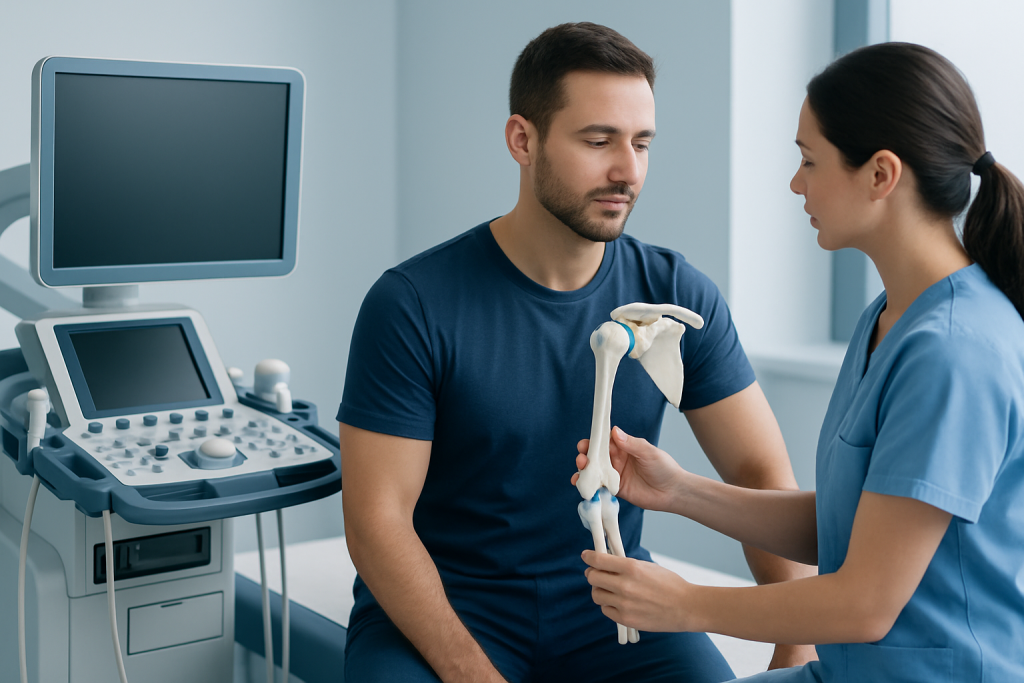
The shoulder is made up of several important articulations. The glenohumeral joint is the best known, but it does not function in isolation. The acromioclavicular joint connects the collarbone to the top of the shoulder blade, while the sternoclavicular joint anchors the collarbone to the chest. The scapulothoracic “articulation” is not a true joint, yet the shoulder blade’s movement across the rib cage is essential for overhead motion.
These parts create a rhythm called scapulohumeral motion, in which the shoulder blade and upper arm move in a coordinated way. The rotator cuff muscles and their tendons keep the arm bone aligned within the socket, while ligaments and the joint capsule provide restraint. Cartilage and the labrum help with cushioning and stability, especially during rotation and elevation of the arm.
When any one part becomes irritated, the entire system can feel affected. For example, a problem in the acromioclavicular joint may hurt when reaching across the body, while a rotator cuff injury may make it difficult to lift the arm or sleep on the affected side. Understanding this shared mechanics helps patients make sense of symptoms that may seem unrelated at first.
Symptoms

Shoulder joint problems can feel different from one person to another, but several patterns appear often. Pain may be sharp during movement, dull at rest, or worse at night. Some people notice stiffness when dressing, combing hair, or reaching into a cabinet, while others describe weakness or an unstable, “slipping” feeling.
Clicking, grinding, or catching can occur when surfaces are irritated or when tissues are not gliding smoothly. Swelling or tenderness may appear after injury, and bruising can follow a fall or direct blow. In some cases, neck pain or tingling in the arm can accompany shoulder symptoms, which is why a clinician usually evaluates the whole region rather than the joint alone.
- Pain with overhead activity or reaching behind the back
- Reduced range of motion
- Weakness, especially when lifting the arm
- Night pain that disrupts sleep
- Feeling that the shoulder is loose or may dislocate
- Visible deformity after trauma in some cases
Persistent or worsening symptoms deserve attention, especially if they interfere with work, driving, exercise, or daily self-care. Early assessment can prevent a temporary irritation from becoming a longer recovery.
Causes & risk factors
Shoulder symptoms may develop gradually from overuse or appear suddenly after an injury. Repetitive overhead activity, heavy lifting, poor mechanics during sport, and prolonged desk posture can all contribute to irritation of the tendons or joints. In other cases, age-related wear affects the cartilage or the rotator cuff over time.
Common causes include rotator cuff tendinopathy or tear, impingement-type pain, frozen shoulder, labral injury, arthritis of the shoulder or acromioclavicular joint, bursitis, and dislocation or subluxation. Some problems are linked to a single event, such as a fall onto an outstretched arm, while others reflect cumulative strain. People with previous shoulder injury may also be more likely to experience recurrent symptoms.
Risk can be higher in athletes who throw, swim, or play racket sports, as well as in manual workers who lift or reach repeatedly. Diabetes, thyroid disorders, and smoking may influence healing in some shoulder conditions. For international patients considering treatment, it is helpful to bring prior imaging, surgical reports, and a clear timeline of symptoms, because these details often shape the orthopedic plan.
Diagnosis
Diagnosis begins with a detailed history and physical examination. A clinician will usually ask when the pain began, which motions worsen it, whether there was a fall or dislocation, and how symptoms affect sleep and daily tasks. Exam maneuvers help assess strength, range of motion, tenderness, instability, and whether the pain appears to come from the shoulder, neck, or both.
Imaging may be used when the cause is unclear or when injury is suspected. X-rays can show fractures, joint alignment, and arthritis. Ultrasound may help evaluate tendons and guide some treatments, while MRI provides more detail about soft tissues such as the rotator cuff, labrum, and cartilage. In selected cases, additional tests may be recommended if nerve involvement or other conditions are suspected.
Patients traveling for assessment often benefit from a stepwise diagnostic approach, since it can reduce unnecessary tests and focus care on the most relevant problem. A good orthopedic plan also considers whether rehabilitation can begin immediately, whether surgery is likely to help, and how follow-up will be arranged after returning home.
Treatment options
Treatment depends on the cause, severity, and duration of symptoms. Many shoulder problems improve with conservative care first. Rest from aggravating activities, ice or heat as advised, and short-term pain-relief strategies may reduce symptoms while the tissue settles. A clinician may also recommend anti-inflammatory medication or other pain control based on the patient’s overall health and medical history.
Physiotherapy is often central to recovery. A structured program may focus on restoring range of motion, strengthening the rotator cuff and scapular muscles, improving posture, and correcting movement patterns that overload the joint. This is especially important for patients whose symptoms started gradually, because the shoulder often recovers best when mobility and control are rebuilt together.
Some patients may need injections for inflammation or pain control, depending on the diagnosis. Surgical treatment is considered when there is a major tear, recurrent dislocation, significant arthritis, or symptoms that do not improve with non-surgical care. Procedures may include arthroscopy, tendon repair, stabilization, or joint replacement in advanced arthritis. For patients who travel for care, the treatment plan should also include practical details such as length of stay, rehabilitation milestones, and the timing of follow-up after discharge.
Prevention & self-care
Not every shoulder problem can be prevented, but the joint often does better when it is used with balance rather than force alone. Gradual training, warm-up before sport, and attention to technique can reduce strain on the articulations and surrounding soft tissues. For office workers, regular posture changes and avoiding long periods with the shoulders rolled forward may be helpful.
At home, self-care usually focuses on protecting the joint without letting it become completely inactive. Gentle range-of-motion exercises, once approved by a clinician, can help limit stiffness. Strengthening should progress slowly, especially after an injury or procedure, because pushing too quickly may provoke symptoms again.
- Use proper lifting mechanics and avoid sudden overload
- Keep the shoulder blade muscles active through guided exercise
- Break up repetitive overhead tasks when possible
- Follow rehabilitation instructions even after pain begins to ease
- Return to sport or heavy work only after clearance when needed
Patients recovering away from home may want a written rehabilitation plan and clear communication about which symptoms are expected and which should be reported. That kind of preparation can make recovery more confident and less disruptive.
When to see a doctor
Medical evaluation is advisable when shoulder pain lasts more than a short period, keeps returning, or limits routine activities. It is also important after a fall, sports injury, or any event that causes visible deformity, major weakness, or the feeling that the shoulder has dislocated. Early assessment can help identify whether the problem is a tendon injury, joint injury, or another condition that benefits from targeted treatment.
Prompt care is especially important if the arm becomes numb, very weak, or increasingly swollen, or if there is severe pain with inability to move the shoulder. Symptoms that follow fever, redness, or a recent procedure also warrant attention, as infection or another complication may need urgent evaluation. Even when symptoms are not dramatic, a persistent loss of motion deserves review because shoulder stiffness can become harder to reverse over time.
For international patients, choosing an orthopedic team that can coordinate diagnosis, imaging, rehabilitation, and follow-up in one pathway may simplify the process considerably. At Acibadem Health Point, multidisciplinary specialists and JCI-accredited hospitals diagnose and treat shoulder conditions for international patients with coordinated care and clear planning.
Living well with a shoulder condition
Shoulder problems often improve when treatment is matched to the underlying structure that is affected. The key is not simply to “push through” pain, but to restore function in a controlled way so the joint can move freely without becoming unstable or overloaded. That balance is different for each diagnosis, which is why personalized assessment is so valuable.
Recovery may take time, especially if the shoulder has been painful for months or if surgery is needed. Patients generally do better when they understand the reason for each exercise, activity restriction, or follow-up visit. Clear guidance also helps international patients plan travel, work absence, and rehabilitation support once they return home.
With the right diagnosis and a realistic treatment plan, many people regain comfortable use of the shoulder and return to normal activities. The shoulder’s anatomy is complex, but effective care becomes much more straightforward when the problem is identified early and managed thoughtfully.
Frequently asked questions
01What are shoulder joint articulations?
Shoulder joint articulations are the connected joints and movement interfaces that allow the arm and shoulder blade to move together. The main one is the glenohumeral joint, but the acromioclavicular, sternoclavicular, and scapulothoracic motions also matter. These parts work as a system, which is why shoulder symptoms can come from more than one structure.
02Why does the shoulder get painful so easily?
The shoulder is designed for mobility, so it sacrifices some stability to achieve a wide range of motion. That makes tendons, ligaments, and muscles work hard to keep the joint aligned. Pain can appear when those structures are irritated, overloaded, injured, or inflamed.
03Can shoulder pain go away without surgery?
Many shoulder conditions improve without surgery, especially when symptoms are caught early. Rest from the provoking activity, physiotherapy, and other conservative treatments may be enough. Surgery is usually reserved for significant tears, repeated dislocations, advanced arthritis, or cases that do not respond to non-surgical care.
04What tests are usually used to diagnose a shoulder problem?
A doctor usually starts with a physical examination and questions about the injury or symptom pattern. X-rays, ultrasound, or MRI may be used when more detail is needed. The choice of test depends on whether the concern is bone, tendon, cartilage, or instability.
05How long does shoulder recovery take?
Recovery time depends on the exact diagnosis and whether treatment is conservative or surgical. A mild strain may improve relatively quickly, while tendon repair, stabilization, or stiffness-related conditions can take longer. A clinician or physiotherapist can give a more realistic timeline after assessment.
06When should a person seek urgent care for shoulder symptoms?
Urgent evaluation is important after a major injury, visible deformity, suspected dislocation, or inability to move the arm. Numbness, major weakness, severe swelling, fever, or redness also need prompt medical attention. These signs can indicate problems that should not wait.
This article is for general information only and is not a substitute for professional medical advice. Please consult a qualified doctor about your individual situation.
Joint and spine care in Turkey — expert assessment & treatment
JCI-accredited · board-certified surgeons · reply within 24h
Add us as a Preferred Source to see more of our trusted health content across Google Search, AI Overviews and Discover.


How can we help you today?
Meet an Acibadem specialist by secure video, before you travel.
Book a video visit