Robotische FUE Artas Kliniek Nederland: What You Need to Know

Key Takeaways
- Robotic FUE with ARTAS is a tool-assisted hair transplant technique, not a standalone treatment.
- It is usually considered for selected adults with stable pattern hair loss and enough donor hair.
- A careful medical assessment matters more than the technology label on its own.
- Recovery is usually gradual, with transplanted hairs shedding before new growth starts.
- Long-term planning may be needed because untreated hair loss can continue in other areas.
Robotische FUE met het ARTAS-systeem is a robotic-assisted hair transplant approach that may help selected patients with pattern hair loss. For people searching for a robotische FUE ARTAS kliniek in Nederland, the most important questions are whether they are a good candidate, how experienced the team is, and what realistic results look like.
Overview
In a modern care journey, the technology may be impressive, but the treatment plan should remain personal. That includes understanding whether the patient needs surgery now, later, or not at all, and whether non-surgical options should be used first or alongside transplantation.
How robotic FUE with ARTAS works
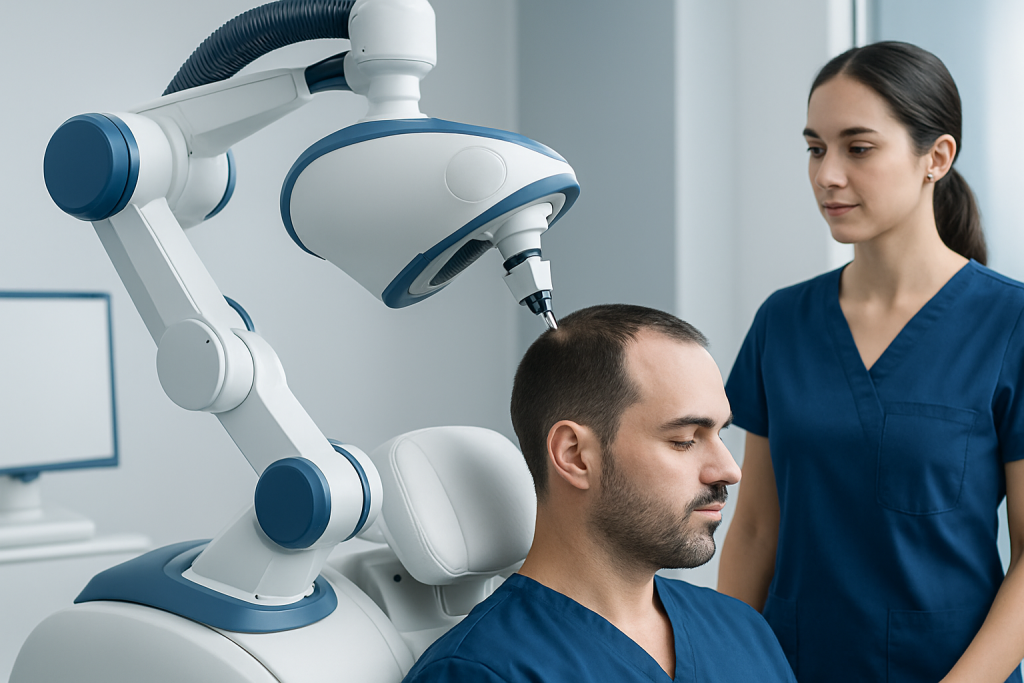
FUE means removing individual follicular units, usually from the back and sides of the scalp, rather than taking a strip of tissue. With ARTAS, a robotic system assists the surgeon in identifying and harvesting grafts based on imaging and programmed parameters. The goal is to improve consistency in graft selection and reduce some of the manual workload during the harvesting phase.
The procedure still requires a qualified surgical team. The doctor decides whether the donor area is suitable, plans the extraction pattern, monitors the process, and handles the design and placement of the grafts. In other words, the robot can assist, but it does not replace clinical expertise or aesthetic judgment.
Patients may hear the term “robotic hair transplant” and assume the device performs the entire operation. That is not accurate. It is a surgical procedure performed by trained professionals, with the robotic component helping at specific stages. The same principles of sterile technique, careful graft handling, and sensible surgical planning still apply.
Because the method depends on the donor area’s characteristics, not everyone with hair thinning is an ideal candidate. Hair type, scalp laxity, contrast between hair and skin, and the pattern of loss all influence whether the system may be suitable.
Symptoms and who may consider treatment

People usually consider robotic FUE after noticing visible thinning, a receding hairline, widening at the crown, or a general loss of density that affects styling confidence. Some patients also seek treatment after hair loss stabilizes following a medical cause, while others want to correct scarring in carefully selected cases.
The best candidates are often adults with pattern hair loss that has been medically assessed and is reasonably stable. A good donor area is essential, because transplanted hairs are taken from there. If the donor area is already weak or diffuse thinning is present, surgery may not provide the coverage the patient expects.
It is also important to distinguish between hair loss that can benefit from transplantation and hair loss that needs medical treatment first. Active inflammatory scalp disease, untreated hormonal issues, nutritional deficiencies, or certain autoimmune conditions may need attention before surgery is even discussed.
- Gradual recession at the temples or hairline
- Thinning at the crown or mid-scalp
- Noticeable decrease in hair density
- Hair loss that affects self-image or styling options
- Stable donor area suitable for harvesting
For patients traveling from abroad, the initial question should not be “Can I have ARTAS?” but “Is this hair loss pattern appropriate for surgical restoration, and what is the safest sequence of care?”
Causes and risk factors
The most common reason people seek FUE hair transplantation is androgenetic alopecia. This inherited pattern of hair loss gradually miniaturizes hair follicles over time, leading to thinner strands and less coverage. Because it often continues slowly over the years, surgical planning has to anticipate future loss, not only the current appearance.
Other causes of thinning may include traction on the hair, certain medications, stress-related shedding, thyroid disorders, iron deficiency, scalp inflammation, and autoimmune hair loss conditions. These causes are not all treated in the same way, and transplantation may be inappropriate if the condition is active or not fully understood.
Risk factors for poorer outcomes include limited donor hair, unrealistic expectations, smoking, poor wound healing, uncontrolled medical illness, and a history of keloid scarring in some patients. Age is less important than stability of the loss pattern and overall medical suitability.
A trustworthy consultation should identify what is causing the thinning, what is still changing, and how much donor hair can be used without compromising future coverage. This is especially important for patients who are arranging care from another country and may only have a short window for surgery and follow-up.
Diagnosis and treatment planning
Before any transplant is scheduled, the hair loss should be evaluated by a clinician experienced in scalp disorders and hair restoration. The assessment often includes a medical history, scalp examination, review of family history, and sometimes blood tests or trichoscopy, which is a magnified inspection of the scalp and hair shafts.
Planning focuses on the diagnosis, donor density, recipient area, and the long-term strategy. A clinic may discuss whether medication, topical therapy, or treatment for an underlying condition should start before surgery. In some cases, a staged approach is safer and more effective than trying to do everything at once.
Patients should expect discussion of the hairline shape, expected density, graft numbers in broad terms, likely recovery time, and the possibility that future sessions may be needed. A careful plan is usually more valuable than a promise of quick transformation.
For international patients, this stage also includes practical details: whether remote pre-assessment is possible, how many days are needed on site, what follow-up can be done locally, and which symptoms after surgery would require contact with the treating team.
Treatment options
Robotic FUE with ARTAS is one option within a broader hair restoration toolkit. It may be chosen because the robotic system can assist with harvesting individual grafts in a highly structured way. However, the visible result depends equally on the surgeon’s artistic placement of grafts and the overall treatment plan.
Other options may include manual FUE, follicular unit transplantation using a strip method, medical treatment for hair loss, camouflage techniques, or a combination of approaches. In many cases, a patient benefits from more than one strategy over time, especially if ongoing hair loss is expected.
During the procedure, local anesthesia is commonly used. After donor harvesting, the grafts are prepared and placed into the thinning areas according to the design plan. Recovery often includes scalp tenderness, temporary redness, and scabbing, which gradually settle.
Possible benefits of robotic FUE may include:
- Individual graft harvesting without a long linear scar
- Consistent assistance during donor extraction
- Potentially shorter manual harvesting time in selected cases
- Natural-looking results when planning and placement are well executed
Even so, robotic FUE is not automatically better for every patient. Some scalps and hair types are more suitable for manual techniques, and the surgeon should explain why one method is preferred over another.
Prevention, self-care, and recovery
Hair transplantation does not prevent future hair loss in untreated areas, so long-term self-care remains important. If a clinician recommends medication or scalp treatment to slow ongoing thinning, that plan is often part of protecting the result. Patients should follow the aftercare instructions they are given, because early healing affects graft survival and comfort.
Typical recovery advice may include sleeping with the head elevated for a short period, avoiding rubbing or scratching the scalp, protecting the area from sun exposure, and postponing strenuous exercise for the recommended time. Washing instructions are usually specific and should be followed closely.
Visible changes happen gradually. Many patients notice shedding of transplanted hairs in the early weeks, which can be normal. New growth typically appears later, and final cosmetic improvement takes time. This timeline can be frustrating for patients who want immediate density, so honest expectation-setting is essential.
Healthy habits support healing, including good nutrition, adequate hydration, and avoiding smoking. If the patient has travel plans, the timing of flights, hotel stays, and clinic reviews should be arranged so that early follow-up is realistic and safe.
When to see a doctor
Medical advice is appropriate whenever hair loss is sudden, patchy, painful, itchy, inflamed, or accompanied by scalp scaling or other skin changes. Those patterns may point to conditions that need diagnosis before any transplant is considered. Even gradual hair loss deserves evaluation if the cause is unclear.
A doctor should also be seen if thinning is affecting emotional well-being or if over-the-counter products have not helped. The earlier the cause is identified, the more treatment options may remain available. In some cases, surgery becomes part of the plan later, after the hair loss has been stabilized.
Patients considering travel for robotic FUE should seek a consultation that feels medically grounded, not sales-driven. It should include candid discussion of candidacy, donor limits, future hair loss, and the need for follow-up. Acibadem Health Point’s multidisciplinary specialists and JCI-accredited hospitals diagnose and treat hair loss and transplant cases for international patients within a coordinated care setting.
If a person is unsure whether robotic FUE is right for them, the safest next step is a hair-loss assessment with a qualified dermatologist or hair-restoration surgeon. That conversation can clarify whether ARTAS-assisted FUE, another procedure, or non-surgical management is the most appropriate path.
A practical view for patients comparing clinics in the Netherlands and abroad
When comparing a robotische fue artas kliniek in Nederland with options abroad, the best comparison is not only the device used. It is the quality of the evaluation, the experience of the surgical team, how carefully the hairline is designed, and whether the clinic gives realistic expectations about density and future loss.
Patients should ask who performs each step of the procedure, how the donor area is protected, what happens if the plan changes during surgery, and how follow-up is handled after travel. A transparent team will answer these questions clearly and without pressure.
For many people, the most reassuring clinic is the one that explains when surgery is appropriate and when it is not. That kind of honesty is often the strongest sign of good hair-restoration medicine.
Frequently asked questions
01What is robotic FUE with ARTAS?
Robotic FUE with ARTAS is a hair transplant method that uses a robotic system to assist with harvesting follicular units from the donor area. The surgeon still makes the medical decisions, designs the transplant, and places the grafts. It is best understood as a technology-assisted version of FUE, not a separate cure for hair loss.
02Is ARTAS suitable for everyone with hair loss?
No. It is usually considered for selected adults with stable pattern hair loss and a healthy donor area. People with active scalp disease, diffuse thinning, or unclear causes of shedding may need other treatment first.
03What should a patient ask a clinic before choosing robotic FUE?
They should ask who performs the procedure, whether they are a suitable candidate, how the donor area is assessed, and what results are realistic. It is also helpful to ask about follow-up, the recovery timeline, and whether non-surgical treatment should be part of the plan.
This article is for general information only and is not a substitute for professional medical advice. Please consult a qualified doctor about your individual situation.
Hair transplant in Turkey — costs, graft counts & a free assessment
JCI-accredited · board-certified surgeons · reply within 24h
Add us as a Preferred Source to see more of our trusted health content across Google Search, AI Overviews and Discover.