Lens Replacement vs LASIK: Which Fits Your Eyes?
Lens replacement vs LASIK is not a one-size-fits-all decision. LASIK reshapes the cornea and is often considered for suitable younger adults, while lens replacement removes the natural lens and may better address age-related near-vision loss or early lens clouding.
Lens Replacement vs LASIK: the key differences
Lens replacement vs LASIK comes down to which part of the eye is treated. LASIK uses a laser to reshape the clear front surface of the eye, called the cornea. Lens replacement, also called refractive lens exchange, removes the natural lens and inserts a clear artificial lens, known as an intraocular lens (IOL).
For many adults with a stable prescription and healthy corneas, LASIK may be an appropriate way to correct short-sightedness, long-sightedness or astigmatism. Lens replacement is more often discussed when the natural lens is becoming less flexible with age, when reading vision is worsening, or when early cataract changes are present. The right choice depends on the individual eye rather than on a preferred procedure.
| Feature | LASIK | Lens replacement |
|---|---|---|
| Area treated | Cornea | Natural eye lens |
| How vision is corrected | Laser reshapes corneal curvature | An IOL replaces the natural lens |
| Typical consideration | Stable prescription and suitable cornea | Presbyopia, high prescriptions, lens changes or cataract risk |
| Effect on future cataracts | Does not prevent cataracts | Natural lens is removed, so a cataract cannot later form in that lens |
| Near vision with age | Reading glasses may still be needed | Can be planned with lens options intended to support distance, intermediate or near vision |
| Type of procedure | Laser procedure on the eye surface | Intraocular surgery |
How a clinician tells LASIK and lens replacement apart
An ophthalmologist begins by identifying the source of the person’s visual difficulty. A refractive error occurs when the eye does not focus light precisely on the retina. LASIK may correct this by changing the corneal shape. By contrast, presbyopia is the gradual loss of the natural lens’s ability to focus at close range, and it cannot be fully solved by simply reshaping the cornea.
The assessment generally includes a current prescription, a check that the prescription has been stable, corneal thickness and mapping, pupil size, tear-film evaluation, eye pressure, and a dilated examination of the lens and retina. The clinician also asks about night driving, computer work, sports, reading needs and expectations around glasses.
Some findings may make either procedure less suitable or require treatment first. Examples include uncontrolled dry eye, corneal disorders, active eye inflammation, glaucoma that needs careful management, significant retinal disease or an unstable prescription. People with diabetes, autoimmune conditions or previous eye surgery need an individualized assessment because these factors can affect healing and outcomes.
Should I get LASIK or lens replacement?
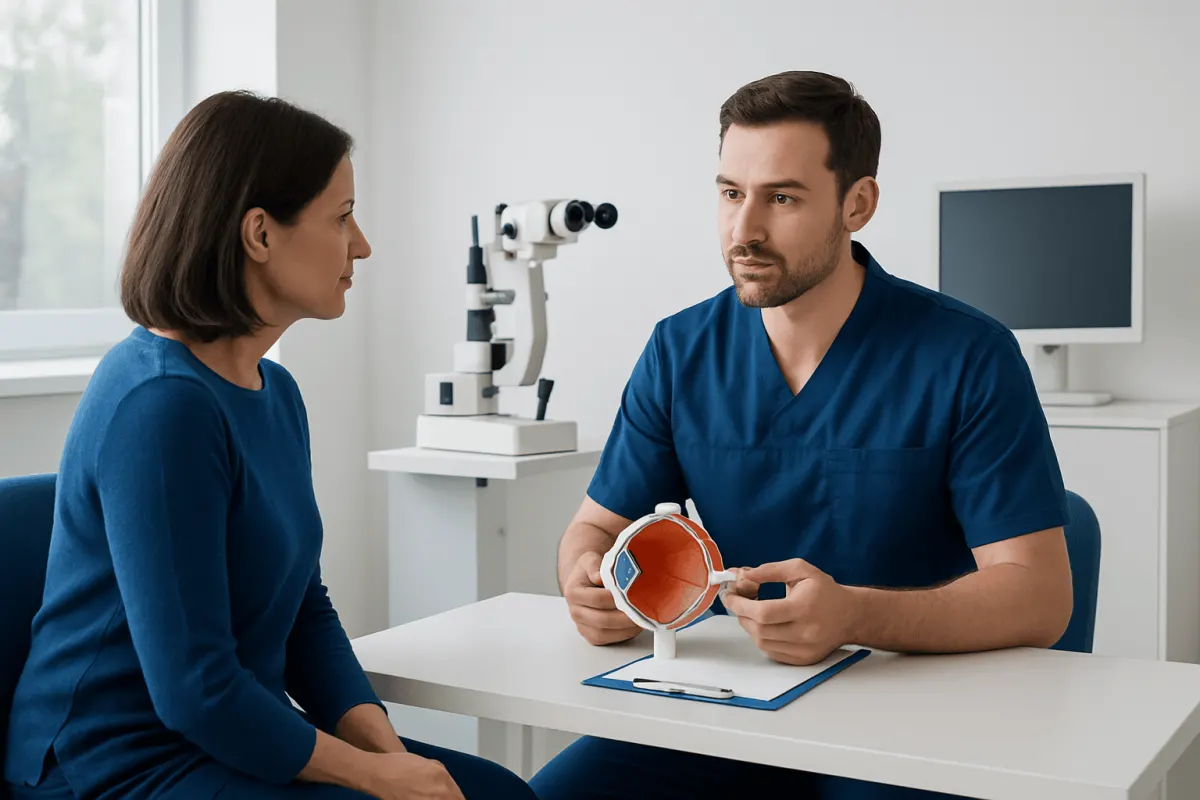
LASIK may be considered when an adult has a stable glasses or contact lens prescription, healthy corneas, manageable dry-eye symptoms and realistic expectations. It is commonly used to address myopia, hyperopia and astigmatism. A person should understand that LASIK changes the cornea but does not stop the natural lens from aging.
Lens replacement may be more suitable for someone whose main concern is age-related difficulty reading, who has early lens clouding, or who has a prescription that is less well suited to corneal laser correction. It may also be discussed for selected people with high long-sightedness or high short-sightedness, depending on eye anatomy and retinal health.
The decision also depends on visual priorities. Monofocal IOLs are usually designed for one main focal distance and may still require glasses for other tasks. Multifocal or extended-depth-of-focus lenses may reduce spectacle dependence for some activities, but can cause visual phenomena such as glare or halos in certain people. A clinician should explain these trade-offs before refractive lens exchange or LASIK is chosen.
At what age is LASIK not worth it?
There is no fixed age at which LASIK automatically stops being worthwhile. Rather, its value changes as the natural lens loses flexibility, usually beginning in the 40s. A person may see well at distance after LASIK yet still need reading glasses because presbyopia continues to develop.
For people in their late 40s, 50s or beyond, an eye specialist considers whether laser correction would meet their long-term needs or whether a lens-based approach would be more practical. If cataract changes are developing, lens replacement or cataract surgery may be a more durable option because the cloudy lens is addressed directly.
Age is only one part of the assessment. A healthy person in their 50s may still be a candidate for LASIK in selected circumstances, while a younger person may not be suitable because of thin or irregular corneas, unstable refraction or other eye-health concerns. The decision should follow a complete ophthalmic examination, not an age cut-off alone.
What is the downside of lens replacement?
The main downside of lens replacement is that it is surgery inside the eye. Although modern cataract and lens surgery is widely performed, it has potential complications, including infection, inflammation, raised eye pressure, retinal swelling, retinal detachment in susceptible eyes, lens-position problems and a remaining need for glasses. These risks are uncommon but important to discuss in relation to a person’s own eye health.
Lens choice requires compromise. Some people with multifocal or extended-depth-of-focus lenses notice halos, glare or reduced contrast, particularly in low light. Others may prefer monofocal lenses because they often provide clearer quality at one chosen distance, accepting that glasses may be needed for reading or other tasks.
After surgery, some people develop clouding of the capsule behind the artificial lens. This is not a new cataract; it is often called posterior capsule opacification and can usually be treated with a brief laser procedure if it affects vision. Lens replacement also does not prevent unrelated eye conditions, including glaucoma or retinal disease.
What to expect from each procedure and recovery
LASIK is usually performed as an outpatient procedure. The surgeon creates a thin corneal flap or uses a flap-free laser method in some cases, then reshapes the corneal tissue to alter focusing power. Vision often improves quickly, but fluctuating vision, light sensitivity, glare and dry-eye symptoms may occur during recovery. Follow-up visits help monitor healing.
Lens replacement is also commonly performed as outpatient surgery, generally one eye at a time. Through a small incision, the surgeon removes the natural lens and places an IOL. Vision can take time to settle, particularly when both eyes are treated on separate days or when the brain is adapting to a multifocal lens design.
Both procedures require careful use of prescribed eye drops and avoidance of eye rubbing, swimming or contaminating the eyes during the early healing period. Follow-up care is essential. People should contact their eye team promptly if they develop increasing pain, marked redness, a sudden fall in vision, flashes, a shower of new floaters or a curtain-like shadow in their visual field.
What eye surgery did Taylor Swift get?
Public reports have stated that Taylor Swift had LASIK eye surgery in 2019, and she discussed the experience publicly. However, a celebrity’s procedure is not medical guidance and does not indicate which treatment is appropriate for another person.
Suitability for LASIK, lens replacement or another vision-correction option depends on a detailed eye examination and personal visual needs. Public information about an individual’s treatment may also be incomplete, so it should not be used to make assumptions about results, recovery or candidacy.
Anyone considering surgery should focus on their own prescription, eye anatomy, ocular surface health and lifestyle. An ophthalmologist can explain whether a corneal procedure, lens procedure, glasses or contact lenses offers the most appropriate balance of benefit and risk.
When to seek medical care
Anyone considering vision correction surgery should arrange a comprehensive consultation with an ophthalmologist rather than relying on age, prescription alone or online screening tools. A prompt assessment is particularly important if vision has changed suddenly, one eye sees differently from the other, or contact lenses have become unexpectedly uncomfortable.
Urgent eye care is needed for sudden loss of vision, severe eye pain, increasing redness, flashes of light, a sudden increase in floaters, or a dark curtain or shadow across vision. These symptoms can have causes unrelated to LASIK or lens replacement but should be assessed without delay.
Acıbadem Health Point’s multidisciplinary ophthalmology specialists at JCI-accredited hospitals assess refractive errors, lens health and other eye conditions for international patients. A consultation can help clarify whether laser vision correction, laser eye surgery, lens replacement or non-surgical correction is most appropriate.
Frequently asked questions
01Is lens replacement safer than LASIK?
Neither procedure is universally safer because they involve different parts of the eye and suit different clinical situations. LASIK is a corneal procedure, while lens replacement is intraocular surgery with its own potential risks. An ophthalmologist can explain which option has the more favorable benefit-risk balance for an individual.
02Can LASIK correct reading vision?
LASIK can be planned to support near vision in selected people, sometimes by treating one eye more for distance and the other more for near tasks, known as monovision. However, adaptation varies and reading glasses may still be needed. A contact lens trial may help determine whether monovision is comfortable before surgery.
03Does lens replacement mean I will never need glasses again?
Not necessarily. The need for glasses depends on the selected IOL, the final refractive result and the visual task. Some people still use glasses for fine print, extended computer use, night driving or precision work.
04Can I have lens replacement after LASIK?
Yes, lens replacement or cataract surgery can often be performed after LASIK. Previous laser treatment must be considered when calculating the power of the artificial lens. Sharing past eye records with the surgeon, when available, can be helpful.
05How long do artificial lenses last?
An intraocular lens is designed to remain in the eye permanently and does not usually need routine replacement. Vision may still change because of other age-related eye conditions or clouding of the lens capsule. Regular eye examinations remain important.
06Can dry eyes affect LASIK eligibility?
Yes. Dry-eye disease can affect preoperative measurements and may worsen temporarily after LASIK. An eye specialist may recommend treating the ocular surface first, reconsidering the procedure, or discussing another option depending on the severity and cause.
This article is for general information only and is not a substitute for professional medical advice. Please consult a qualified doctor about your individual situation.
Explore treatments in Turkey — costs, top hospitals & a free quote
JCI-accredited · board-certified surgeons · reply within 24h
Add us as a Preferred Source to see more of our trusted health content across Google Search, AI Overviews and Discover.