Image of Tick That Carries Lyme Disease: Key Features
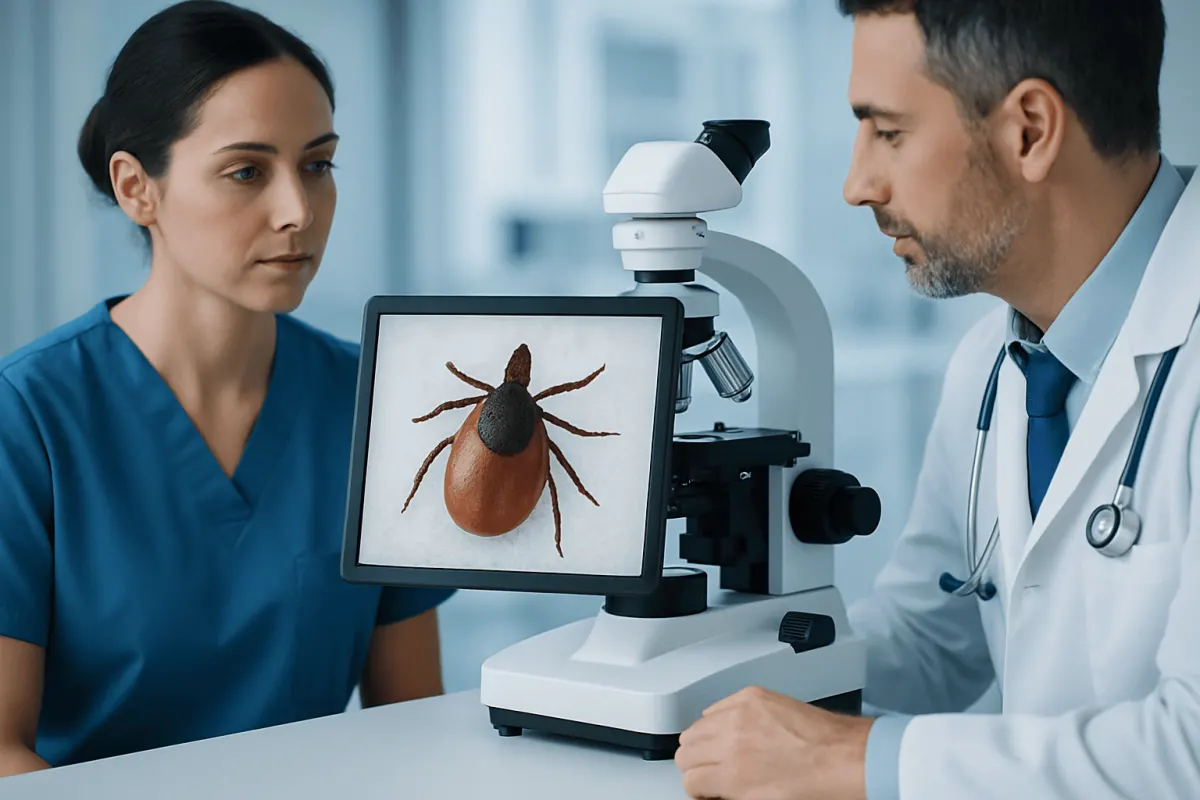
An image of a tick that carries Lyme disease most often shows a blacklegged tick, also called a deer tick, from the Ixodes family. However, tick appearance alone cannot confirm infection, so symptoms, possible exposure, and timely medical assessment remain important.
What an Image of a Tick That Carries Lyme Disease Can Show
An image of tick that carries Lyme disease commonly shows a blacklegged tick, also known as a deer tick. In North America, Lyme disease is mainly transmitted by Ixodes scapularis in the northeastern, mid-Atlantic, and north-central United States, and by Ixodes pacificus along parts of the Pacific coast. Related Ixodes ticks can transmit Lyme disease in parts of Europe and Asia.
Adult female blacklegged ticks are often orange-brown with a darker area near the head, while adult males appear darker overall. Their bodies are typically oval and flat before feeding. Young ticks, called nymphs, are especially important in transmission because they are extremely small—often comparable in size to a poppy seed—and may go unnoticed on the skin.
A photograph can help a person understand what a possible Lyme-carrying tick looks like, but it cannot determine whether an individual tick is infected. Tick color, size, and markings can vary with life stage, sex, region, and whether the tick has fed. A healthcare professional considers the location of exposure, duration of attachment, symptoms, and, when appropriate, laboratory testing rather than relying on tick identification alone.
How Lyme Disease Is Transmitted
Lyme disease is caused by Borrelia bacteria. These bacteria are maintained in natural cycles involving ticks and animal hosts, particularly small mammals and birds. People may become infected when an infected blacklegged tick feeds on them. Lyme disease does not usually spread through casual person-to-person contact, food, water, or ordinary contact with pets.
The likelihood of transmission generally increases the longer an infected tick remains attached. For this reason, finding and removing ticks promptly is useful. However, there is no reliable way to estimate infection risk from the appearance of a bite alone, and not everyone who is bitten by a blacklegged tick develops Lyme disease.
Ticks are most active during warmer months in many locations, but exposure can occur whenever temperatures allow ticks to be active. They may be found in wooded, brushy, grassy, and leaf-litter-covered environments. Pets can carry unattached ticks indoors, although they do not directly transmit Lyme disease to people.
Symptoms and the Expected Outlook

Early Lyme disease may begin days to weeks after a tick bite. A characteristic early sign is erythema migrans, an enlarging red skin rash that may feel warm but is not usually painful or itchy. It does not always resemble a classic “bull’s-eye”; it can be uniformly red or have a clear center. The rash often expands gradually over days and can occur where the tick was attached.
Other early symptoms can include fever, chills, headache, tiredness, muscle aches, joint aches, and swollen lymph nodes. Some people do not recall a tick bite, since nymphal ticks are easy to miss and tick saliva can reduce the sensation of a bite. Conversely, a small red bump that appears immediately after a bite and resolves quickly is often a local irritation rather than Lyme disease.
Without treatment, infection can sometimes affect the nervous system, heart, or joints. Possible later features include facial weakness, severe headache with neck stiffness, palpitations, dizziness, numbness or tingling, and episodes of swelling and pain in a large joint, particularly the knee. The outlook is generally very good when Lyme disease is recognized and treated appropriately. Some symptoms, especially fatigue or aches, can take time to settle even after effective treatment, and ongoing symptoms deserve individualized medical review.
Diagnosis: Why a Tick Photo Is Not Enough
Clinicians diagnose Lyme disease by combining a person’s symptoms, physical examination findings, travel or outdoor exposure history, and laboratory results when needed. When a person has a typical expanding erythema migrans rash and a plausible exposure history, a clinician may diagnose and treat Lyme disease without waiting for blood tests. Early antibody tests can be negative because the immune system may not yet have produced detectable antibodies.
For symptoms that are less specific or occur later, blood testing for antibodies to Borrelia may help support the diagnosis. Testing is interpreted carefully because antibodies can take several weeks to develop and may remain positive long after an earlier infection has resolved. A positive result does not, by itself, prove that current symptoms are caused by active Lyme disease.
If possible, a removed tick may be saved in a sealed container or bag for potential identification, but routine testing of ticks is usually not recommended to guide individual care. Tick testing may not be available, may not be standardized, and cannot show whether bacteria were transmitted. People should avoid delaying medical advice while waiting for a tick test result.
Modern Treatment Approaches
Lyme disease is treated with antibiotics selected according to the stage of illness, a person’s age, pregnancy status, allergies, other health conditions, and the body systems involved. Early uncomplicated infection is commonly managed with an oral antibiotic. The exact medicine and duration should be determined by a qualified clinician rather than self-treatment.
More complex manifestations, such as certain neurologic or cardiac complications, may require specialist assessment and sometimes intravenous antibiotic treatment. Clinicians also evaluate for other tick-borne infections when symptoms, laboratory findings, travel history, or the local epidemiology suggest that possibility. Treatment plans should address hydration, rest, pain relief where appropriate, and follow-up for symptoms that persist or change.
Antibiotics are effective for most people with Lyme disease, but they can cause side effects and are not beneficial for every unexplained symptom after a tick exposure. Taking antibiotics “just in case” is not appropriate for every bite. In selected high-risk circumstances, a clinician may discuss preventive antibiotic treatment after a recognized tick bite; this decision depends on the tick species, estimated attachment time, geographic setting, and the person’s medical circumstances.
For international patients who need assessment, Acıbadem Health Point’s multidisciplinary specialists and JCI-accredited hospitals can evaluate suspected Lyme disease and coordinate care when appropriate. A consultation is particularly useful when symptoms involve the heart, nervous system, or joints, or when the diagnosis remains uncertain.
Tick Removal and Practical Prevention
If a tick is found attached, it should be removed as soon as possible with fine-tipped tweezers. The person should grasp the tick close to the skin surface and pull upward with steady, even pressure. Twisting, crushing the tick, or applying substances such as petroleum jelly, nail polish, alcohol, or heat is not recommended, as these methods do not safely remove an attached tick.
After removal, the bite area and hands should be cleaned with soap and water or an appropriate antiseptic. If small mouthparts remain in the skin, they often work their way out naturally; trying to dig deeply into the skin may cause more irritation. It can be helpful to note the date and likely location of the bite and monitor for symptoms during the following weeks.
Prevention includes walking in the center of trails, avoiding tall grass and dense brush when possible, wearing long sleeves and long trousers in tick-prone areas, and using tick repellents as directed on the product label. Checking the entire body after outdoor activity is important, including the scalp, behind the ears, under the arms, around the waist, behind the knees, and in the groin area. Clothing can be placed in a hot dryer after outdoor time to help kill ticks that may be present.
- Perform tick checks on children and pets after time outdoors.
- Shower soon after returning indoors when practical.
- Keep yards less attractive to ticks by clearing leaf litter and managing tall grass.
- Ask a veterinarian about suitable tick prevention for pets.
When to Seek Medical Care
Medical care should be sought promptly if an expanding rash develops after a possible tick bite or outdoor exposure, especially in an area where Lyme disease occurs. A clinician should also be contacted for fever, flu-like symptoms, new fatigue, headache, unexplained joint swelling, facial weakness, palpitations, fainting, chest discomfort, or neurologic symptoms after a possible exposure.
Urgent assessment is appropriate for severe headache with neck stiffness, trouble breathing, fainting, chest pain, marked weakness, confusion, or new problems with movement or sensation. These symptoms can have many causes, but they should not be managed at home. Early evaluation supports accurate diagnosis and appropriate treatment.
People who are pregnant, immunocompromised, have significant medication allergies, or are caring for a young child should contact a clinician for individualized advice after a concerning tick bite. Even if no symptoms develop, a healthcare professional can explain whether observation alone is suitable or whether preventive treatment should be considered in the specific situation.
Frequently asked questions
01What does the tick that carries Lyme disease look like?
The ticks most commonly associated with Lyme disease are blacklegged ticks in the Ixodes family. Adult females are often orange-brown with a darker area near the head, while nymphs are much smaller and may be difficult to see. Appearance varies, so a photo cannot confirm whether a tick carries Lyme-causing bacteria.
02Can a person get Lyme disease from any tick?
No. Lyme disease is mainly associated with infected blacklegged ticks and related Ixodes species in certain geographic regions. Many tick species do not transmit Lyme disease, and even within a Lyme-endemic area, not every blacklegged tick is infected.
03How soon do Lyme disease symptoms appear after a tick bite?
Symptoms can begin days to weeks after a bite. An expanding rash may be an early sign, along with fever, fatigue, headache, and body aches. Some people do not notice a bite or develop a recognizable rash, so new symptoms after outdoor exposure should be discussed with a clinician.
04Should a tick be tested for Lyme disease?
Routine tick testing is generally not recommended for making treatment decisions. A positive tick test cannot show whether bacteria were transmitted, and a negative result does not rule out exposure to another infected tick. Medical advice should be based on the bite circumstances and the person's symptoms.
05Is Lyme disease curable?
Most people recover well with appropriate antibiotic treatment, particularly when Lyme disease is identified early. Recovery time varies, and some symptoms can persist for a period after treatment. Persistent, worsening, or new symptoms should be reviewed by a healthcare professional rather than treated with additional antibiotics without assessment.
06What should be done after removing a tick?
Clean the skin and hands, record when and where the bite may have occurred, and watch for an expanding rash or symptoms over the next several weeks. Promptly contact a clinician if symptoms develop or if the bite may have occurred in a region where Lyme disease is common. A clinician can assess whether any preventive treatment is appropriate.
This article is for general information only and is not a substitute for professional medical advice. Please consult a qualified doctor about your individual situation.
Explore treatments in Turkey — costs, top hospitals & a free quote
JCI-accredited · board-certified surgeons · reply within 24h
Add us as a Preferred Source to see more of our trusted health content across Google Search, AI Overviews and Discover.