Basal Cell Skin Cancer on Face: Diagnosis and Care
Basal cell skin cancer on the face is the most common type of skin cancer and usually grows slowly, rarely spreading to distant organs. It still needs timely medical assessment because an untreated lesion can gradually damage nearby skin, cartilage, nerves, or structures around the eyes, nose, lips, and ears.
Overview: basal cell skin cancer on the face
Basal cell skin cancer on the face, also called facial basal cell carcinoma (BCC), is a cancer that begins in basal cells in the outer layer of the skin. It commonly develops on sun-exposed areas, especially the nose, cheeks, forehead, eyelids, ears, temples, and upper lip. BCC usually grows slowly and is very unlikely to spread elsewhere in the body, particularly when it is identified and treated early.
Although its outlook is generally excellent, facial BCC should not be ignored. The face contains delicate structures and relatively little spare tissue in some areas. Over time, a growing tumor can extend beneath the skin and affect nearby cartilage, muscle, nerves, or the eye area. Prompt assessment helps clinicians choose treatment that aims to remove the cancer while preserving healthy tissue and appearance.
BCC is different from melanoma and squamous cell carcinoma, but any new, changing, non-healing, or bleeding skin lesion deserves professional review. A dermatologist or other trained clinician can examine the area and determine whether testing is needed.
Signs and symptoms to notice
Facial basal cell carcinoma can look different from person to person. A common appearance is a shiny, skin-colored or pink bump with a pearly edge. Tiny visible blood vessels may be present on its surface. The center can become crusted, ulcerated, or depressed as the lesion enlarges.
Other BCCs appear as a persistent red, scaly patch, a pale scar-like area, or a sore that seems to heal but repeatedly breaks down or bleeds. In people with darker skin tones, lesions may be brown, black, bluish, or darker than the surrounding skin, which can make them easier to confuse with other benign marks.
- A spot that bleeds with little trauma or without an obvious cause
- A non-healing sore lasting several weeks
- A bump, plaque, or patch that slowly enlarges
- Persistent crusting, tenderness, itching, or irritation in one location
- A scar-like patch without a known injury
These features do not confirm cancer on their own. Conditions such as eczema, acne, infections, or harmless growths can resemble BCC, so examination is the safest way to clarify the cause.
Why facial basal cell carcinoma develops

Ultraviolet (UV) radiation is the leading preventable cause of basal cell carcinoma. UV exposure from sunlight can damage skin-cell DNA over many years. The face receives regular incidental sun exposure during daily activities, which helps explain why BCC often occurs there. Indoor tanning devices also expose the skin to harmful UV radiation.
Risk is influenced by a combination of lifetime exposure and individual susceptibility. People with fair skin, light eyes or hair, a history of severe sunburns, frequent outdoor work or recreation, or previous skin cancer may have a higher likelihood of developing BCC. However, it can affect people of every skin tone and should never be dismissed because someone does not fit a typical risk profile.
Older age, immune suppression from certain medical conditions or medicines, previous radiation treatment, and rare inherited syndromes can also increase risk. Having one BCC raises the likelihood of developing another skin cancer in the future, making ongoing skin surveillance and sun protection especially important.
How basal cell skin cancer on the face is diagnosed
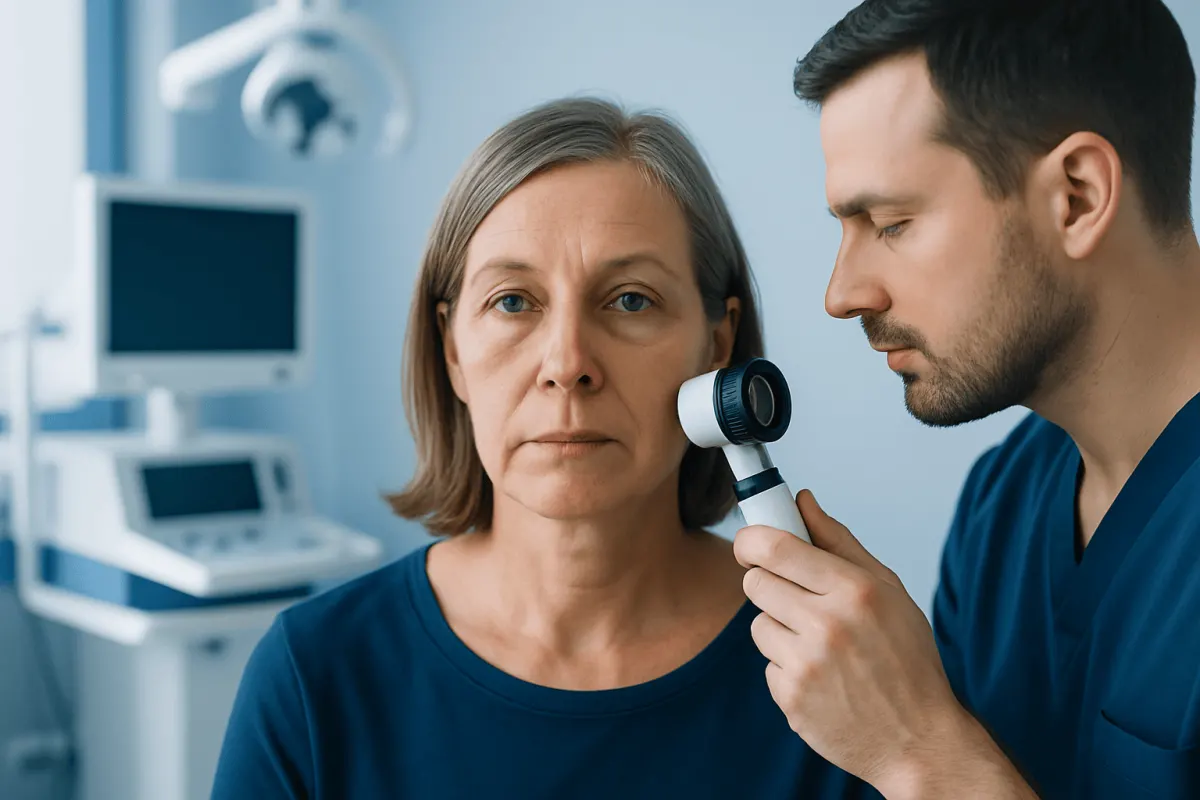
Diagnosis usually begins with a focused medical history and a close skin examination. The clinician will ask when the spot first appeared, whether it has changed, and whether it bleeds, scabs, hurts, or fails to heal. They may use a dermatoscope, a handheld magnifying device with light, to examine details beneath the skin surface.
A biopsy is needed to confirm basal cell carcinoma. After numbing the area, the clinician removes a small sample or sometimes the entire visible lesion for laboratory examination. The pathology result identifies the type of BCC and may describe features that influence treatment planning, such as whether it has a more aggressive growth pattern.
Facial location matters when planning care. Lesions on the central face, around the eyes, nose, lips, and ears may be considered higher risk because of their tendency to recur or their proximity to important structures. Imaging is not routine for most BCCs, but it may be considered if a tumor is large, recurrent, deeply invasive, or causing symptoms that suggest involvement beyond the skin.
Treatment choices for basal cell carcinoma on the face
Treatment is individualized according to the cancer’s size, location, subtype, borders, whether it is new or recurrent, and the person’s overall health. The central goal is complete removal or destruction of the cancer while minimizing unnecessary loss of healthy tissue. For many facial BCCs, surgery provides the most reliable way to confirm that the cancer has been removed.
Standard surgical excision removes the tumor along with a small margin of normal-looking skin. The removed tissue is examined in a laboratory. On sensitive or high-risk facial sites, Mohs micrographic surgery may be recommended. This technique removes tissue in thin layers and examines each layer during the procedure, allowing the surgeon to continue only where cancer cells remain and preserve as much healthy skin as possible.
Depending on the individual situation, reconstruction may involve direct closure, a skin flap, or a skin graft. When a lesion is near the eyelid, nose, lip, or ear, care may involve specialists with expertise in skin cancer surgery and facial reconstruction. The treating team can explain expected healing, scar care, and whether additional reconstructive planning is appropriate.
Selected superficial or low-risk BCCs may be treated with non-surgical approaches. These may include curettage and electrodessication, cryotherapy, topical immune-modulating or chemotherapy creams, photodynamic therapy, or radiation therapy. Advanced BCC that cannot be managed with surgery or radiation may be considered for systemic targeted medicines or immunotherapy under oncology supervision.
Does a basal cell carcinoma need to be removed?
In most cases, yes. A confirmed basal cell carcinoma should be treated rather than watched indefinitely, even though it usually grows slowly and rarely spreads. Without treatment, it can enlarge, ulcerate, invade more deeply, and require a larger procedure later. This is particularly important on the face, where local growth can affect function as well as appearance.
Removal does not always mean the same operation for every person. Some small, superficial lesions may be suitable for topical treatment or other non-surgical methods, while a high-risk lesion on the nose or near the eye may be best managed with Mohs surgery. A clinician can balance cancer control, cosmetic considerations, medical history, and patient preferences.
Very rarely, observation may be discussed for a person with major health limitations, a limited life expectancy, or a lesion unlikely to cause meaningful symptoms during that time. This is a personalized medical decision, not a general approach for facial BCC, and requires regular review with the healthcare team.
What are the alternative treatment options for basal cell carcinoma?
Alternatives to conventional excision are available for selected basal cell carcinomas, but they are not interchangeable. The best option depends strongly on the cancer’s depth, microscopic subtype, size, and facial location. A treatment that is reasonable for a small superficial lesion on the trunk may not provide adequate control for a lesion near the nose, eyelid, or lip.
Topical medicines may be considered for certain superficial BCCs, usually when surgery is less suitable. Photodynamic therapy combines a light-sensitive medicine with a specific light source and can be used for selected superficial lesions. Curettage with electrodessication or cryotherapy may also be options in carefully chosen low-risk cases, though they do not provide the same margin assessment as surgical methods.
Radiation therapy can be useful when surgery is not feasible or would cause substantial functional concerns. It is not always preferred for younger patients or in areas where later surgery may be needed. For rare locally advanced disease, oncology teams may consider medicines that target the hedgehog signaling pathway or immunotherapy. These decisions require specialist assessment and monitoring for side effects.
How long can you live with basal cell carcinoma without treatment?
There is no reliable or safe timeframe. Basal cell carcinoma may remain small or grow slowly for months or years, but its behavior cannot be predicted accurately from appearance alone. Even a lesion that seems unchanged can extend beneath the visible surface.
Most BCCs do not shorten life directly because spread to distant organs is uncommon. However, delaying treatment can allow local invasion that becomes painful, causes tissue loss, affects nearby nerves or facial structures, and makes treatment more complex. In very neglected cases, locally destructive disease can lead to serious complications.
For this reason, a suspicious or biopsy-confirmed lesion should be assessed and treated on the timetable recommended by the clinician. People who have concerns about surgery, cost, recovery, travel, or other medical conditions should discuss them openly so that practical, appropriate options can be explored.
Sun protection, follow-up, and when to seek medical care
Is sun exposure safe after having basal cell carcinoma? Outdoor activity can still be part of a healthy life, but deliberate tanning and unprotected UV exposure are not recommended after BCC. Previous BCC indicates increased risk of future skin cancers. Protection should include shade when practical, broad-brimmed hats, protective clothing, sunglasses, and broad-spectrum sunscreen with SPF 30 or higher applied as directed and reapplied during prolonged outdoor exposure.
Follow-up schedules vary according to the number, type, and location of prior skin cancers. A clinician may recommend regular professional skin checks and encourage monthly self-examination using mirrors or help from a trusted person for hard-to-see areas. Any changing or persistent lesion should be reported rather than waiting for the next routine appointment.
When to seek medical care: Medical review is appropriate for a facial spot that does not heal within several weeks, repeatedly bleeds or crusts, grows, changes color or shape, or causes persistent pain, numbness, or tingling. More urgent assessment is sensible if a lesion is close to the eye, affects vision or eyelid movement, or appears to be rapidly enlarging. Acıbadem Health Point’s multidisciplinary specialists and JCI-accredited hospitals evaluate and treat skin cancers for international patients, with care tailored to the lesion and the person’s needs.
Frequently asked questions
01Can basal cell carcinoma on the face spread to other organs?
Basal cell carcinoma very rarely spreads to distant organs. Its more important risk is local growth into nearby skin and deeper facial tissues if it is left untreated. Timely diagnosis and treatment usually provide an excellent outlook.
02Is a biopsy always needed for suspected facial basal cell carcinoma?
A biopsy is generally used to confirm the diagnosis before definitive treatment, although occasionally a small lesion may be fully removed during the diagnostic procedure. The laboratory examination identifies the cancer type and can help guide treatment selection. A clinician will explain which biopsy method is suitable for the lesion.
03Is Mohs surgery always necessary for basal cell carcinoma on the face?
No. Mohs surgery is often considered for high-risk sites and tumors with features that make complete removal more challenging, such as lesions on the nose, eyelids, lips, ears, or recurrent tumors. Small, low-risk cancers in some facial locations may be treated effectively with standard excision or another appropriate method.
04Can basal cell carcinoma come back after treatment?
Yes, recurrence is possible, especially with larger, recurrent, aggressive, or incompletely treated tumors. Appropriate treatment and follow-up reduce this risk, and many recurrences can be managed successfully when detected early. A person who has had BCC also has a higher chance of developing a new skin cancer elsewhere.
05What does healing after facial basal cell carcinoma surgery involve?
Healing depends on the treatment method, lesion size, and repair needed. Mild swelling, bruising, tenderness, or temporary tightness can occur after surgery, especially on the face. The surgical team provides individualized wound-care instructions and explains when to return for review or suture removal.
06Can sunscreen prevent every future basal cell carcinoma?
Sunscreen is an important part of reducing UV damage, but it cannot eliminate all risk. It works best alongside shade, protective clothing, avoiding tanning beds, and regular skin checks. Consistent daily sun protection is particularly valuable for people who have previously had BCC.
This article is for general information only and is not a substitute for professional medical advice. Please consult a qualified doctor about your individual situation.
Persistent digestive symptoms? Get evaluated in Turkey
JCI-accredited · board-certified surgeons · reply within 24h
Add us as a Preferred Source to see more of our trusted health content across Google Search, AI Overviews and Discover.