Are Teeth Shaved Down for Veneers in Turkey? What Really Happens
Key Takeaways
- Thin porcelain veneers usually involve only minimal enamel reduction; crowns require the tooth to be reshaped all the way round, which is far more extensive.
- Many widely shared "Turkey teeth" images show crowns fitted to healthy teeth — a plan that should always be discussed and justified before travel.
- A written treatment plan, with X-rays or photographs reviewed by a dentist, should come before any booking or deposit.
- Costs are normally quoted per unit, so the total depends heavily on how many teeth are treated; ask what is and is not included.
- Accreditation such as JCI, dentist qualifications and registration are practical selection criteria, not marketing extras.
- Plan for aftercare in the UK before flying, including a local dentist willing to review the work and manage routine maintenance.
The phrase "Turkey teeth" usually refers to crowns rather than true veneers — and the two involve very different amounts of tooth preparation. This guide explains what really happens during treatment planning, what packages typically include, and how UK patients can plan travel, budgets and aftercare sensibly.
What People Actually Mean by "Turkey Teeth"
“Turkey teeth” is a media phrase rather than a dental term. It is generally used to describe very white, very uniform smiles created abroad — and in most of the widely shared cases, the work involved was not veneers at all, but full-coverage crowns. Understanding that distinction is the single most useful thing a prospective patient can do before booking anything, because veneers and crowns sit at opposite ends of the scale when it comes to how much natural tooth is involved.
A veneer is a thin shell, usually porcelain or a ceramic material, bonded to the front surface of a tooth. A crown is a cap that covers the whole tooth, which means the tooth underneath must be reshaped on all sides to make room for it. Both can produce a natural-looking result in the right circumstances; they are simply answers to different problems. Veneers tend to suit mild discolouration, small chips, minor gaps or slightly irregular shapes. Crowns are more often indicated where a tooth is heavily filled, root-treated, cracked or structurally weakened.
The concern raised by UK dentists and regulators is not that treatment happens abroad. It is that healthy, structurally sound teeth are sometimes prepared for crowns when a more conservative option — orthodontics, whitening, composite bonding or veneers — might have achieved a comparable cosmetic result with far less irreversible change. That is a clinical judgement, and it deserves a proper conversation with a qualified dentist rather than a decision made from photographs.
Turkey Teeth Shaved Down: How Much Tooth Is Really Removed?
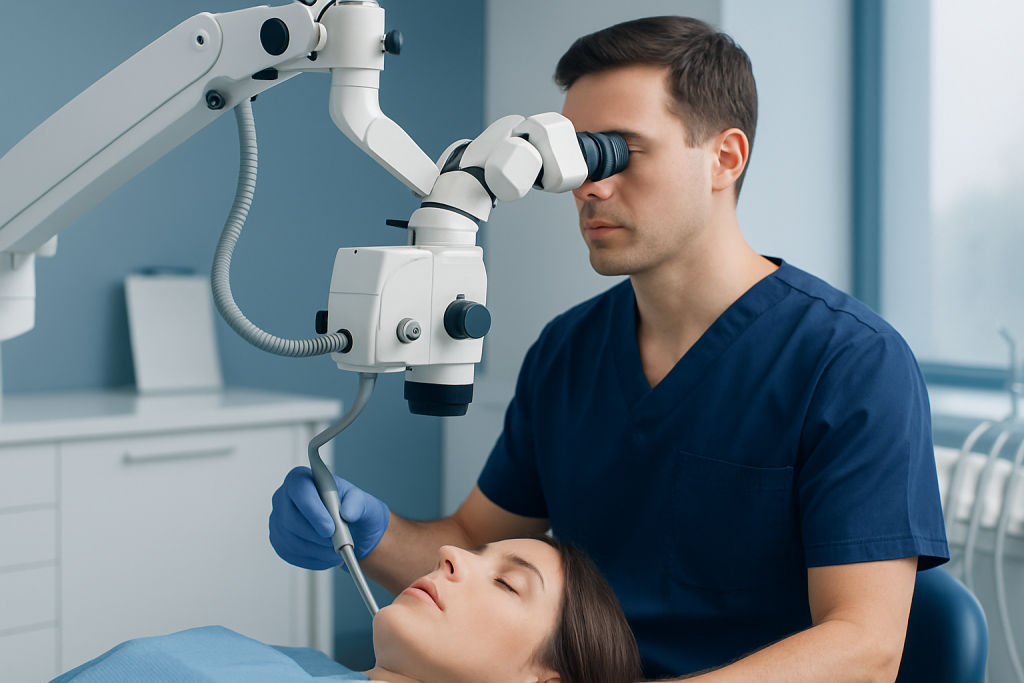
The honest answer to the question of whether turkey teeth shaved down is a real phenomenon is: it depends entirely on what is being fitted. If the plan is genuine porcelain veneers, preparation is typically limited to a thin layer of enamel on the front and biting edge of the tooth — enough to allow the veneer to sit flush rather than bulky. Some minimal-preparation veneer systems remove even less. If the plan is crowns, considerably more tooth structure has to be removed all the way around, because the restoration has to encircle the tooth.
This is not unique to Turkey. Crown preparation is the same procedure whether it is carried out in Istanbul, London or Manchester; the technique is dictated by the restoration, not the country. What differs between cases is the treatment decision that led there. A patient who arrives requesting a dramatic change in colour, shape and alignment across a whole smile may be offered crowns simply because crowns can deliver that change quickly, where orthodontics might take many months.
Preparation of this kind is irreversible. Once enamel is removed it does not grow back, and the tooth will require some form of restoration from that point onwards. Restorations also have a finite lifespan and will need replacing at intervals over a lifetime, which is a long-term commitment worth factoring in — particularly for younger patients. None of this makes crowns the wrong choice; it makes an unhurried, documented discussion of alternatives essential.
- Whitening or composite bonding — the least invasive routes for colour and small shape changes.
- Orthodontics, including clear aligners — addresses alignment without altering tooth structure.
- Veneers — limited enamel reduction, suited to specific cosmetic concerns.
- Crowns — the most extensive preparation, generally reserved for teeth already compromised.
Assessment Before You Fly: Records, Photographs and Second Opinions
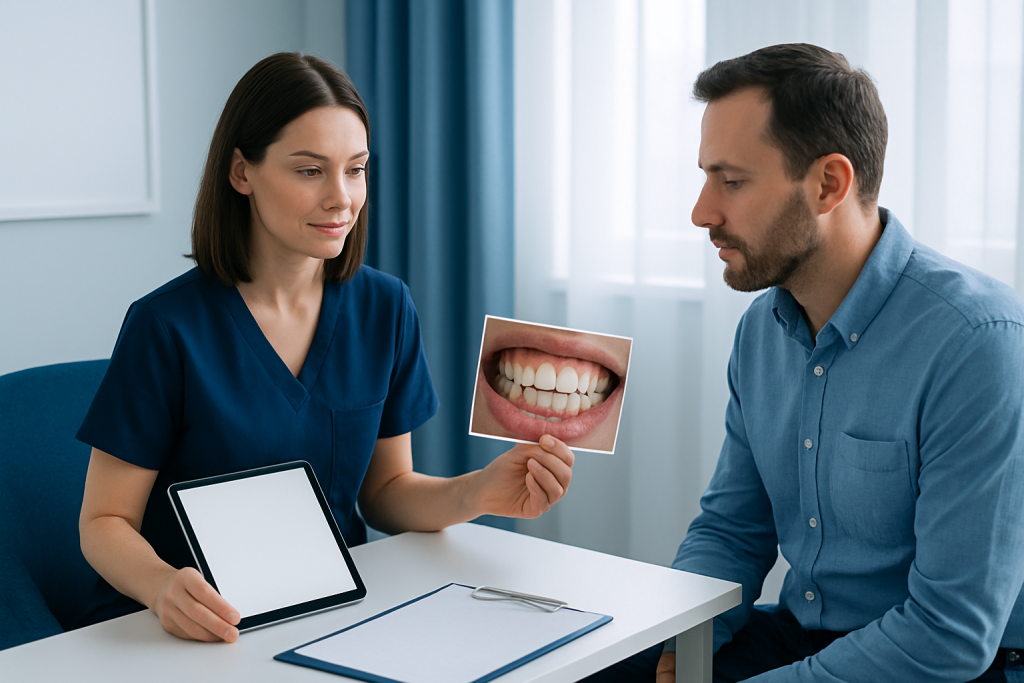
Reputable international dental programmes begin with a remote assessment rather than an arrival-day decision. Patients are usually asked to send recent dental X-rays, intraoral and smile photographs, and a summary of their dental history, including any root canal treatment, gum disease, grinding or existing restorations. A dentist reviews these and issues a provisional treatment plan describing what is proposed, how many units, in which material, and over how many appointments.
A video consultation is the point at which to ask direct questions: is the recommendation veneers or crowns, and why; what would happen if fewer teeth were treated; what less invasive options were considered and ruled out; and what the plan is if a tooth turns out to need root canal treatment once preparation begins. A plan that cannot answer those questions in writing is not yet a plan.
Gum health and any active decay must be stabilised before cosmetic work, and this sometimes changes both the timeline and the cost. It is also entirely reasonable to take the provisional plan to a UK dentist for a second opinion before committing. An independent view costs relatively little and may either confirm the approach or suggest a more conservative alternative — either outcome is useful.
What Dental Treatment Packages Typically Include
Coordinated dental travel packages vary, but most are built around a similar structure. Understanding what sits inside the quoted figure — and what sits outside it — prevents unwelcome surprises mid-trip.
- Initial in-person examination, digital scans and X-rays on arrival
- Treatment planning, shade selection and, in some cases, a trial smile or mock-up
- Tooth preparation, temporary restorations, laboratory work and final fitting
- Airport transfers and clinic transfers during the stay
- Hotel accommodation for a stated number of nights
- Interpreter or English-speaking coordinator support
- A written treatment record and post-treatment instructions to take home
Items that are frequently not included, and are worth confirming explicitly, include flights, travel insurance, extra hotel nights if the schedule extends, and any preparatory treatment such as fillings, extractions, gum therapy, root canal treatment or bone grafting. If implants are part of the discussion, healing time between stages usually means a second trip.
Ask, too, what happens in the event that a restoration needs adjustment after fitting, and whether any warranty applies to the materials, what it covers, and how it would be honoured from the UK.
Cost Bands and Realistic Budget Planning
Dental work abroad is normally priced per unit — per veneer, per crown or per implant — rather than as a single flat fee, so the total is driven by how many teeth are treated. A handful of upper front teeth sits in a modest band; a full upper and lower smile makeover of sixteen to twenty units sits in a substantially higher one. Materials matter as well: composite bonding is generally the lowest band, layered porcelain and zirconia sit higher, and implant-supported work higher still.
Rather than chasing the lowest headline figure, it is more useful to build a realistic total: treatment units, plus preparatory work that may be needed, plus flights, insurance, and a contingency for additional nights. Budgeting should also include the long-term picture — restorations require maintenance, hygiene appointments and eventual replacement, and those costs will be incurred in the UK.
Be cautious of quotations issued without any clinical records, or of pricing that changes significantly after arrival. A credible coordinator will give an indicative planning range in advance and explain clearly which variables could move it.
Choosing a Clinic: Accreditation, Credentials and Questions to Ask
Accreditation is a practical filter. Joint Commission International (JCI) accreditation indicates that a hospital or health facility has been externally assessed against international standards for patient safety, infection control, record-keeping and clinical governance. It does not guarantee a particular cosmetic outcome, but it does indicate that systems are in place and independently reviewed.
Credentials matter just as much. Patients are entitled to know the name of the dentist who will treat them, their qualifications, their registration status with the Turkish dental authority, and their experience in prosthodontics or restorative dentistry specifically. Sedation or general anaesthesia, if offered, should be delivered by an appropriately qualified anaesthetist in a facility equipped for it.
Other sensible checks include whether the laboratory work is carried out in-house or externally, which materials are used and whether their provenance is documented, whether a written informed-consent process explains the irreversibility of tooth preparation, and how medical records are shared afterwards. Any clinic that discourages a second opinion or presses for a same-day decision is signalling something important.
Travel Timing, Recovery and Aftercare Back Home
Veneer and crown treatment is usually staged across a single trip: examination and preparation early on, temporary restorations while the laboratory produces the definitive work, then try-in, adjustment and final cementation. That commonly requires a stay of around a week to ten days, though the exact schedule depends on the number of units and whether preparatory treatment is needed. Implant cases are different and normally require two separate visits months apart.
Recovery from veneer or crown work is generally straightforward, but temporary sensitivity to hot and cold, mild gum tenderness and a period of adjusting to a new bite are common. Patients are usually advised to eat softer foods early on and to avoid staining foods while temporaries are in place. Anyone travelling should build in a buffer day before the return flight rather than fitting the final appointment tightly against departure.
Aftercare in the UK is the part most often overlooked. Before travelling, it is wise to identify a local dentist willing to take over routine care, and to bring home a full treatment record: materials used, shade, number and position of units, and any warranty documentation. Ongoing maintenance — hygiene appointments, night guards for those who grind, and prompt attention to any looseness or sensitivity — protects the investment far more than anything done in the surgery on the day.
When to Speak to a Patient Coordinator
A patient coordinator is the right first call once someone has moved from curiosity to serious consideration but before any deposit is paid. Coordinators gather and forward clinical records, arrange video consultations with the treating dentist, translate the treatment plan into a realistic itinerary, and give an indicative cost range so that the trip can be budgeted properly. They also handle the practical layer — visa guidance, accommodation, transfers, interpreter support and scheduling around flights.
It is also appropriate to contact a coordinator when a plan received elsewhere feels unclear, when a second opinion is wanted on whether crowns are genuinely indicated, or when a previous course of treatment has left problems that need reviewing. Bringing existing X-rays and photographs to that conversation makes it far more productive.
Acibadem Health Point coordinates dental and wider care for international patients across Acıbadem’s JCI-accredited hospitals and clinics, where multidisciplinary specialists assess each case and prepare a documented treatment plan before travel. Whatever route a patient chooses, the principle is the same: understand exactly what will be removed from the tooth, why, and what the alternatives are — and have that conversation with a qualified dentist before booking a flight.
Frequently asked questions
01Do teeth have to be shaved down for veneers in Turkey?
For genuine porcelain veneers, only a thin layer of enamel is usually removed from the front and biting edge of the tooth. The extensive reshaping seen in many "Turkey teeth" stories is associated with crowns, which cover the whole tooth and therefore require preparation on all sides. The amount removed is determined by the type of restoration, not by the country where it is carried out.
02How can I tell whether I am being offered veneers or crowns?
Ask the clinic to state it explicitly in the written treatment plan, including the material and the number of units. Veneers are described as facings bonded to the front surface; crowns are full-coverage caps. If a plan uses vague terms such as "laminates" or "smile design" without specifying, request clarification before agreeing to anything.
03Can enamel that has been removed grow back?
No. Enamel does not regenerate, so any tooth preparation is permanent and the tooth will need a restoration from that point onwards. This is why it is important to discuss less invasive alternatives — such as whitening, composite bonding or orthodontics — with a dentist before choosing crowns for otherwise healthy teeth.
04How long should I plan to stay in Turkey for veneer or crown treatment?
Most veneer and crown cases are completed within roughly a week to ten days, allowing time for examination, preparation, laboratory work and final fitting with adjustments. The precise schedule depends on how many teeth are treated and whether preparatory work such as fillings or gum treatment is required. Implant treatment usually needs two separate trips several months apart.
05What should I do about aftercare once I am back in the UK?
Arrange for a UK dentist to take over routine care and take home a complete treatment record, including materials, shade and the position of each unit. Attend regular check-ups and hygiene appointments, and contact a dentist promptly if you notice looseness, persistent sensitivity, gum inflammation or a change in your bite. Good day-to-day cleaning around the margins of restorations is essential to their longevity.
06How much does this kind of treatment cost?
Costs are normally quoted per unit, so the total depends mainly on how many teeth are treated and which materials are used, with composite bonding at the lower end and implant-supported work at the higher end. A realistic budget should also include flights, insurance, possible preparatory treatment, extra nights and future maintenance in the UK. A coordinator can provide an indicative planning range once clinical records have been reviewed.
07Does JCI accreditation guarantee a good cosmetic result?
No accreditation can guarantee an aesthetic outcome, because results depend on individual anatomy, oral health and the treatment chosen. JCI accreditation indicates that a facility has been independently assessed against international standards for safety, hygiene and governance, which is a useful selection criterion alongside the treating dentist's qualifications and registration.
This article is for general information only and is not a substitute for professional medical advice. Please consult a qualified doctor about your individual situation.
Explore treatments in Turkey — costs, top hospitals & a free quote
JCI-accredited · board-certified surgeons · reply within 24h
Add us as a Preferred Source to see more of our trusted health content across Google Search, AI Overviews and Discover.