Turkey Teeth Before and After: Realistic Results and What to Expect

Key Takeaways
- Most "turkey teeth" cases involve full-coverage crowns rather than thin veneers, which means permanent reshaping of natural teeth — an irreversible step that deserves a careful, written treatment plan.
- Realistic before-and-after changes include shade, shape, spacing and symmetry; they do not correct every bite problem, gum condition or underlying decay on their own.
- Packages commonly bundle consultation, imaging, temporary restorations, final restorations, hotel and airport transfers — but inclusions vary and should be confirmed in writing.
- Costs are usually quoted per tooth and sit in bands influenced by material, number of units and any preparatory work; indicative planning figures are not the same as a personalised quote.
- JCI accreditation, verifiable dentist registration and clear consent documents are more useful selection criteria than gallery photographs.
- Ask before flying who provides adjustments, repairs or emergency care once back in the UK, and take full records home.
"Turkey teeth before and after" usually describes the visible change after crowns or veneers are fitted during a short trip abroad, typically across one or two visits within about a week to ten days. This guide explains what realistic results look like, what packages generally include, how to plan costs and travel, and what aftercare in the UK involves.
Turkey Teeth Before and After: What the Photographs Actually Show
Search for turkey teeth before and after and the results are dominated by side-by-side photographs: worn, discoloured or crowded teeth on the left, a uniform white smile on the right. In clinical terms, what has usually changed is the outer surface of the teeth. Crowns or veneers have been bonded over the natural teeth to alter shade, shape, length and apparent alignment. The underlying jaw position, gum health and bite have not been transformed by the restorations alone — those are assessed and managed separately.
Realistic outcomes are therefore best described as cosmetic and functional improvements within the limits of a person’s own anatomy. A skilled result looks proportionate to the face, respects the gum line and allows normal speech and chewing. Very bright, opaque, identically shaped teeth photograph well but can look conspicuous in daily life, and shade choice is a decision patients should make deliberately rather than defaulting to the brightest option available.
It is also worth reading galleries critically. Photographs may be taken under different lighting, at different angles, with lip retractors, or shortly after fitting when gums are still settling. They rarely show the same smile several years later. A more informative request is to ask the treating dentist what proportion of tooth structure will be removed, what material is planned, and what the restoration is expected to look like in ordinary daylight — supported by a digital preview or a trial mock-up where possible.
Veneers, Crowns and Why the Difference Matters
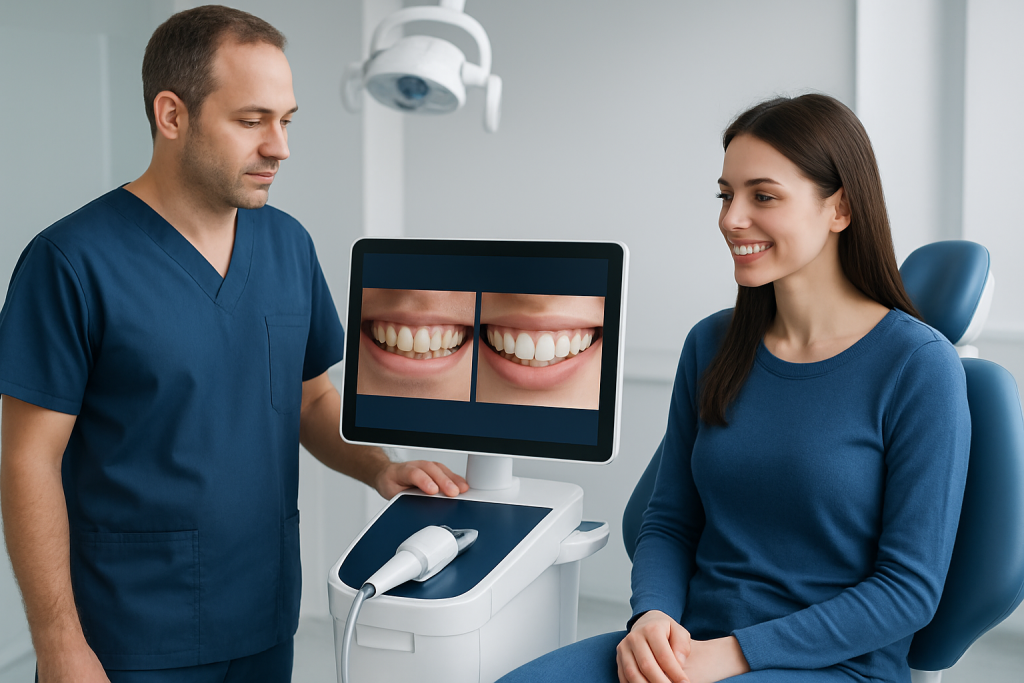
The phrase “turkey teeth” is a media label rather than a dental procedure. In practice, most cases involve full-coverage crowns, often in zirconia or a layered ceramic, fitted over teeth that have been reduced on all surfaces. Veneers, by contrast, are thin facings bonded mainly to the front surface with far less preparation. Both can produce striking before-and-after images, but the biological cost is very different, and the two are not interchangeable.
Removing tooth structure is permanent. Depending on how much is taken away and how close the preparation comes to the nerve, some teeth may later require root canal treatment, and restorations themselves have a finite lifespan and will eventually need replacing. This is not a reason to avoid treatment — crowns are a well-established, routine restorative option — but it is a reason to insist on a documented diagnosis explaining why crowns rather than orthodontics, whitening, composite bonding or minimal-preparation veneers are being recommended.
Good practice before any cosmetic work includes an examination for decay and gum disease, radiographs, photographs and a discussion of the bite. Any active problems are normally stabilised first. Patients who are unsure about a plan proposed abroad can ask for a written treatment plan and a second opinion, including a video consultation with the treating team, before committing to travel or to irreversible preparation.
What Treatment Packages Typically Include
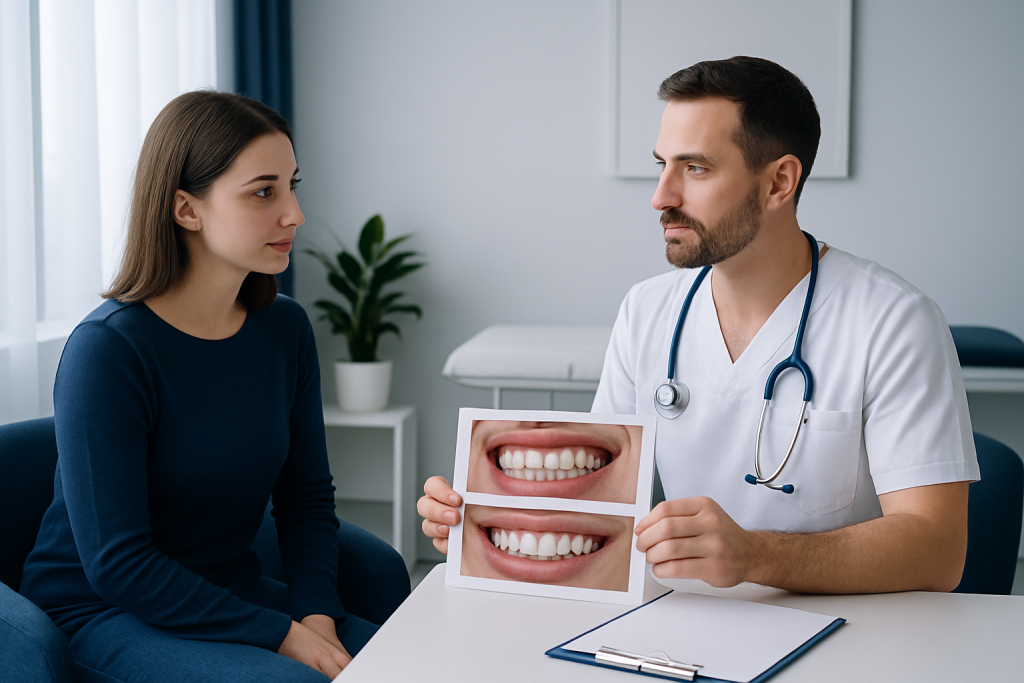
International dental packages are built around a compressed schedule. A typical structure involves an assessment and imaging on arrival, tooth preparation and impressions or digital scans, a period wearing temporary restorations while the laboratory produces the final work, a try-in appointment for shade and fit, and cementation before departure. Some plans that involve extractions, gum treatment or implants require a healing interval and a second trip months later.
Inclusions vary considerably between providers, so patients benefit from a written, itemised list rather than a headline figure. Commonly bundled items include:
- Initial consultation, examination and radiographs or 3D imaging
- Temporary restorations and the laboratory-made final restorations
- Airport transfers and clinic transfers during the stay
- Hotel accommodation for a defined number of nights
- Interpreter support and a named coordinator for scheduling
Items that are frequently excluded — and worth clarifying in advance — include flights, extra nights if the schedule extends, root canal treatment or extractions found during examination, gum therapy, bone grafting, night guards, and any revision work after returning home. Asking specifically “what would be charged separately if a tooth needs root canal treatment during preparation?” often reveals more than a general price list.
Planning Costs: Thinking in Bands, Not Quotes
Dental work abroad is normally priced per tooth or per unit, and the total depends on how many teeth are treated, which materials are chosen and what preparatory treatment is needed. Rather than fixating on a single figure, it helps to think in bands. Entry-level bands generally correspond to standard zirconia crowns in higher-volume clinics; mid bands to layered or high-translucency ceramics with more laboratory involvement; and upper bands to complex full-mouth rehabilitation, implant-supported work or cases requiring extensive preparatory treatment.
Comparable private treatment in the UK typically sits at a higher level, which is why cost is a common motivator for travelling. Savings, however, are only meaningful when the plans being compared are equivalent — the same number of units, the same material, the same preparatory work and the same warranty terms. A package covering ten crowns cannot be compared fairly with a UK quote for twenty. Travel, accommodation, time off work and any future maintenance in the UK should also enter the calculation.
No responsible provider can give a firm figure before examining the patient. Preliminary estimates based on photographs and an OPG radiograph are useful for budgeting, but they are indicative planning ranges, not quotations, and may change once a clinical examination takes place. Patients should expect a final, itemised plan to be confirmed in writing after assessment and before irreversible treatment begins, and should feel free to pause at that point.
Choosing a Clinic: Accreditation, Credentials and Consent
Selection criteria that hold up over time are structural rather than photographic. International accreditation — most commonly Joint Commission International (JCI) — indicates that a hospital or clinic has been externally assessed against standards covering patient identification, infection control, medication safety, record-keeping and complaint handling. It does not predict an individual aesthetic outcome, but it does say something meaningful about the systems around the chair.
Equally important is knowing who will actually perform the treatment. Patients can ask for the treating dentist’s name, their registration with the Turkish authorities, their qualifications and their specific experience with the planned procedure — for example prosthodontics or implant dentistry. It is reasonable to ask whether the same clinician will carry out preparation and fitting, whether the laboratory is in-house, and which brand and grade of ceramic or implant system is used, since these details affect future maintenance in the UK.
Consent documentation deserves the same scrutiny. A robust process explains alternatives (including doing nothing), the amount of tooth reduction planned, the risks of sensitivity, nerve involvement, gum recession and restoration failure, the expected lifespan of the work, and exactly what any guarantee covers and requires — many warranties depend on documented check-ups and may not cover travel costs for revisions. Written information in English, provided in advance rather than on the day of treatment, allows genuine reflection.
Timing the Trip: Appointments, Recovery and Flying
Most crown or veneer plans are arranged over roughly five to ten days on site, with several appointments separated by laboratory time. Patients are usually free between visits, though the mouth may feel tender and temporary restorations require care with hard and sticky foods. Recovery from preparation itself is generally straightforward: mild sensitivity to hot and cold, tender gums and a period of adjusting to new tooth shapes and speech are common in the early phase.
Where extractions, implants or bone grafting are involved, timelines lengthen considerably and are staged over months rather than days, with healing between phases. Flying shortly after minor dental work is usually acceptable, but individual advice should come from the treating clinician, particularly after surgery or sedation. Building a buffer day before the return flight is sensible, so that any adjustment to the bite or contact points can be made in person rather than remotely.
Practical planning also matters: travel insurance that acknowledges planned treatment abroad, confirmation of who to contact out of hours, a realistic view of how much sightseeing is compatible with multiple appointments, and clarity on visa or entry requirements for UK travellers. A coordinator should be able to set out the appointment schedule day by day before departure so that flights and accommodation are not booked around guesswork.
Aftercare Once You Are Home in the UK
Aftercare is the part of the journey most often underestimated. Before leaving, patients should collect a full clinical record: the treatment plan carried out, tooth-by-tooth notes, radiographs and scans, materials and batch or implant system details, laboratory information and warranty terms. UK dentists can maintain and repair work far more easily when they know exactly what has been fitted, and this documentation is also essential if a complication arises.
Registering with a UK dentist — or continuing with an existing one — and arranging an early review is advisable, alongside routine hygiene appointments. Crowns and veneers do not decay, but the tooth and gum beneath them can, so daily interdental cleaning, careful brushing around margins and attention to grinding or clenching all influence how long restorations last. A night guard is often recommended for patients who clench.
It is important to understand in advance that remedial work in the UK is usually charged privately and that returning abroad for adjustments involves further travel. Complaints or concerns about care received overseas are handled under the legal framework of the country where treatment took place, not by the General Dental Council. Knowing this before travelling helps patients weigh the arrangement realistically rather than discovering it later.
When to Speak to a Patient Coordinator
A patient coordinator is useful earlier than most people assume — ideally at the stage of gathering information rather than after a decision has been made. Coordinators can arrange a remote review of photographs and radiographs, organise a video consultation or second opinion with the treating team, outline indicative cost planning ranges, explain what a package does and does not include, and set out a realistic appointment schedule before any flights are booked.
They also handle the logistics that make a short, appointment-dense trip workable: airport and clinic transfers, accommodation near the site of care, interpreter support during consultations, and coordination if the plan needs to change after examination. Good coordination should feel like clarification rather than persuasion; a coordinator who cannot answer questions about exclusions, clinician credentials or revision policy is a reason to slow down.
Acibadem Health Point coordinates care for international patients across Acıbadem’s multidisciplinary specialists and JCI-accredited hospitals, including assessment, planning and follow-up arrangements for people travelling from the UK. Whichever route a patient chooses, the underlying principle is the same: any decision to reshape healthy teeth should follow an individual examination and a written plan discussed with a qualified dentist, not a gallery of before-and-after photographs.
Frequently asked questions
01Are "turkey teeth" veneers or crowns?
In most widely publicised cases they are full-coverage crowns rather than thin veneers, because crowns can mask larger discrepancies in shape and alignment. Crowns require the tooth to be reduced on all surfaces, which is irreversible. Patients should ask their dentist to state clearly, in writing, which restoration is planned for each tooth and how much tooth structure will be removed.
02How long does a typical dental trip to Turkey take?
Crown or veneer plans are commonly arranged over about five to ten days, with several appointments separated by laboratory time. Cases involving extractions, implants or bone grafting are staged over months and usually need two trips with a healing interval between them. The exact schedule depends on the clinical findings at examination, so it should be confirmed before flights are booked.
03How much does treatment cost compared with the UK?
Costs are usually quoted per tooth and fall into bands influenced by material, the number of units and any preparatory treatment such as root canal therapy or gum care. Prices abroad are generally lower than comparable UK private fees, but savings are only meaningful when identical plans are compared, and travel, accommodation and future maintenance should be included. A personalised figure can only be confirmed after a clinical examination.
04What should be checked before choosing a clinic?
Useful criteria include international accreditation such as JCI, the named treating dentist's registration and relevant experience, whether the same clinician performs preparation and fitting, the specific materials and systems used, and a written consent document covering risks and alternatives. It is also important to know exactly what any guarantee covers and what conditions apply. Photographic galleries alone are not a reliable basis for a decision.
05Who provides aftercare once the patient returns to the UK?
Routine check-ups, hygiene appointments and any repairs are normally managed by a UK dentist, usually on a private basis, unless the patient returns abroad. Taking home complete records — treatment notes, radiographs, materials and warranty terms — makes ongoing care considerably easier. Complications should be reviewed promptly by a dentist rather than left until the next planned trip.
06Do crowns or veneers fitted abroad last for life?
No restoration is permanent. Crowns and veneers have a finite lifespan that depends on materials, bite forces, oral hygiene and habits such as clenching, and they will eventually need replacement. Careful daily cleaning around the margins, regular professional review and a night guard where recommended all help protect both the restorations and the natural tooth beneath.
07Is it possible to get a second opinion before travelling?
Yes. Many international programmes offer remote review of photographs and radiographs and video consultations with the treating team, and patients can also seek an independent opinion from a UK dentist. Because tooth preparation is irreversible, taking time to compare plans is reasonable and should not be discouraged by any provider.
This article is for general information only and is not a substitute for professional medical advice. Please consult a qualified doctor about your individual situation.
Explore treatments in Turkey — costs, top hospitals & a free quote
JCI-accredited · board-certified surgeons · reply within 24h
Add us as a Preferred Source to see more of our trusted health content across Google Search, AI Overviews and Discover.