African American Hair Implants: What You Need to Know

Key Takeaways
- Textured hair can be restored with hair transplant methods, but the approach must account for curl direction and follicle shape.
- A thorough consultation should assess hair loss pattern, donor density, scalp health, and any traction or inflammatory hair loss.
- FUE and FUT may both be used, but not every technique suits every patient with textured hair.
- Recovery includes protecting the scalp, following washing instructions, and waiting patiently for new growth to mature over several months.
- A board-certified specialist with experience in diverse hair types can help set realistic expectations and reduce avoidable risks.
African American hair implants refer to hair restoration approaches designed for people with tightly coiled, curly, or textured hair. The best results depend on careful planning, an experienced surgeon, and a technique that protects both the donor area and the natural curl pattern.
Overview
African American hair implants are hair restoration procedures planned for people with Black, African American, or other highly textured hair. In practical terms, the goal is the same as in any hair transplant: move healthy follicles from a donor area, usually the back or sides of the scalp, to thinning areas where new growth is needed.
What makes the conversation different is the hair itself. Curly and coiled follicles grow in a curved path beneath the skin, and that shape changes how they should be harvested and placed. A specialist who understands textured hair can better protect the follicle during surgery and create a result that looks natural rather than flat or uneven.
For international patients, the decision is often not just about the procedure, but about finding a team that can evaluate the hair loss cause, explain whether surgery is appropriate, and build a recovery plan that works after returning home. That planning matters as much as the operation itself.
What Hair Implants Can and Cannot Do
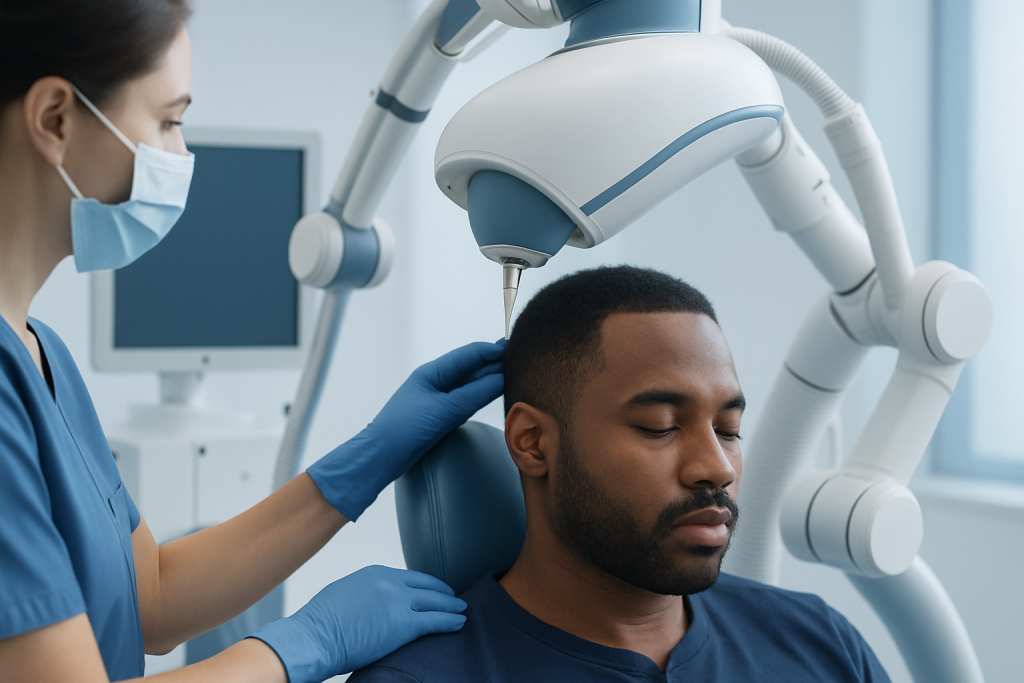
Hair implants, more commonly called hair transplants, can improve areas of permanent hair loss or thinning when enough healthy donor hair is available. They can help restore the hairline, fill in crown thinning, or improve density in selected areas where follicles have stopped producing strong hair.
They are not a cure for every type of hair loss. If shedding is caused by an active medical condition, such as untreated scalp inflammation, scarring alopecia that is still progressing, or a nutritional or hormonal issue that has not been addressed, surgery alone may not be the right first step. In those situations, the underlying cause should be evaluated and treated before any transplant is considered.
Another important expectation is texture. Transplanted hair usually keeps the donor area’s characteristics, so a patient with tightly coiled hair generally keeps that texture after surgery. That can be an advantage, because the restored hair blends more naturally with the surrounding hair when the planning is done well.
Symptoms and Types of Hair Loss to Discuss

People seeking African American hair implants often notice a receding hairline, widening part, thinning at the crown, or patchy loss along traction-prone areas such as the temples and edges. Some also seek treatment after years of tight braids, weaves, loc styles, chemical processing, or repeated tension on the scalp.
The pattern of hair loss helps guide the next step. Traction alopecia, male pattern hair loss, female pattern hair loss, and some forms of scarring alopecia may look similar at first glance, but they do not all respond to the same treatment. A careful scalp exam can distinguish between reversible thinning and hair loss that has permanently damaged follicles.
Patients should also mention itching, burning, tenderness, flaking, redness, or sudden shedding. These symptoms can point to scalp disease or inflammation, and those issues usually need attention before surgery is planned.
Causes and Risk Factors
Hair loss in Black patients can be influenced by genetics, hormones, age, medical conditions, and grooming practices. Androgenetic alopecia, also called pattern hair loss, is a common inherited cause. Traction from hairstyles that repeatedly pull on the hairline can also contribute, especially when it happens over many years.
Several factors can make surgical planning more complex. Tight curl pattern, thicker follicle curvature, a tendency toward keloid scarring in some patients, and pre-existing scalp inflammation all deserve attention. None of these automatically rule out a transplant, but they do make surgeon experience especially important.
Medical background also matters. A history of lupus, central centrifugal cicatricial alopecia, alopecia areata, anemia, thyroid disease, or recent childbirth can change the recommended approach. Because hair loss often has more than one cause, the evaluation should look at the whole picture rather than one visible patch at a time.
How Diagnosis Is Performed
Diagnosis usually begins with a detailed conversation about when the hair loss started, which areas changed first, and whether the hair shedding is stable or still worsening. The clinician may ask about hair care habits, chemical treatments, hairstyles, medications, family history, and any scalp symptoms.
The scalp is then examined closely. A specialist may use magnification, dermoscopy, or a hair-pull test to study follicle openings, density, and signs of inflammation or scarring. In some cases, blood tests are ordered to look for contributing factors such as iron deficiency, thyroid imbalance, or other systemic concerns.
If the diagnosis is uncertain or a scarring condition is suspected, a scalp biopsy may be recommended. That step can be very useful before surgery, because transplanting into an active inflammatory process may lead to poor growth or continued loss after the procedure.
Treatment Options
Treatment is not always surgery first. If the hair loss is early, active, or linked to scalp disease, the plan may include medical therapy, style changes that reduce tension, and scalp care before considering implants. For some patients, that approach preserves existing hair and improves the appearance enough that surgery is no longer necessary.
When a transplant is appropriate, two main surgical approaches are commonly discussed: FUE, or follicular unit extraction, and FUT, or follicular unit transplantation. FUE removes individual follicular units, while FUT removes a thin strip of scalp that is then dissected into grafts. In textured hair, the best choice depends on donor quality, curl pattern, scalp laxity, the desired hairline design, and the surgeon’s familiarity with these hair types.
Placement is just as important as harvesting. The angle, direction, and density of grafts must match the surrounding curls so the result does not look plugged or irregular. A natural outcome requires planning for how the hair will behave when short, styled, washed, and grown out over time.
Some patients also use non-surgical therapies alongside or before surgery. These may include topical or oral medications prescribed by a clinician, platelet-rich plasma in selected cases, or treatment of underlying scalp inflammation. The right combination depends on the diagnosis and the patient’s overall health.
Prevention and Self-care
Not all hair loss can be prevented, but some types can be slowed or reduced. Hairstyles that place constant tension on the hairline should be used cautiously, and it can help to alternate styles so one area is not under repeated stress. Gentle detangling, avoiding unnecessary heat or chemical trauma, and paying attention to early breakage are also worthwhile.
After a transplant, self-care becomes part of the treatment itself. Patients are usually advised to protect the scalp from friction, sun exposure, and scratching. Washing instructions matter, because the grafts are delicate in the early healing phase and need time to anchor securely.
For patients traveling from another country, the aftercare plan should be written clearly before departure. It helps to know when to resume shampooing, exercise, headwear, and styling, and which follow-up appointments can be done virtually or with a local physician if needed.
When to See a Doctor
It is sensible to seek medical advice when hair loss is persistent, spreading, or causing scalp discomfort. A prompt visit is especially important if the scalp is red, tender, scaly, or patchy, because those findings may signal an inflammatory condition rather than simple pattern thinning.
People considering African American hair implants should schedule a consultation before assuming surgery is the answer. A qualified doctor can confirm the diagnosis, explain whether the donor area is strong enough, and discuss realistic results based on the patient’s hair density and texture.
For international patients, a specialist team can also coordinate imaging, lab work, and the surgical timeline in a way that reduces unnecessary travel. Acibadem Health Point’s multidisciplinary specialists and JCI-accredited hospitals diagnose and treat hair loss conditions for international patients, with attention to both medical safety and practical recovery planning.
Frequently asked questions
01Can African American hair be transplanted successfully?
Yes, textured hair can be transplanted successfully when the surgeon understands the curl pattern and follicle shape. The technique and design need to be adapted to the patient’s hair characteristics, not copied from a one-size-fits-all plan.
02Is FUE or FUT better for textured hair?
Neither method is automatically best for everyone. The right option depends on the donor area, the extent of hair loss, the surgeon’s skill with textured follicles, and the patient’s goals.
03Will transplanted hair keep its natural curl?
In most cases, yes. Transplanted follicles usually keep the traits of the donor hair, so coiled or curly texture generally remains after surgery.
04Can traction alopecia be treated with hair implants?
Sometimes, but only if the traction-related hair loss is stable and the follicles are no longer actively being damaged. If the condition is still progressing, the first step is usually to stop the traction and treat the scalp.
05How long does it take to see results after a hair transplant?
Healing happens first, then shedding of the transplanted hairs may occur before new growth starts. Noticeable improvement usually develops gradually over several months, with final maturation taking longer.
06What should a patient ask during the consultation?
It helps to ask about the diagnosis, whether the loss is stable, which technique is recommended, how the surgeon handles textured follicles, and what aftercare will look like after returning home. Patients should also ask what results are realistic for their donor supply.
This article is for general information only and is not a substitute for professional medical advice. Please consult a qualified doctor about your individual situation.
Hair transplant in Turkey — costs, graft counts & a free assessment
JCI-accredited · board-certified surgeons · reply within 24h
Add us as a Preferred Source to see more of our trusted health content across Google Search, AI Overviews and Discover.