Hair Transplant Curly Hair: Procedure, Benefits, Risks and Recovery

Key Takeaways
- Curly hair transplant surgery can work very well, but the underlying follicle shape makes planning and extraction more technical.
- Both the donor area and the curl pattern must be evaluated before surgery to reduce the risk of graft damage or an unnatural look.
- Recovery is usually similar to other hair transplants, yet aftercare matters more when the scalp is tightly curled, coiled, or prone to dryness.
- Not every person with curly hair is an ideal candidate; scalp health, hair density, and the cause of hair loss all influence the outcome.
- Results appear gradually, and final growth often takes several months as transplanted follicles settle into their new location.
A hair transplant for curly hair can restore fullness while preserving the natural curl pattern, but it requires careful planning because curly follicles grow in a curved shape beneath the skin. The best results come from a surgeon experienced with textured hair, realistic expectations, and a recovery plan that protects both the grafts and the scalp.
Overview
A hair transplant for curly hair is designed to move healthy hair follicles from a donor area to thinning or balding areas while keeping the hair’s natural texture intact. The procedure can be highly effective, but it is more technically demanding than transplants on straight hair because curly follicles often curve beneath the skin and may extend deeper than expected.
That hidden curve matters during extraction. If the follicle is not removed carefully, it can be damaged before it is even transplanted. For that reason, a surgeon who understands textured hair patterns, scalp anatomy, and density planning is especially important when someone is considering hair restoration for wavy, curly, or coily hair.
For international patients, the decision often begins long before surgery: choosing a clinic, sharing scalp photos remotely, confirming whether the donor area is suitable, and discussing how follow-up will work once the person has returned home. Those early steps help set realistic expectations and make the treatment plan safer and clearer.
Symptoms and Hair Loss Patterns That Lead to Treatment
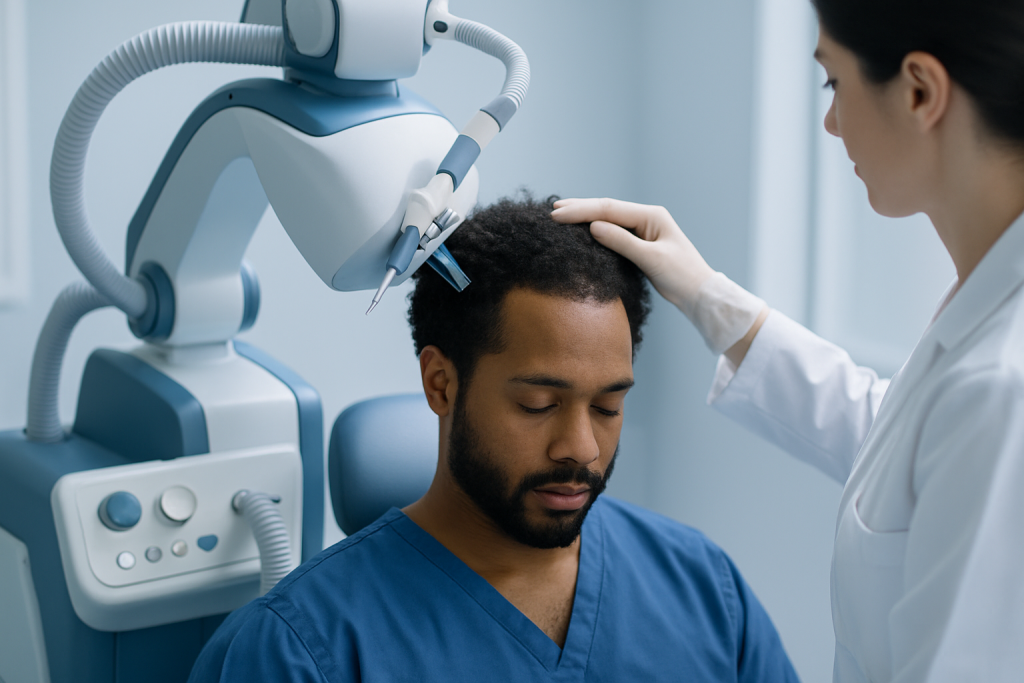
People usually do not seek a transplant because of curl type itself; they seek it because hair loss has changed the shape, coverage, or styling options of their hair. In curly hair, thinning may first show up as widening part lines, a less defined hairline, or reduced volume rather than obvious bare patches.
Androgenetic alopecia is a common reason for seeking restoration, but traction alopecia, scarring hair loss, and some forms of past inflammation can also affect textured hair. Because curly hair often has more visual density even when some loss is present, changes may progress quietly before they become more noticeable in photographs or daily grooming.
- Gradual thinning at the temples or crown
- Loss of density along the front hairline
- Patchy areas after tight styles or repeated tension
- Reduced fullness that makes the scalp easier to see
A consultation helps determine whether the person is dealing with temporary shedding, stable pattern hair loss, or a condition that needs treatment first. A transplant is usually considered only when the underlying hair loss pattern is understood and reasonably stable.
Causes and Risk Factors

The basic cause of a transplantable hair loss problem is usually follicle miniaturization or loss of viable hair in the recipient area, while the donor area remains strong enough to supply grafts. In curly hair, the donor zone must be assessed with extra care because the visible hair shafts do not always reflect the direction and depth of the follicle under the scalp.
Several factors can influence candidacy and planning. A person with dense donor hair, stable hair loss, and healthy scalp skin may have more predictable results than someone with active inflammation, recent shedding, or a history of scarring alopecia. Traction from tight braids, loc styles, weaves, or repeated pulling can also contribute to loss that may or may not be suitable for transplantation depending on the state of the follicles.
Skin tone, healing tendency, and previous scalp procedures may also affect the strategy. In textured hair patients, surgeons often think not only about replacing lost density but also about preserving the natural direction, spacing, and curl pattern so the transplant blends rather than stands out.
Diagnosis and Preoperative Evaluation
Before any procedure is scheduled, the clinician evaluates the cause of hair loss, the stability of the pattern, and the quality of both donor and recipient areas. This usually includes a medical history, scalp examination, and sometimes magnified inspection of the hairs and follicles to understand growth direction and density.
For curly hair, mapping the donor area can be especially important. The curved follicle path means the extraction angle may differ from what is seen at the surface, so planning tools and surgeon experience matter. The team may also discuss medications, prior hair treatments, recent chemical processing, and any scalp conditions that could influence healing.
When a patient is traveling from another country, the evaluation may begin with high-quality photographs or video consultations, followed by an in-person assessment before surgery. That process allows the surgical team to confirm whether the plan is realistic, how many grafts may be needed, and whether a staged approach would be safer than trying to do everything at once.
Treatment Options and How the Procedure Works
The two main transplant techniques are follicular unit extraction (FUE) and follicular unit transplantation (FUT), also called strip harvesting. In curly hair, FUE is often discussed because it can avoid a linear scar, but the most suitable method depends on the individual’s hair characteristics, donor supply, scalp laxity, and the surgeon’s experience.
During FUE, the surgeon removes individual follicular units from the donor area and places them into small recipient sites. Because curly follicles can turn under the skin, extraction must be done with careful angling to avoid transection. In FUT, a strip of scalp is removed from the donor area, and grafts are prepared under magnification; this may provide a large number of grafts in some patients, though it also leaves a scar that must be considered.
The design of the hairline and recipient pattern matters just as much as the extraction technique. For curly hair, the natural irregularity and volume can be an advantage, but only if the placement respects the way the hair lifts, bends, and frames the face. A well-planned transplant should look balanced both when styled and when the hair is worn naturally.
- Pre-op planning: donor assessment, hairline design, and graft estimation
- Extraction: careful removal of follicles without damaging the curved root
- Site creation: tiny incisions placed to match natural direction and density
- Implantation: grafts positioned to support curl pattern and overall coverage
Benefits and Expected Results
The main benefit of a curly hair transplant is restoration that can blend naturally with the person’s own texture. Because curls add visual fullness, even a moderate number of well-placed grafts may create a meaningful improvement in coverage and framing.
Another benefit is psychological and practical: some people feel more comfortable wearing shorter styles, leaving hair loose, or avoiding certain techniques that were previously used to disguise thinning. A transplant can also support areas where styling options have become limited by hair loss.
Results do not appear immediately. Transplanted hairs often shed before new growth begins, which can be surprising if a patient is not prepared for it. Over the following months, the follicles gradually resume growth, and the final appearance usually becomes clearer as the hairs thicken and the curl pattern becomes more visible.
Risks and Possible Complications
Hair transplantation is generally considered safe when performed by qualified specialists, but it still carries medical and cosmetic risks. For curly hair, some risks are more closely tied to the technical challenge of handling curved follicles and creating a natural-looking pattern.
Possible complications include swelling, temporary redness, discomfort, infection, poor graft survival, scarring, or an uneven result if the angle and density are not well planned. In some cases, donor hairs may be damaged during extraction if the curl is not accurately anticipated beneath the skin.
Other concerns are not unique to curly hair but remain important: shock loss in nearby hair, delayed healing, and the possibility that the transplant does not fully meet expectations if hair loss continues in untreated areas. A candid discussion before surgery helps patients understand what the procedure can and cannot accomplish.
Recovery, Aftercare, and Long-Term Maintenance
Recovery usually starts with protecting the grafts from friction, pressure, and excessive moisture or manipulation during the early healing period. The scalp may feel tender at first, and the transplanted area often needs gentle handling rather than aggressive washing, scratching, or styling.
Curly and coily hair types can be more prone to dryness, so aftercare often includes a careful cleansing routine and scalp care plan tailored to the surgeon’s instructions. Patients should avoid tight hairstyles, heavy products on the healing area, and anything that could disturb the grafts while they are settling in.
Long-term maintenance may include medical treatment for ongoing hair loss, if appropriate, because a transplant does not stop future thinning in untreated follicles. The best outcomes usually come from combining surgery with a sensible hair-care routine, follow-up visits, and attention to scalp health over time.
For patients coming from abroad, the recovery plan should also account for travel timing, local access to supplies, and when it is safe to fly home. A clear written aftercare plan makes it easier to continue healing consistently after leaving the clinic.
When to See a Doctor
A doctor’s evaluation is helpful before any transplant is planned, especially if hair loss is recent, patchy, or associated with itching, scaling, pain, or redness. These features may point to a scalp condition that should be treated first.
After surgery, medical advice should be sought if there is increasing pain, spreading redness, discharge, fever, or sudden shedding that seems unusual. Even when recovery is normal, follow-up matters because the surgeon can assess graft growth, donor healing, and whether the pattern is progressing as expected.
People considering treatment from another country should choose a clinic that can provide structured follow-up and clear communication after they return home. At Acibadem Health Point, multidisciplinary specialists and JCI-accredited hospitals diagnose and treat hair loss conditions for international patients in a coordinated way, which can be especially helpful when planning care across borders.
Prevention and Self-care
Not every form of hair loss can be prevented, but the scalp can often be protected from avoidable stress. People with curly hair may benefit from gentle styling choices that reduce traction, as repeated pulling can gradually weaken the hairline and temples.
Healthy self-care also includes treating dandruff or scalp irritation early, avoiding harsh chemical processing when hair is already fragile, and using products that do not leave the scalp dry or inflamed. If hair shedding seems to be increasing, it is better to investigate the cause sooner rather than assume the problem will resolve on its own.
After a transplant, patience is part of self-care. The scalp needs time to heal, and the new hairs need months to show their full effect. Consistent follow-up, realistic expectations, and a gentle routine usually support the most satisfying long-term result.
Frequently asked questions
01Can curly hair be transplanted successfully?
Yes, curly hair can be transplanted successfully when the surgeon understands how curly follicles travel beneath the skin. The main challenge is technical rather than cosmetic, because the follicle’s curved path makes careful extraction and placement more important.
02Is FUE better than FUT for curly hair?
Neither method is automatically better for every person. FUE is often favored because it avoids a linear scar, but FUT may be appropriate in some cases depending on donor supply, hair characteristics, and the surgeon’s judgment.
03Will the transplanted hair keep its curl pattern?
In most cases, transplanted hair keeps the texture it had in the donor area. Once it grows in the new site, it usually retains its natural curl, although the appearance can vary slightly with length, healing, and styling.
04How long does recovery take after a curly hair transplant?
Early healing usually takes days to a couple of weeks, but visible growth takes much longer. Many patients notice gradual improvement over several months, with the final result becoming clearer as the hairs mature.
05Is a curly hair transplant painful?
The procedure is typically performed with local anesthesia, so discomfort during surgery is usually limited. Some soreness, tightness, or sensitivity can occur afterward, but this is generally manageable with proper aftercare.
06Who is a good candidate for a hair transplant with curly hair?
A good candidate usually has stable hair loss, enough healthy donor hair, and a scalp condition that is suitable for surgery. A consultation is needed to confirm whether the cause of hair loss and the pattern of thinning make transplantation a sensible option.
This article is for general information only and is not a substitute for professional medical advice. Please consult a qualified doctor about your individual situation.
Hair transplant in Turkey — costs, graft counts & a free assessment
JCI-accredited · board-certified surgeons · reply within 24h
Add us as a Preferred Source to see more of our trusted health content across Google Search, AI Overviews and Discover.