Kettlebell Swings

Key Takeaways
- Kettlebell swings are a hip-driven movement, not a squat or a front-arm lift.
- Good technique helps reduce strain on the lower back, shoulders, and hands.
- They can support fitness goals such as power, endurance, and core engagement.
- People with pain, recent injury, or balance concerns should get individualized guidance first.
- Progressing gradually is usually safer than choosing a heavier kettlebell too soon.
Kettlebell swings are a dynamic exercise that can improve hip strength, conditioning, and movement coordination when performed with good technique. For many people, they can be a useful part of a fitness or rehabilitation plan, but the movement should be matched to the person’s current health, experience, and mobility.
Overview
Kettlebell swings are one of the most recognizable movements in functional training. At first glance, they may look simple: the kettlebell travels between the legs and then swings forward to about chest height. In reality, the exercise depends on coordinated hip movement, trunk control, and timing.
The main idea is to use a powerful hip hinge rather than lifting with the arms. When the movement is taught well, kettlebell swings can help people build lower-body strength, improve conditioning, and practice forceful hip extension in a controlled way. That makes the exercise useful for active adults, athletes, and some rehabilitation programs.
Because the swing is fast and repetitive, it is not the best starting point for everyone. People who are new to exercise, recovering from pain, or unsure about their movement mechanics may benefit from learning the hinge pattern first with guidance from a clinician, physiotherapist, or qualified trainer.
How the movement works
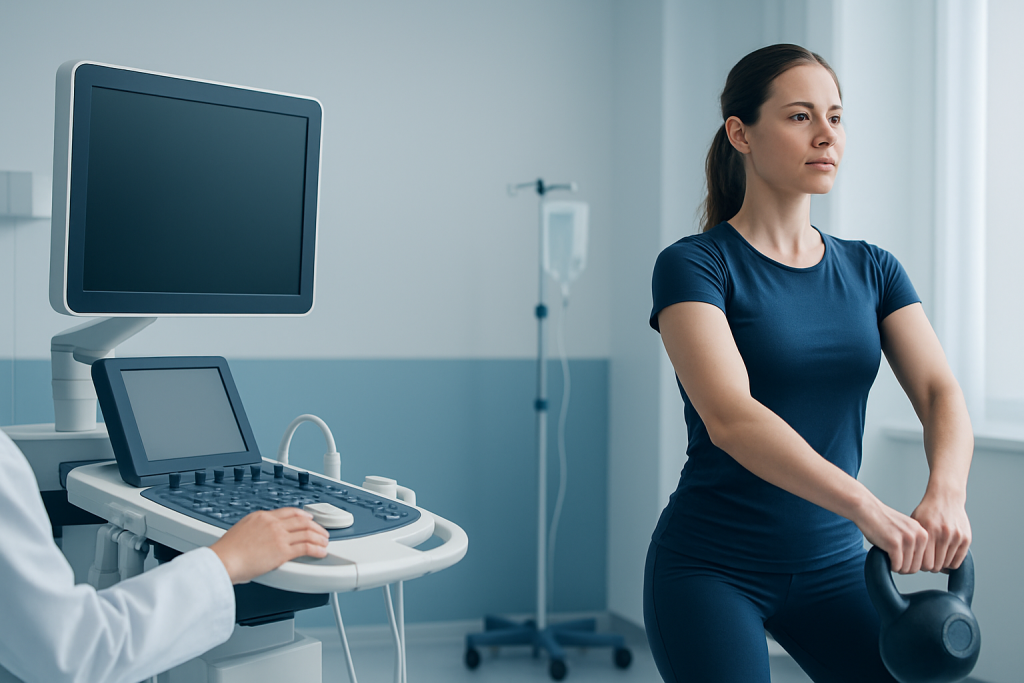
A proper kettlebell swing begins with the hips moving backward while the spine stays long and neutral. The kettlebell is then guided back between the thighs, and the hips drive forward to send the weight upward. The arms guide the bell, but the hips create the force.
At the top of the swing, the body should feel tall and stable, with the glutes and core engaged. The bell is allowed to float because of momentum; it should not be pulled up with the shoulders. The bell then returns along the same path as the hips hinge again for the next repetition.
This pattern matters because the exercise trains an athletic skill: generating power efficiently while keeping the trunk organized. In rehabilitation settings, that can be helpful for people who need to relearn safe bending, lifting, and force transfer. For others, it simply offers an efficient way to combine strength and cardiovascular work in one movement.
Benefits and practical uses

Many people choose kettlebell swings because they are time-efficient. A short set can raise the heart rate while also challenging the posterior chain, which includes the glutes, hamstrings, and back muscles. The exercise can also reinforce posture awareness and trunk stiffness during movement.
Some of the most common reasons people add kettlebell swings to a routine include:
- building hip power for sport and daily activity
- improving conditioning without long equipment-heavy workouts
- strengthening the glutes and hamstrings
- practicing core control during dynamic movement
- supporting a broader return-to-activity plan under supervision
For international patients who travel for rehabilitation or sports medicine care, the exercise may be used as part of a personalized home program after assessment. In those cases, the exact pace, volume, and progression are usually adjusted to match recovery goals, movement quality, and any travel-related limitations.
Common mistakes and why they matter
Many swing-related problems come from turning the movement into a squat, a front raise, or a back lift. When the knees bend too much and the torso stays too upright, the hips do less work than intended. When the arms do too much lifting, the shoulders may take on unnecessary strain.
Another frequent issue is rounding the lower back during the backswing. A neutral spine is generally easier to control and may reduce unwanted stress on the back. The swing also should not be forced into a very high arc if the person cannot maintain good control; chest-height swings are enough for most standard versions of the exercise.
Breathing and grip can also affect quality. Holding the breath for too long may make the movement feel stiff, while a grip that is too tense can fatigue the forearms before the hips are challenged. A coach or physiotherapist can often spot these issues quickly and make the drill safer and more effective.
Who should be cautious
Kettlebell swings are not appropriate for every body at every stage. People with new or unexplained back pain, recent abdominal surgery, pelvic floor symptoms, shoulder problems, vertigo, or balance difficulties may need to modify the exercise or avoid it until they are assessed.
Extra caution is also sensible during pregnancy, after childbirth, and after any musculoskeletal injury. Even when a person has trained with kettlebells before, pain, fatigue, medication changes, or limited sleep can affect coordination and control. The safest option is to return gradually rather than resuming a prior routine all at once.
If there is any concern about technique, the person’s medical history, or whether the movement fits a rehabilitation plan, a qualified clinician can assess readiness and suggest alternatives such as deadlifts, carries, hip bridges, or lighter hinge drills.
How kettlebell swings are assessed and taught
When a patient or athlete is learning kettlebell swings, the first step is usually a movement assessment. A clinician or coach may look at hip mobility, hamstring length, trunk stability, shoulder comfort, and how the person bends and stands from the floor. This helps identify whether the swing is a good choice right now.
Teaching often starts with simple cues and progressions. A person may practice hip hinging without weight, then use a deadlift pattern with a kettlebell, and only later move into the swing. This stepwise approach can make the movement easier to understand and may reduce the chance of overloading the wrong tissues.
In rehabilitation programs, progress is typically based on movement quality rather than speed or repetition count. If the person loses posture, feels pain, or cannot maintain rhythm, the exercise may need to be scaled back. That same principle applies whether care is happening locally or after travel for specialist treatment.
Training tips and self-care
For most people, the safest way to approach kettlebell swings is to begin with a light load and a small number of repetitions. The bell should feel manageable enough that the person can stay focused on technique instead of simply surviving the set. Increases in weight or volume are usually best made gradually.
Helpful habits include warming up the hips and hamstrings, wearing stable shoes, and making sure the training area is clear. Rest between sets matters too, especially for beginners, because fatigue can quickly change mechanics. If the movement starts to feel rushed or sloppy, stopping the set is often the best decision.
Self-care also includes recovery outside the workout. Adequate sleep, hydration, and balanced training load all support safer performance. People recovering from injury may benefit from combining kettlebell work with mobility, core training, and clinician-guided strengthening so the exercise fits the broader recovery plan rather than standing alone.
When to see a doctor
Medical advice is appropriate if kettlebell swings cause sharp pain, numbness, tingling, unusual shortness of breath, dizziness, or a sense that the back or shoulder is not moving normally. A person should also seek evaluation if discomfort keeps returning each time the exercise is attempted.
It is wise to speak with a doctor, physiotherapist, or sports medicine specialist before starting swings if there is a history of spine injury, hernia, pelvic floor concerns, recent surgery, or a condition that affects balance or coordination. The right guidance can help decide whether the exercise is suitable and how it should be modified.
Acibadem Health Point works with multidisciplinary specialists in JCI-accredited hospitals to diagnose and treat musculoskeletal and rehabilitation-related conditions for international patients, including those who need a careful return to exercise after injury or treatment.
Frequently asked questions
Are kettlebell swings good for beginners?
They can be, but many beginners do better when they first learn the hip hinge with simpler drills. A light load and close supervision can make the movement safer and easier to understand. If coordination, back pain, or balance is an issue, a clinician may suggest a different starting exercise.
Should kettlebell swings feel in the back or the legs?
They should mainly feel like work in the hips, glutes, hamstrings, and core. Some trunk effort is normal because the body must stay stable, but sharp back discomfort is not expected. If the lower back is doing most of the work, the technique likely needs adjustment.
Can kettlebell swings help with weight loss?
They can support an overall fitness plan because they are physically demanding and may improve conditioning. However, weight management depends on many factors, including nutrition, sleep, activity level, and medical history. The exercise works best as part of a broader, realistic routine.
How heavy should a kettlebell be for swings?
There is no single correct weight for everyone. The right choice depends on strength, experience, mobility, and the reason for training. A safe approach is to start lighter than expected and increase only when technique stays consistent.
Are kettlebell swings safe for people with back pain?
Sometimes, but not always. Some people with resolved or well-managed back issues can learn the movement safely, while others should avoid it or use a modified pattern. A medical or physiotherapy assessment is the best way to decide.
What is the difference between a kettlebell swing and a squat?
A swing is a hip hinge, meaning the hips move back and then snap forward to create momentum. A squat involves more bending at the knees and usually keeps the torso more upright. Mixing up the two can change which muscles work and may affect safety.
References
- American College of Sports Medicine
- National Institute of Arthritis and Musculoskeletal and Skin Diseases
- Mayo Clinic
- World Health Organization
- National Strength and Conditioning Association
This article is for general information only and is not a substitute for professional medical advice. Please consult a qualified doctor about your individual situation.