What Is FUE Without Shaving? A Complete Medical Guide

Key Takeaways
- FUE without shaving is a variation of follicular unit extraction that leaves most or all of the donor hair untrimmed.
- It may help patients keep their procedure less noticeable in daily life and during travel or work.
- Candidate selection depends on hair length, donor density, the size of the transplant, and the pattern of hair loss.
- The technique can be more time-consuming and technically demanding than standard shaved FUE.
- Recovery and aftercare are similar to other hair transplants, with careful washing, protection, and follow-up important.
FUE without shaving is a hair transplant approach in which the donor area is not fully clipped before follicular unit extraction. It can be useful for selected patients who want a more discreet procedure and a faster return to normal appearance, but it is not suitable for everyone.
Overview
FUE without shaving is a hair transplant technique in which the surgeon removes follicular units from the donor area without fully shaving the scalp first. In practical terms, the hair around the extraction sites is left long enough to help cover the tiny punch points, making the procedure less visible to others.
For many patients, that discretion is the main attraction. Someone planning a transplant while continuing to work, attend meetings, or travel internationally may prefer a method that does not require a closely clipped donor area. The trade-off is that unshaven FUE usually takes longer and demands a highly experienced surgical team.
It is important to understand that “without shaving” does not mean “without preparation.” The surgeon still needs a carefully planned donor map, clear visibility of the follicles, and a realistic estimate of how many grafts can be safely extracted. The decision is therefore medical as well as cosmetic, based on hair characteristics, the pattern of hair loss, and the patient’s goals.
How the technique is different from standard FUE
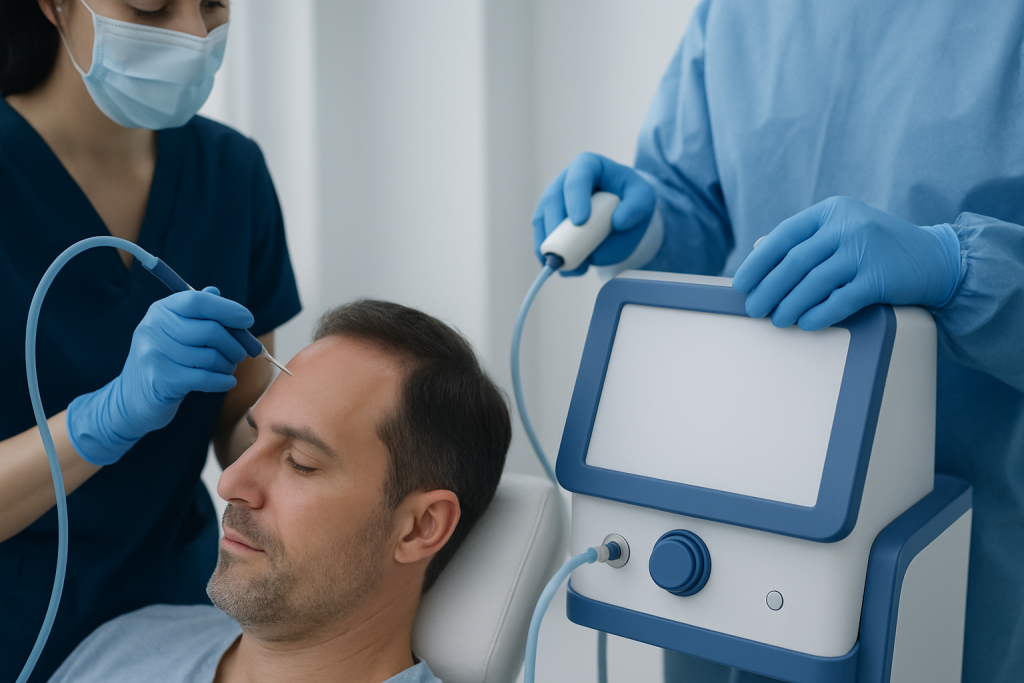
Standard FUE typically involves trimming the donor area so the surgeon can identify, isolate, and remove follicular units more efficiently. This makes the extraction field easier to see and can shorten procedure time, especially when a larger number of grafts is needed.
With FUE without shaving, the surgeon works around longer hairs. The visible hair can help disguise the donor site after the procedure, but it also requires more careful handling. Each graft must be selected and removed without excessive cutting or transecting of adjacent hairs.
There are several variations of the approach. Some patients have the donor area partially trimmed in hidden sections, while others have only a narrow strip shaved under longer hair. The best option depends on how many grafts are needed, where the donor hair is located, and how much concealment matters to the patient after surgery.
- Standard FUE: donor area is usually clipped short
- Unshaven or no-shave FUE: donor hair is left long for concealment
- Partial shaving: only a small, hidden area is trimmed
Who may be a good candidate

FUE without shaving is often considered for patients who value privacy and wish to return to routine activities without an obvious change in appearance. It may be appealing for people with public-facing jobs, those who cannot easily explain a shaved scalp, or international patients who want to travel home with minimal visible signs of treatment.
Good candidates usually have enough donor density and hair length to allow the surgeon to work safely while still keeping the area reasonably covered. Patients with longer hair and limited-to-moderate graft requirements are often more suitable than those needing a very large session.
Not everyone is a match for this approach. If the donor hair is very short, if the scalp is difficult to access, or if a large number of grafts is required, standard shaved FUE or another transplant plan may be more practical. The final decision should come from an in-person assessment rather than a general preference alone.
Causes of hair loss and factors that affect planning
Hair transplantation is usually performed for androgenetic alopecia, also called pattern hair loss. In this condition, follicles in specific areas become sensitive to hormonal influences over time, leading to gradual thinning at the hairline, temples, mid-scalp, or crown. FUE does not stop the underlying tendency to thin; it redistributes resilient follicles from the donor area to thinning areas.
Other types of hair loss may also be evaluated, including traction-related hair loss, scarring alopecias, and shedding after illness or stress. Some of these conditions are not suitable for transplant until the disease is stable, and some are not appropriate for surgery at all. A careful diagnosis matters because the wrong procedure can lead to disappointing or uneven results.
Planning is also shaped by the donor zone, hair curl, hair color contrast with the scalp, and the quality of the existing hair. These details influence both the ease of extraction and the final cosmetic effect. For patients traveling from abroad, the surgeon may also need to plan follow-up visits, remote check-ins, and the timing of return flights so the recovery window is realistic.
What happens during diagnosis and consultation
The consultation usually begins with a medical history, scalp examination, and discussion of the patient’s goals. The surgeon will want to know how long the hair loss has been present, whether it is still progressing, and whether the patient has had prior procedures, medications, or scalp treatments.
Photographs, density measurements, and a donor assessment are commonly used to decide whether FUE without shaving is technically feasible. The doctor may examine the scalp under magnification to estimate follicle spacing, evaluate hair shaft caliber, and identify areas where extraction can be done with minimal visible impact.
Patients should expect a candid discussion of limitations. If the desired graft count is too high for an unshaven approach, the surgeon may recommend a different plan rather than trying to force the technique. In hair restoration, a conservative and well-matched plan usually serves the patient better than a purely aesthetic preference that ignores donor safety.
Treatment options and the procedure itself
Once the plan is confirmed, the surgeon marks the donor and recipient areas and designs a hairline or filling pattern that suits the patient’s face and age. Local anesthesia is used so the procedure is generally comfortable, although patients may feel pressure or vibration during extraction and placement.
In FUE without shaving, individual follicular units are harvested one by one from among the longer hairs. The grafts are then prepared and implanted into the thinning or bald areas using the selected placement method. Because the surgeon must work carefully around surrounding hair, the session may take longer than a standard shaved FUE session.
The main options that may be discussed include:
- Unshaven FUE: donor hair remains long throughout the process
- Partially shaved FUE: only hidden or small sections are trimmed
- Standard FUE: most efficient for higher graft numbers or simpler access
Some patients also ask about newer or branded names for the same general concept. The exact label matters less than whether the team has the training and planning discipline to perform the extraction safely and achieve a natural distribution of grafts.
Recovery, results, and self-care
Recovery after FUE without shaving is broadly similar to recovery after other FUE procedures. Mild swelling, redness, crusting, or tenderness can occur for a short period, and the donor area may feel tight or sensitive. Because the surrounding hair is left longer, some people find the donor area easier to conceal during the first days of healing.
Aftercare usually includes gentle washing, avoiding rubbing or scratching, protecting the scalp from sun and heavy sweating, and following the clinic’s instructions about sleeping position and activity. If the patient is returning to another country, it is sensible to clarify when the first wash will happen, how to handle the first several days of recovery while traveling, and whom to contact if questions arise after arrival home.
Visible growth from the transplanted follicles does not appear immediately. Shedding of transplanted hairs in the early weeks is normal, and new growth typically develops gradually over subsequent months. A reputable team will explain the timeline honestly so the patient knows what is expected and when follow-up review is appropriate.
- Use the prescribed washing technique exactly as instructed
- Avoid strenuous exercise until the surgeon says it is safe
- Protect the scalp from direct sun exposure
- Keep all follow-up appointments, including virtual checks if traveling abroad
Risks, limitations, and when to seek medical advice
As with any surgical procedure, FUE without shaving carries some risks. These may include infection, bleeding, temporary swelling, numbness, poor graft survival, or visible scarring at the extraction sites. Most side effects are limited and manageable when the procedure is done by qualified professionals and aftercare instructions are followed carefully.
The main limitation is not medical safety alone but surgical practicality. Because the hair is left unshaven, the doctor may need more time to work, and the number of grafts that can be extracted in one session may be lower. Patients seeking very extensive coverage may need a different approach or staged treatment.
A doctor should be contacted if redness worsens instead of improving, pain becomes significant, drainage appears, or the scalp develops feverish warmth or spreading swelling. Patients should also seek review if they are unsure whether healing is on track, especially when they have already returned to their home country and need guidance from the treating team.
Acibadem Health Point’s multidisciplinary specialists and JCI-accredited hospitals diagnose and treat hair loss for international patients, including those considering discreet transplant options such as FUE without shaving.
Prevention & self-care for protecting the result
Hair transplant surgery works best when the surrounding hair and scalp are healthy. Patients are usually advised to avoid smoking before and after surgery if possible, since smoking can affect healing. A balanced diet, stable sleep, and sensible scalp care also support recovery, although they do not replace medical treatment.
For people with ongoing pattern hair loss, long-term planning matters. A transplant restores density in selected areas, but native hair may continue to thin over time. Doctors may therefore discuss ongoing medical management, periodic reassessment, or future sessions to keep the overall appearance balanced.
It is also wise to protect the scalp from unnecessary trauma. Tight hairstyles, aggressive brushing, unapproved topical products, and premature return to intense exercise can all interfere with healing. A simple rule is helpful: if a care step feels forceful, hot, or irritating, it is better to check with the treating team first.
When to see a doctor
A consultation is appropriate for anyone with progressive hair thinning who is considering a transplant and wants to know whether FUE without shaving is realistic. It is especially useful for patients who need a discreet approach because of work, social reasons, or travel plans.
Medical review is also important if hair loss is sudden, patchy, painful, or associated with scalp redness, scaling, or scarring. These features may point to a condition that needs diagnosis before any surgical plan is made. Even when the goal is cosmetic, the scalp should be evaluated as a medical issue first.
Patients who have already had a transplant and are unhappy with healing, density, or direction of growth should seek follow-up rather than waiting. Early assessment can clarify whether the issue is part of normal recovery or whether a correction, medical treatment, or longer observation period is needed.
Frequently asked questions
01What does FUE without shaving mean?
It means the donor area is not fully shaved before follicular unit extraction. The surgeon removes grafts while keeping surrounding hair long enough to help conceal the extraction sites. This can make the procedure less noticeable in everyday life.
02Is FUE without shaving better than standard FUE?
It is not better for everyone; it is simply different. Unshaven FUE may be preferred for privacy, but standard FUE can be more efficient when more grafts are needed. The best choice depends on the patient’s hair, donor density, and treatment goals.
03Does unshaven FUE take longer?
Usually, yes. Working around longer hair requires more time and precision, so the session can take longer than a shaved approach. The exact duration depends on the number of grafts and the complexity of the case.
04Will people notice I had a hair transplant?
FUE without shaving is designed to be more discreet, especially in the donor area. Some redness or minor swelling may still be visible in the first days, but the longer hair often helps conceal the procedure. Results and visibility vary from person to person.
05Who should avoid FUE without shaving?
It may not suit patients who need a very large number of grafts, have very short donor hair, or have a scalp condition that has not been properly evaluated. It is also less suitable when donor access is difficult. A surgeon should assess whether another method is safer or more effective.
06How soon can someone travel after the procedure?
Many patients can travel after their surgeon confirms that the immediate post-procedure period is stable, but timing should be individualized. For international patients, it is helpful to plan a short recovery window and understand the first washing and follow-up schedule before leaving the clinic.
This article is for general information only and is not a substitute for professional medical advice. Please consult a qualified doctor about your individual situation.
Hair transplant in Turkey — costs, graft counts & a free assessment
JCI-accredited · board-certified surgeons · reply within 24h
Add us as a Preferred Source to see more of our trusted health content across Google Search, AI Overviews and Discover.