

What Is Benign Mole? A Complete Medical Guide
- 8 min read
- Published November 27, 2026
Key Takeaways
- Most benign moles are harmless and stable over time.
- A mole that changes in size, shape, color, or symptoms should be checked.
- Sun exposure and genetic factors can influence mole development.
- Doctors use skin examination and, when needed, dermoscopy or biopsy to confirm whether a mole is benign.
- Treatment is usually only needed for irritation, cosmetic reasons, or concern about cancer.
A benign mole is a common, usually harmless growth made of pigment-producing cells in the skin. Most do not require treatment, but any changing, unusual, or symptomatic mole should be assessed by a qualified clinician.
Overview
A benign mole is a noncancerous skin growth formed by clusters of melanocytes, the cells that make skin pigment. Many people have several moles, and most appear during childhood, the teen years, or early adulthood. In everyday practice, the term usually refers to a common mole that remains stable and does not show warning signs of skin cancer.
For patients deciding whether a mole needs attention, the most useful question is not simply whether it exists, but whether it has changed. A mole that has looked the same for years is often reassuring. A mole that is new, grows quickly, becomes irregular, or starts itching or bleeding deserves a medical review.
Benign moles may be flat or raised, brown, tan, pink, or even skin-colored. They can appear anywhere on the body, including areas that are easy to see and areas that are hidden by clothing. Because people traveling for care often want clarity before or during a trip, a clear skin examination can help determine whether a lesion is likely benign and whether any treatment is needed now or later.
Symptoms and Typical Appearance
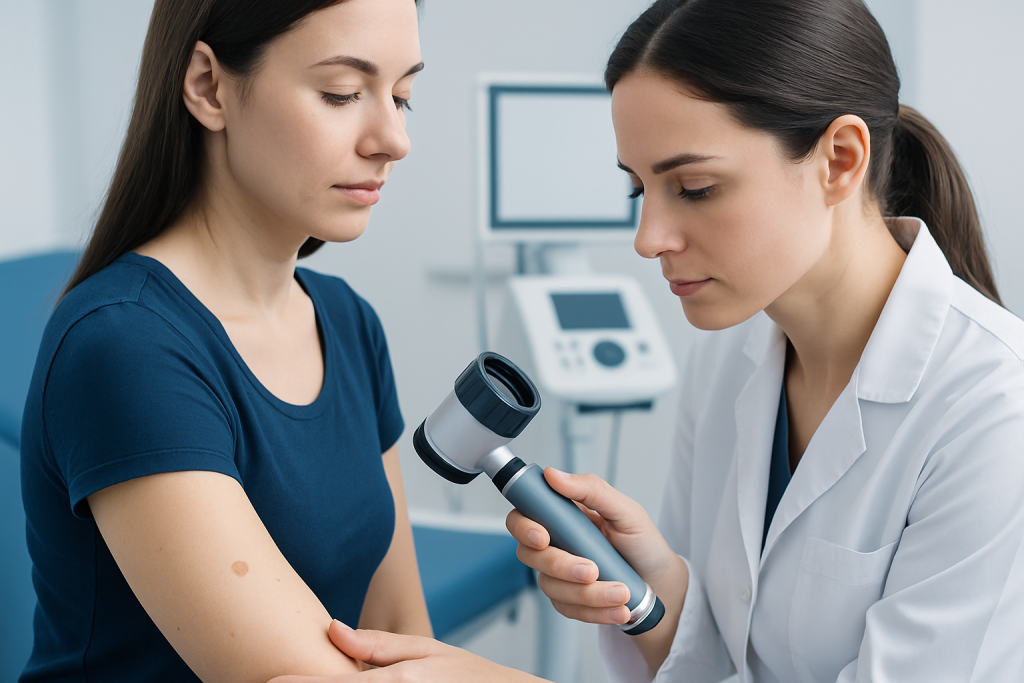
Benign moles usually have a familiar, orderly look. They are often round or oval, with smooth borders and a fairly even color. Some are small and flat; others are dome-shaped or slightly elevated. They may feel soft or firm, and many remain unchanged for long periods.
Common features of a benign mole can include:
- Symmetrical shape
- Even or uniform coloring
- Small size, often less than about 6 mm, though size alone is not enough to decide
- Stable appearance over time
- No persistent bleeding, crusting, or pain
Symptoms such as itching or tenderness do not automatically mean cancer, but they do make an exam more important. A mole can also become irritated by shaving, friction from clothing, or repeated rubbing. Even then, a clinician may want to look at it to make sure the irritation is truly mechanical rather than a sign of something else.
Causes and Risk Factors
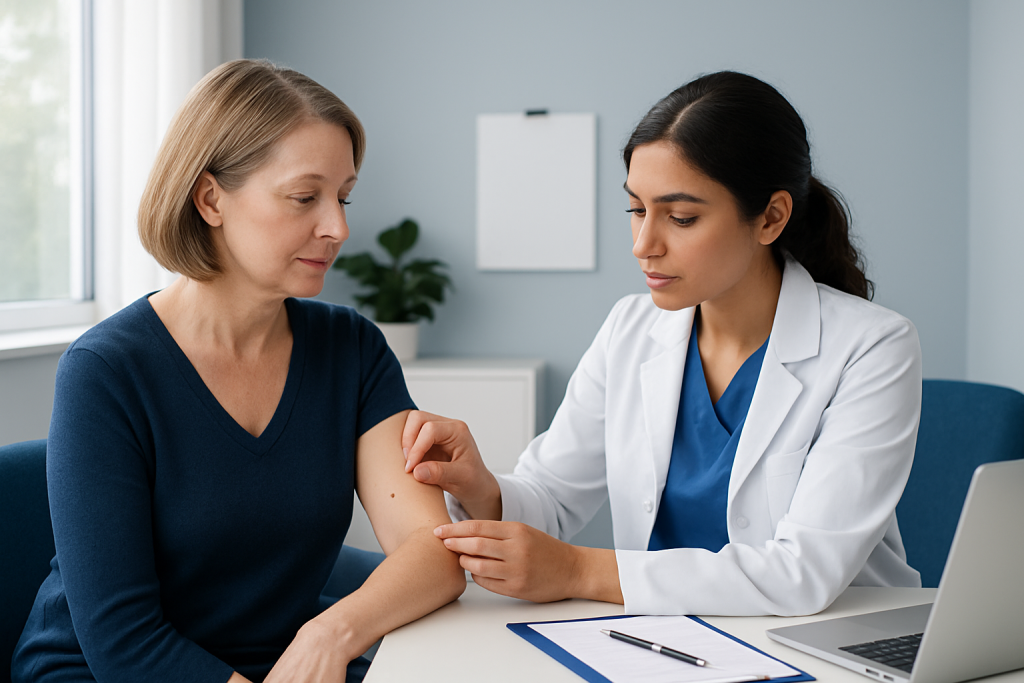
Moles develop when pigment cells grow in a cluster rather than spreading evenly through the skin. Genetics play a major role, which is why some families seem to have many moles while others have few. Hormonal changes may also influence when new moles appear, especially during adolescence and pregnancy.
Sun exposure is an important factor. Ultraviolet light can contribute to the appearance of new moles and may also increase the chance that some moles change over time. People with fair skin, lighter eyes, a tendency to sunburn, or a history of intense sun exposure are often monitored more closely.
Risk factors for having more moles or for needing closer observation include:
- A personal or family history of many moles
- Frequent sun exposure or past sunburns
- Very fair skin or difficulty tanning
- A history of atypical or unusual-looking moles
- Reduced ability to monitor the skin at home because of hard-to-see areas
It is helpful to remember that the presence of a mole does not mean disease. The main clinical task is to separate a common, stable mole from a lesion that deserves further assessment.
How Doctors Diagnose a Benign Mole
Diagnosis usually begins with a careful skin examination. A doctor will look at the mole’s shape, border, color, size, and location, and ask whether it has changed over time. They may also ask about symptoms such as bleeding, itching, pain, or crusting, as well as personal and family history of skin cancer.
Dermatoscopy, also called dermoscopy, is a noninvasive tool that allows the clinician to see patterns beneath the skin surface. This can improve confidence in distinguishing a benign mole from a lesion that needs removal or closer follow-up. For patients who are arranging care from another country, this step is often efficient and can provide a clear plan before travel or before returning home.
If the appearance is uncertain, or if the mole has suspicious features, the doctor may recommend a biopsy. During a biopsy, a small sample or the entire lesion is removed and examined under a microscope. This is the most reliable way to confirm whether a lesion is benign, atypical, or cancerous.
Treatment Options
Many benign moles do not need treatment at all. If a mole is stable, harmless, and not bothersome, observation is often the best approach. The decision to remove a mole is usually based on symptoms, cosmetic concerns, repeated irritation, or diagnostic uncertainty.
When removal is appropriate, a doctor may use a simple surgical excision or another minor office procedure, depending on the mole’s type and location. The goal is to remove the lesion safely and, when needed, send it for laboratory analysis. Patients considering treatment while traveling should discuss wound care, activity limits, and follow-up timing before the procedure, since healing plans can affect return travel.
It is important not to attempt self-removal. Cutting, burning, or using unproven home methods can cause infection, scarring, and delayed diagnosis. Even a mole that seems clearly harmless should be evaluated by a clinician before any procedure is done.
Prevention and Self-care
Not every mole can be prevented, especially when genetics are involved. Still, skin habits can reduce unnecessary changes and help people notice new or evolving lesions earlier. Sun protection is one of the most practical steps, since ultraviolet exposure can influence the skin over time.
Useful self-care habits include regular sunscreen use, protective clothing, seeking shade during strong sun, and avoiding tanning beds. Equally important is a simple skin-check routine at home. Looking at the skin once a month, ideally in good light, can help a person notice a mole that has changed or a new spot that was not there before.
When checking moles, people often use the ABCDE guide as a memory aid:
- Asymmetry
- Border irregularity
- Color variation
- Diameter growth
- Evolving appearance
This list is not a diagnosis tool, but it can prompt timely medical review. A photograph can also help track changes, especially for people with many moles or limited access to regular dermatology follow-up.
When to See a Doctor
A clinician should evaluate any mole that is new and unusual, keeps changing, or begins to bleed, crust, itch, or hurt without a clear reason. The same applies to a mole that looks different from a person’s other moles, or one that appears unlike the surrounding skin in a memorable way.
People with many moles, a family history of skin cancer, or a previous biopsy showing an atypical mole may benefit from periodic skin checks. This is especially useful for international patients who may split care between home and travel destinations, since consistent records and photos can make follow-up easier across different clinics.
For people who need specialized evaluation, Acibadem Health Point’s multidisciplinary specialists and JCI-accredited hospitals diagnose and treat skin conditions for international patients in a coordinated setting. A prompt assessment is often the simplest way to turn uncertainty into a clear plan.
Living With Benign Moles
Most benign moles become part of a person’s long-term skin pattern rather than a problem to manage daily. Once a clinician has confirmed that a mole is harmless, the main task is monitoring for change and protecting the skin from unnecessary sun damage.
Many patients find it helpful to keep a brief record of notable moles, especially those on the back, scalp, or other hard-to-see areas. A trusted family member or partner can sometimes help with checks. The goal is not to create anxiety, but to make skin awareness practical and manageable.
When a mole is confirmed as benign, reassurance is usually appropriate. If anything changes later, another review can be arranged without delay, which is often the most balanced and patient-friendly approach.
Frequently asked questions
01What is a benign mole?
A benign mole is a noncancerous skin growth made of pigment cells. It usually stays stable and does not require treatment unless it changes, becomes irritated, or is removed for cosmetic reasons.
02How can someone tell if a mole is harmless?
A harmless mole is often symmetrical, evenly colored, and stable over time. Even so, only a qualified clinician can confirm whether a mole is benign, especially if it is new or changing.
03Can a benign mole turn into cancer?
Most benign moles remain harmless. Any mole that starts changing in shape, color, size, or symptoms should be checked, because the concern is not the old label but the current behavior of the lesion.
04Do all moles need to be removed?
No, most moles do not need removal. Doctors usually recommend treatment only if the mole is bothersome, cosmetically concerning, repeatedly irritated, or uncertain on examination.
05Is a biopsy always needed?
No, many moles can be assessed by visual examination and dermoscopy alone. A biopsy is used when the diagnosis is not clear or when the mole has features that need microscopic evaluation.
06What should someone do if a mole starts itching or bleeding?
It is sensible to arrange a medical check, even if irritation may have a simple cause. Itching or bleeding does not automatically mean cancer, but it is a change that deserves professional assessment.
This article is for general information only and is not a substitute for professional medical advice. Please consult a qualified doctor about your individual situation.
Oncology care in Turkey — second opinion and treatment plan
JCI-accredited · board-certified surgeons · reply within 24h
Add us as a Preferred Source to see more of our trusted health content across Google Search, AI Overviews and Discover.



How can we help you today?
Meet an Acibadem specialist by secure video, before you travel.
Book a video visit