What Do Lice Look Like?

Key Takeaways
- Head lice are small, wingless insects that are usually grayish-white, tan, or darker after feeding.
- Nits are lice eggs that stick firmly to hair shafts and are often confused with dandruff.
- Itching, scalp irritation, and a tickling feeling are common signs, but lice can be present without obvious symptoms.
- Careful wet combing and good lighting can help identify lice more reliably than a quick visual check.
- Treatment usually includes an anti-lice product plus combing, with repeat checks to make sure all lice are gone.
Head lice are tiny insects that live on the scalp and feed on small amounts of blood. Knowing how to recognize live lice, nits, and common signs can help families act early and reduce spread.
Overview
When someone asks, “What does lice look like?” they are usually trying to tell the difference between a true infestation and ordinary flakes, lint, or dry scalp. Head lice are tiny parasitic insects that live close to the scalp and move by crawling from hair to hair. They are most often found behind the ears and at the nape of the neck, where the hair is warm and protected.
Adult head lice are about the size of a sesame seed or smaller, and they do not fly or jump. Their color can vary from pale gray to tan or brown, and they may look darker after feeding. Because they move quickly and avoid light, many people notice the eggs first rather than the live insects.
Understanding the appearance of lice matters because early identification can make treatment simpler and help limit spread within households, schools, and shared living settings. For families traveling internationally or arranging care away from home, knowing what to look for can also help them decide when a local clinic visit is worthwhile.
What lice and nits look like
People often worry that they are seeing lice when they are actually looking at dry scalp flakes or hair products. A simple clue is whether the object moves or sticks firmly to one hair. Lice themselves move; nits do not.
Color alone is not enough to identify an infestation. Lice may look nearly translucent on some hair colors and darker on others, and their appearance can change slightly after feeding. A careful inspection with a fine-toothed comb is often more useful than trying to judge by color from a distance.
Because lice can be subtle, the goal is not perfection but a good-quality check. If a caregiver can part the hair section by section and see small insects or firmly attached eggs near the scalp, that is enough reason to consider treatment and professional advice.
Symptoms and signs to notice
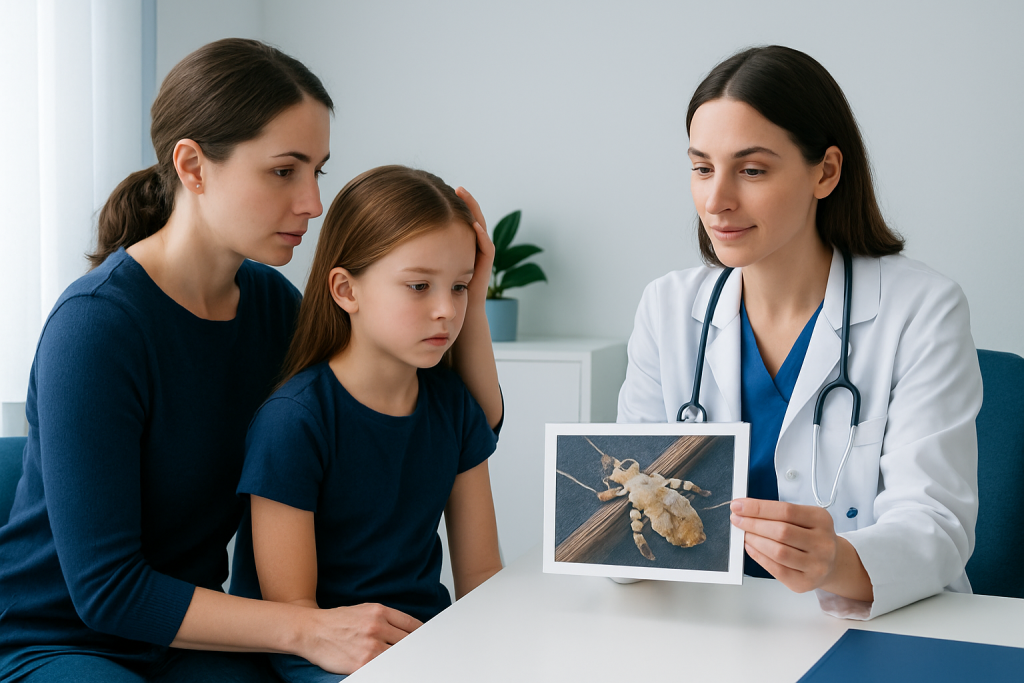
The most familiar symptom is itching, especially around the scalp, ears, and neck. This itching is caused by a reaction to lice saliva and may take time to appear, which means a person can have lice before they feel uncomfortable. Some children, in particular, do not complain early.
Other signs can include a tickling feeling in the hair, frequent scratching, small red bumps on the scalp or neck, and trouble sleeping if itching is worse at night. In some cases, the scalp may become irritated from repeated scratching rather than from the lice themselves.
A close look may also reveal nits near the scalp, live lice moving quickly, or tiny specks on a comb after wet combing. It is worth remembering that itching alone does not prove lice, since eczema, dry skin, or other scalp conditions can cause similar discomfort.
Causes and risk factors
Head lice spread mainly through direct head-to-head contact. This is why they are common among children, siblings, and people who spend time in close contact, such as while playing, studying, or taking group transport. Lice do not spread because a person is unclean, and having head lice is not a sign of poor hygiene.
Sharing items that touch the hair, such as hats, hairbrushes, scarves, pillows, and headphones, can also contribute to spread, although direct contact is more common. Crowded settings and shared sleeping arrangements may make transmission more likely.
Anyone with hair can get lice, but school-age children are especially vulnerable because they often have close contact with each other. Families who are living abroad or moving between homes may find it helpful to check all household members at the same time if one person is diagnosed.
- Close contact during play or sleepovers
- Sharing hair accessories, brushes, or hats
- Living in crowded or shared spaces
- Not checking early when itching begins
Diagnosis
Diagnosis is usually made by finding a live louse or a viable nit on the scalp or hair. A healthcare professional may use a bright light, a magnifying lens, or a fine-toothed comb to inspect the hair section by section. This method is often more reliable than a quick glance.
Wet combing can make lice easier to detect because damp hair slows them down and the comb catches them more effectively. A white towel or tissue may be placed under the hair to help spot what comes out during the process. For many families, this is one of the clearest ways to confirm the problem at home.
In some cases, a clinic visit is helpful if the diagnosis is uncertain, if the scalp is very irritated, or if treatment has already been tried without success. For international patients, seeing a clinician can also provide a clear treatment plan that is easy to follow after returning home.
Treatment options
It is important not to use home remedies that can irritate the scalp or delay effective treatment. Strong chemicals, oils, or heat-based methods may cause discomfort without reliably solving the problem. A gentle, evidence-based approach is usually safer and more effective.
Some families also benefit from cleaning bedding, hats, and hair tools, but extensive home disinfection is generally not necessary. Lice survive poorly away from the scalp, so a practical focus on hair care and close-contact checks is usually enough.
When treatment is being coordinated from another country, families may want clear instructions on what was used, when combing should be repeated, and what to do if symptoms continue. Good written guidance can make follow-up much easier.
Prevention and self-care
Prevention is mainly about reducing head-to-head contact and avoiding shared hair items. Children can be reminded not to swap hats, combs, helmets, or hair accessories. If one household member has lice, it is sensible to check the others promptly rather than waiting for everyone to become itchy.
During treatment, gentle scalp care can help comfort the skin. A soft brush or comb, mild shampoo, and avoidance of scratching can reduce irritation. If the scalp has been scratched raw, keeping nails short may help prevent skin injury and secondary infection.
Self-care also includes follow-up. A single treatment is not always the end of the process, so a planned re-check is valuable. Families managing care while traveling should keep the treatment schedule and contact instructions in writing so nothing is missed.
When to see a doctor
Medical advice is helpful if the diagnosis is uncertain, if a child has significant scalp irritation, or if lice keep returning despite proper treatment. A clinician can confirm whether the problem is lice, dandruff, eczema, or another scalp condition. This can prevent unnecessary treatment and frustration.
Prompt care is also sensible if there are signs of skin infection, such as increasing redness, swelling, warmth, pus, or pain from scratching. A healthcare professional should also be consulted if a person is very young, pregnant, has sensitive skin, or has already tried several products without success.
For families seeking care across borders, an organized evaluation can be reassuring. Acibadem Health Point’s multidisciplinary specialists and JCI-accredited hospitals diagnose and treat head lice for international patients, with support that can help clarify the condition and the next steps.
Frequently asked questions
01What does lice look like in hair?
Head lice are tiny, wingless insects that may look like small moving specks on the scalp or hair. They are often grayish-white, tan, or darker after feeding. Nits look like small oval eggs firmly attached to a single hair shaft.
02How can someone tell lice from dandruff?
Dandruff usually comes off the hair easily, while nits stay stuck to the hair shaft. Lice also move, whereas dandruff does not. A fine-toothed comb and bright light can make the difference easier to see.
03Do lice always cause itching?
Not always. Some people itch soon after infestation, while others have lice for a while before noticing symptoms. That is why a scalp check is useful even if itching is mild or absent.
04Can head lice jump or fly?
No. Head lice crawl and spread mainly through direct head-to-head contact. They do not jump or fly.
05Should the whole family be treated if one person has lice?
Not necessarily, but close household members should be checked carefully. Treatment is usually recommended for those who are found to have lice or nits close to the scalp, according to local medical advice. A doctor can help decide who needs treatment.
06How long can lice live away from the scalp?
Head lice usually do not survive long away from a human scalp because they need warmth and blood meals. This is why practical cleaning and close-contact checks matter more than extreme home disinfecting.
This article is for general information only and is not a substitute for professional medical advice. Please consult a qualified doctor about your individual situation.
Hair transplant in Turkey — costs, graft counts & a free assessment
JCI-accredited · board-certified surgeons · reply within 24h
Add us as a Preferred Source to see more of our trusted health content across Google Search, AI Overviews and Discover.