Treatment for Urethral Stricture: Your Options
Treatment for stricture in urethra aims to restore urine flow, relieve symptoms and reduce the risk of complications. The best option depends on the stricture’s size, location, scar severity, prior treatments and the person’s overall health.
Overview: treatment for stricture in urethra
Treatment for stricture in urethra is selected according to the scar tissue’s location, length and severity, as well as whether it has returned after earlier treatment. Options range from careful monitoring in selected cases to urethral dilation, an endoscopic incision and reconstructive surgery. A urologist can explain which approach is likely to offer the best balance of symptom relief and long-term success.
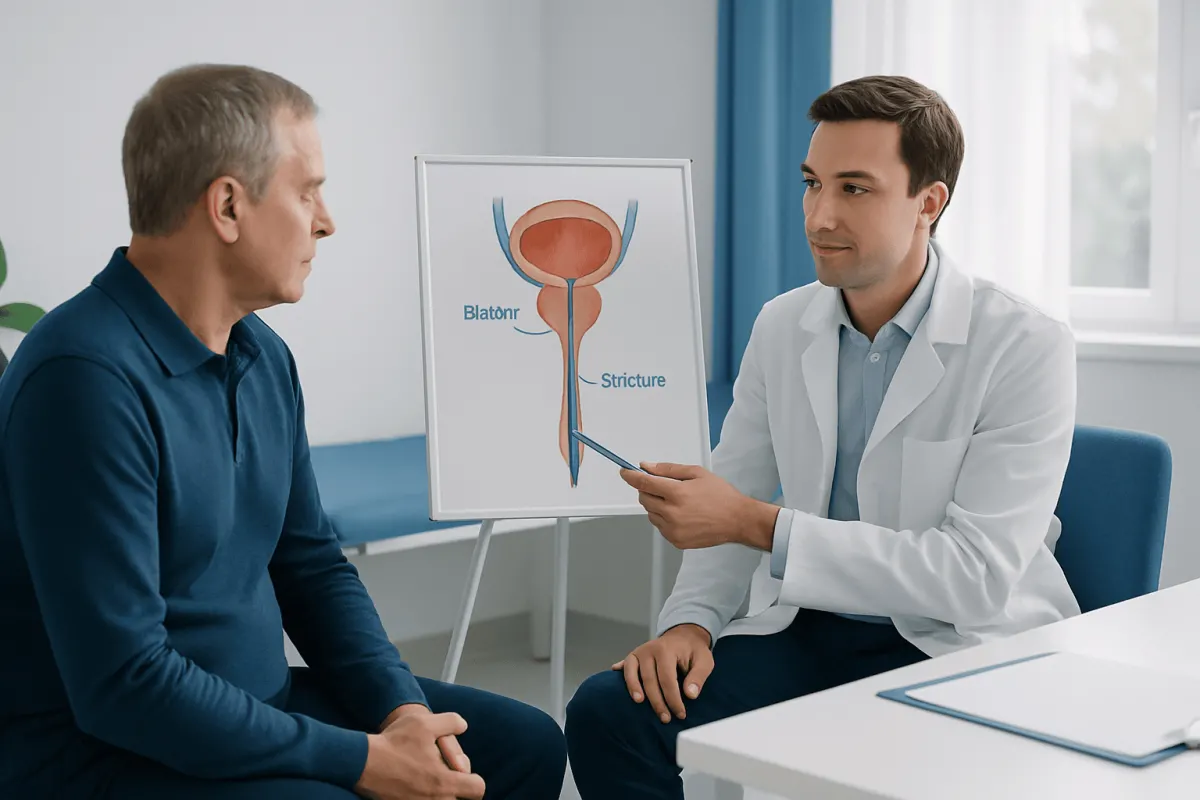
A urethral stricture develops when scar tissue narrows the urethra, the passage through which urine leaves the bladder. This can slow or split the urine stream, cause straining, incomplete emptying, urinary infections or discomfort. Strictures are more common in men because the urethra is longer, but they can also occur in women and children.
The goal of treatment is not simply to widen the urethra temporarily. It is to help urine drain effectively, protect bladder and kidney function when at risk, and choose an approach suited to the individual pattern of scarring. Some people need only one procedure, while others benefit from specialist reconstructive care.
Symptoms, causes and how strictures are assessed
Symptoms can develop gradually or become noticeable after an infection, injury or medical procedure. Common signs include a weak stream, prolonged urination, spraying or splitting of urine, straining, dribbling after urination, feeling that the bladder has not emptied, and repeated urinary tract infections. Blood in the urine or semen, pelvic discomfort, and reduced urine flow may also occur.
Scar tissue may form after trauma to the pelvis or perineum, previous urethral catheterization or surgery, urinary infection, inflammation, radiation therapy or certain skin conditions. In some cases, no definite cause is identified. A previous procedure for a stricture can also be associated with recurrence because scar tissue may reform.
Assessment usually begins with a medical history, physical examination and urine testing. A urologist may measure urine flow with uroflowmetry and check how much urine remains in the bladder after voiding. Further tests may include cystoscopy, in which a narrow camera examines the urethra, and imaging such as a retrograde urethrogram or voiding cystourethrogram to map the stricture accurately.
These tests help distinguish a urethral stricture from other causes of poor flow, such as an enlarged prostate, bladder dysfunction or infection. Accurate mapping is especially important before reconstructive surgery because treatment planning depends on the stricture’s exact site and extent.
Treatment options: dilation, endoscopic treatment and urethroplasty
Observation may be appropriate when a narrowing is mild, symptoms are minimal and there is no evidence of recurrent infection, poor bladder emptying or kidney impact. Follow-up is important, since symptoms and urine flow can change over time. Antibiotics may treat an active urinary infection but do not remove the scar tissue causing a stricture.
Urethral dilation gradually stretches the narrowed area using specialized instruments or balloons. It is often performed as an outpatient procedure and may be considered for a short, uncomplicated stricture. However, the scar can narrow again. Some people are taught intermittent self-catheterization after dilation in carefully selected circumstances, but this should only be done with a clinician’s guidance because it can cause irritation, infection or injury.
Direct visual internal urethrotomy, often called DVIU, is an endoscopic procedure in which a surgeon makes an incision in the scar tissue using a camera passed through the urethra. It can be useful for certain short strictures, particularly when treatment has not been needed before. Repeat dilation or repeat DVIU may have decreasing durability for recurrent strictures, so a reconstructive opinion is often appropriate after recurrence.
Urethroplasty is reconstructive surgery that removes the scarred segment and reconnects healthy ends when the narrowing is short, or widens the urethra using tissue grafts or flaps when it is longer or more complex. Grafts are commonly taken from the inside of the cheek. This approach is often considered for recurrent, long, traumatic or complex strictures because it can provide more durable results than repeated endoscopic procedures.
- Dilation: widening of the narrowed segment; usually less invasive but recurrence is possible.
- DVIU: endoscopic incision of scar tissue; often considered for selected short strictures.
- Urethroplasty: open reconstruction; commonly recommended for many recurrent or complex strictures.
How long does it take to recover from urethral stricture surgery?
Recovery from urethral stricture surgery varies with the procedure and the person’s health. After dilation or DVIU, many people return to light daily activities within a few days, although urinary discomfort, mild bleeding or urgency can occur temporarily. The care team may advise avoiding strenuous activity, cycling and sexual activity for a period of time.
After urethroplasty, recovery usually takes several weeks. A urinary catheter is commonly left in place while the repair heals; the exact duration differs according to the reconstruction and the surgeon’s plan. Before catheter removal, imaging may be used to confirm that the repaired area has healed appropriately.
Temporary tiredness, perineal soreness, swelling, bladder spasms or discomfort around the catheter can occur. Pain control plans may include prescribed medication and practical measures such as hydration and avoiding constipation. The surgical team should be contacted if pain is increasing rather than improving, urine stops draining through the catheter, fever develops, or there is significant bleeding.
Follow-up visits are important after any procedure because a stricture can recur, sometimes months or years later. Follow-up may include symptom review, urine-flow measurement, bladder residual checks, cystoscopy or imaging when needed.
How successful is urethral stricture surgery?
Success depends on the type of procedure, the stricture’s characteristics and whether it has been treated before. Dilation and DVIU can improve urine flow, particularly for selected short strictures, but recurrence is relatively common. Their results are generally less durable when the stricture is longer, dense, caused by significant trauma or has already returned after treatment.
Urethroplasty is widely regarded as the most durable surgical approach for many recurrent or complex urethral strictures. Success also depends on factors such as the location of the scar, previous operations, infection, smoking, tissue health and the reconstruction technique required. A surgeon should discuss expected outcomes in the context of the individual case rather than relying on one general figure.
A good outcome may mean stronger urine flow, less straining, fewer infections and improved bladder emptying. It does not always mean that future monitoring is unnecessary. Some people need additional treatment if narrowing returns, while others remain symptom-free over the long term.
For people who need complex evaluation or reconstruction, multidisciplinary urology teams at Acıbadem Health Point’s JCI-accredited hospitals can assess and treat urethral strictures for international patients. The most appropriate plan should always be made with a qualified urologist after complete assessment.
How painful is a urethral stricture?
A urethral stricture is not always painful. For many people, the main issue is a progressively weaker stream, straining or a feeling of incomplete bladder emptying. Discomfort can range from none to mild or moderate and may be felt during urination, in the urethra, lower abdomen, pelvis or perineum.
Pain may become more noticeable if the bladder is overfull, there is a urinary tract infection, urine flow is severely restricted or catheterization has irritated the urethra. Burning when urinating, fever, chills, cloudy urine or new pelvic pain may suggest infection and should be assessed promptly.
Severe lower abdominal pain with an inability to urinate can indicate acute urinary retention. This needs urgent medical attention because the bladder may require prompt drainage. People should not try to force urine out or insert instruments into the urethra themselves.
Will urethral stricture get worse?
A urethral stricture can remain stable for a time, but it may gradually narrow further as scar tissue contracts. This can lead to worsening flow, increased straining, recurrent infections, bladder stones or urinary retention. Not every narrowing progresses at the same rate, which is why symptoms and objective tests both matter.
Untreated significant blockage can put pressure on the bladder and, in some situations, affect the upper urinary tract. Regular review is particularly important when there are recurrent infections, rising residual urine after voiding, reduced kidney function or troublesome symptoms.
There is no reliable home treatment that reverses urethral scar tissue. Drinking an appropriate amount of fluid and treating constipation may support comfortable urination, but they do not cure a stricture. Avoiding unnecessary urethral instrumentation when possible and following catheter-care instructions may help reduce irritation or injury.
After treatment, reporting changes early can help identify recurrence before symptoms become severe. A return of weak stream, spraying, straining or repeated infections should prompt a urology review rather than repeated self-treatment.
When to seek medical care
Medical assessment is advisable for a persistent weak urine stream, straining, spraying, repeated urinary infections, incomplete emptying or unexplained urinary discomfort. These symptoms can have several causes, so testing is needed before assuming a stricture is present. Early evaluation can help prevent avoidable bladder problems and guide appropriate treatment.
Urgent medical care is needed if a person cannot pass urine, develops severe lower abdominal pain or swelling, or has fever and chills with urinary symptoms. These signs may indicate urinary retention or infection requiring prompt treatment. Visible blood in urine, particularly with clots or trouble urinating, also warrants timely evaluation.
People recovering from a procedure should follow their surgeon’s specific instructions on catheter care, activity and follow-up. They should contact their care team about fever, increasing redness or swelling around an incision, worsening pain, heavy bleeding, foul-smelling drainage, or a catheter that is not draining.
Frequently asked questions
01What is the best treatment for stricture in urethra?
The best treatment depends on the stricture’s length, location, cause, severity and whether it has returned after prior treatment. Dilation or DVIU may suit selected short strictures, while urethroplasty is often preferred for recurrent, longer or complex scar tissue. A urologist uses imaging and endoscopic assessment to recommend an individualized plan.
02How long does it take to recover from urethral stricture surgery?
Recovery after dilation or DVIU is often measured in days to a few weeks, depending on symptoms and activity demands. Urethroplasty generally requires several weeks of healing and commonly includes a temporary catheter. The surgeon will advise when it is safe to return to work, exercise, cycling and sexual activity.
03How successful is urethral stricture surgery?
Results vary by procedure and by the characteristics of the scar. Endoscopic procedures can be effective for selected short strictures but may have a greater chance of recurrence, especially after previous treatment. Urethroplasty generally offers the most durable outcome for many recurrent or complex strictures.
04How painful is a urethral stricture?
A stricture may cause no pain, with weak flow or straining being the main symptoms. Some people experience burning during urination, pelvic discomfort or lower abdominal pressure, particularly if infection or bladder overfilling occurs. Severe pain with inability to urinate requires urgent medical assessment.
05Will urethral stricture get worse?
Some strictures can gradually become tighter because scar tissue contracts over time. Worsening narrowing may cause reduced flow, recurrent infection, bladder emptying problems or urinary retention. Regular follow-up helps identify changes and determine when treatment is needed.
06Can a urethral stricture heal on its own?
Established scar tissue in the urethra does not usually disappear on its own. Mild symptoms may fluctuate, but the underlying narrowing can remain or progress. A urologist can determine whether monitoring is reasonable or whether a procedure is recommended.
This article is for general information only and is not a substitute for professional medical advice. Please consult a qualified doctor about your individual situation.
Explore treatments in Turkey — costs, top hospitals & a free quote
JCI-accredited · board-certified surgeons · reply within 24h
Add us as a Preferred Source to see more of our trusted health content across Google Search, AI Overviews and Discover.