Sore Knees in Teenager: What You Need to Know
Key Takeaways
- Most teenage knee pain is caused by overuse, muscle imbalance, or growth-related strain rather than a serious problem.
- Pain that follows sports, stair climbing, running, or jumping often points to irritation around the kneecap or tendons.
- Swelling, locking, giving way, fever, or pain after an injury deserves medical evaluation.
- Rest, activity changes, ice, and guided rehabilitation can help many teenagers recover safely.
- A doctor may recommend imaging or specialist assessment if symptoms persist or the knee is unstable.
Sore knees in teenager are often linked to growth, sports overuse, or minor strain, but persistent pain should not be ignored. Understanding the pattern of symptoms helps families decide when home care is enough and when a doctor should assess the knee.
Overview
Sore knees in teenager are common, especially during growth spurts and active school years. In many cases, the discomfort comes from the way bones, muscles, and tendons are adapting to rapid change, repeated sport, or a small strain that needs time to settle.
The good news is that most teen knee pain improves with the right mix of rest, gradual return to activity, and simple supportive care. The important step is to notice the pattern: where the pain is felt, what makes it worse, and whether there are warning signs that point to a more specific injury or joint condition.
For families comparing options across borders, the same basic principles apply whether care happens close to home or during a planned trip for a second opinion. A clear assessment early on can prevent months of guesswork and help a teenager get back to school, sport, and daily movement with confidence.
Symptoms
Teen knee pain does not always feel the same from one person to another. Some teenagers describe a dull ache around the front of the knee, while others notice sharp pain when climbing stairs, kneeling, squatting, or landing from a jump.
Common patterns include pain that appears during activity and eases with rest, tenderness around the kneecap, stiffness after sitting for a long time, or pain on the inner or outer side of the knee. Some teenagers also report a sense that the knee is weak or does not fully trust them during sports.
Symptoms that deserve closer attention include:
- Swelling that appears soon after an injury or keeps returning
- Locking, catching, or inability to fully straighten the knee
- Giving way or repeated instability
- Redness, warmth, fever, or feeling unwell
- Pain that wakes the teenager at night or steadily worsens
These features do not always mean a serious diagnosis, but they do suggest that a medical examination is a good idea rather than waiting it out.
Causes & Risk Factors
In teenagers, knee pain is often related to overuse rather than one single injury. Running, jumping, sudden increases in training, and long hours of sport can irritate structures around the knee before the body has fully adapted.
One frequent explanation is patellofemoral pain, which is pain felt around or behind the kneecap. Another is irritation where the tendon attaches below the kneecap, especially in active adolescents. Growth-related conditions can also appear during periods of rapid height change, when bones lengthen faster than muscles become flexible and strong enough to keep up.
Risk factors often include:
- Recent increase in training load or competition
- Tight hamstrings, quadriceps, or calf muscles
- Weakness in the hips, thighs, or core
- Flat feet or other alignment differences
- Previous knee injury or poor recovery from one
- Specialist sports involving running, jumping, or pivoting
Less commonly, sore knees in teenager may come from meniscus injury, ligament sprain, infection, inflammatory arthritis, or a bone problem. That is why a careful history and physical examination matter, especially when pain is persistent or unusual.
Diagnosis
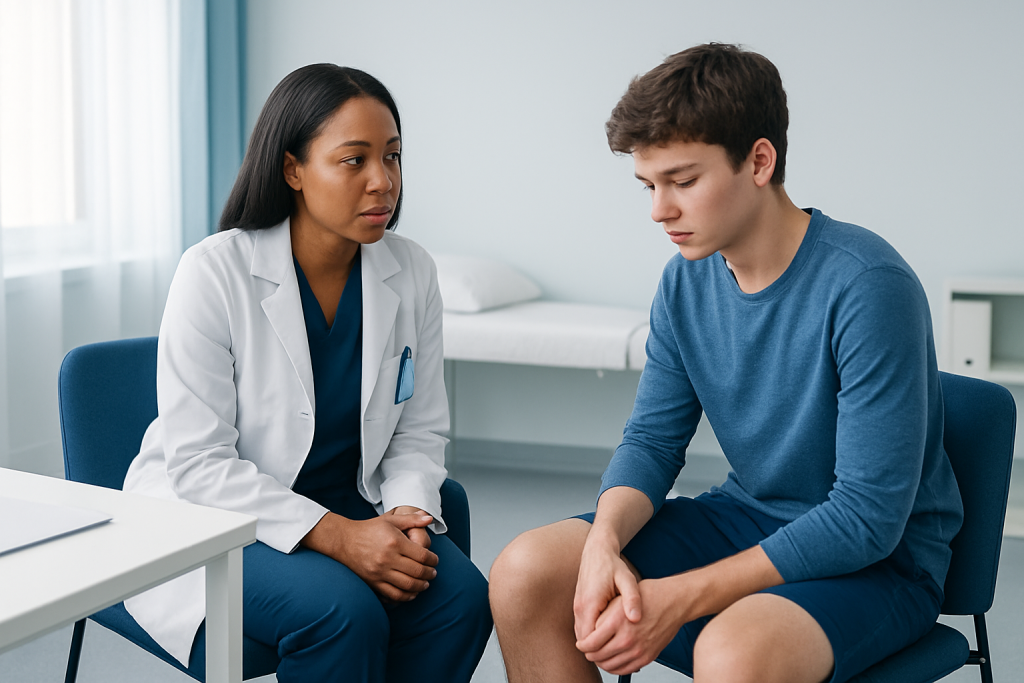
A doctor usually begins by asking how the pain started, where it is located, and which movements make it better or worse. In teenagers, the story is often as important as the scan because many knee problems can be identified through a thoughtful examination.
The exam may include checking walking pattern, knee range of motion, tenderness, swelling, stability, and nearby muscle strength. The doctor may also assess hips, feet, and posture, since pain around the knee can sometimes be influenced by mechanics higher or lower in the leg.
Imaging is not always required at the first visit. X-rays may be used if there was an injury, there is concern about the bones, or symptoms are not improving as expected. MRI may be considered when soft tissue injury, cartilage damage, or internal knee problems are suspected. Blood tests are reserved for cases where inflammation or infection is being considered.
Treatment Options
Treatment depends on the cause, but the first goal is usually to calm the irritated tissue and restore comfortable movement. Many teenagers improve with temporary reduction in painful activities rather than complete inactivity.
Conservative care often includes relative rest, ice after activity, and short-term activity modification. A rehabilitation plan may focus on stretching tight muscles and strengthening the thighs, hips, and core so the knee is better supported during sport and daily movement. If the pain is linked to technique or training errors, adjusting footwear, practice surfaces, or workout load may help.
In some cases, a doctor may recommend:
- Physical therapy or supervised exercise therapy
- Temporary brace, taping, or support for selected conditions
- Anti-inflammatory pain relief if considered appropriate by a clinician
- Return-to-sport guidance to avoid repeated flare-ups
Surgery is uncommon for ordinary adolescent overuse pain, but it may be needed for certain structural injuries such as a significant ligament tear, meniscus injury, or a condition that does not respond to non-surgical treatment. The best treatment plan is individualized, especially for teenagers who need to balance recovery with school sports or upcoming travel.
Prevention & Self-care
Teenagers can often reduce knee strain by giving the body time to adapt. A gradual warm-up before exercise and a stepwise return after rest or injury are simple but effective habits.
Supportive self-care also includes good sleep, balanced nutrition, staying hydrated, and paying attention to muscle flexibility and strength. If one sport season is especially intense, cross-training with lower-impact exercise can reduce repetitive load on the knees.
Helpful habits include:
- Increase training volume slowly, not all at once
- Stop or scale back activities that trigger sharp pain
- Use ice after heavy activity if swelling or soreness appears
- Work on hip, thigh, and calf strength as advised
- Choose shoes that are appropriate for the sport
- Do not return to competition before walking, squatting, and running are comfortable
Parents and teenagers should avoid assuming every ache is just “growing pain.” Mild pain that appears only occasionally may settle with rest, but recurring soreness deserves attention so that sport habits and biomechanics can be corrected early.
When to See a Doctor
Medical assessment is sensible when sore knees in teenager last more than a short time, keep returning, or interfere with sport, school activities, or walking. A doctor can help separate a simple overuse problem from a condition that needs targeted treatment.
Prompt care is especially important if the knee became painful after a fall, twist, or collision, or if the teenager cannot bear weight comfortably. Swelling, redness, fever, or a feeling that the knee is unstable should also be checked without delay.
Families who live abroad or are considering treatment during travel should look for a team that can evaluate the knee thoroughly, explain the diagnosis clearly, and create a safe recovery plan that works across follow-up visits. Acibadem Health Point’s multidisciplinary specialists and JCI-accredited hospitals diagnose and treat knee conditions for international patients, with care planned around both medical needs and practical recovery.
Living With and Recovering From Teen Knee Pain
Recovery is usually smoother when the teenager understands the reason for the pain and the plan for getting back to activity. Clear milestones, such as pain-free walking, stair climbing, and light jogging, are more useful than rushing toward a fixed calendar date.
Parents can support recovery by keeping expectations realistic and encouraging honest reporting of symptoms. If pain changes location, becomes more frequent, or starts to affect sleep or mood, the treatment plan may need to be adjusted.
When treatment is well matched to the cause, many teenagers return to their usual routines without long-term problems. The key is to treat persistent knee pain as a signal to assess mechanics, load, and injury risk rather than something a young person simply has to endure.
Frequently asked questions
01Are sore knees in teenager usually serious?
Most of the time, teenage knee pain is linked to overuse, growth, or minor strain rather than a serious disease. Still, persistent pain, swelling, locking, or instability should be assessed by a doctor.
02Can growing pains cause knee pain in teenagers?
Growth can contribute to discomfort because muscles and tendons may feel tight during rapid changes in height. However, repeated knee pain should not always be labeled as growing pains without an evaluation, especially if it is linked to activity or one specific area.
03Should a teenager stop sports if the knee hurts?
Not always, but painful activities may need to be reduced or modified for a while. Continuing through sharp or worsening pain can delay healing, so a clinician or physical therapist can guide a safe return.
04When is an X-ray or MRI needed for knee pain?
Imaging is considered when there was an injury, symptoms are not improving, or the doctor suspects a bone, cartilage, or internal joint problem. Many overuse problems can be diagnosed first with a history and examination alone.
05What can parents do at home for sore knees in teenager?
Short-term rest from painful activities, ice after exercise, and gradual return to movement are common first steps. If the pain keeps coming back or affects daily life, a medical review is a better next step than waiting indefinitely.
06Can poor posture or flat feet cause teen knee pain?
They can contribute in some teenagers by changing how force travels through the leg. A doctor or physical therapist can look at alignment, strength, and movement patterns to decide whether orthotics or exercises might help.
This article is for general information only and is not a substitute for professional medical advice. Please consult a qualified doctor about your individual situation.
Joint and spine care in Turkey — expert assessment & treatment
JCI-accredited · board-certified surgeons · reply within 24h
Add us as a Preferred Source to see more of our trusted health content across Google Search, AI Overviews and Discover.