RPR Blood Test: What It Measures and What Results Mean

Key Takeaways
- The RPR (rapid plasma reagin) test is a screening blood test for syphilis; it detects antibodies associated with infection rather than the bacteria itself.
- A nonreactive (negative) result is the expected, normal finding in people without syphilis.
- A reactive (positive) result must be confirmed with a second, more specific treponemal test before any diagnosis is made.
- Results are often reported as a titer (for example 1:8 or 1:32), which helps doctors judge disease activity and monitor response to treatment.
- Biological false positives can occur in pregnancy, autoimmune conditions and some infections, which is why confirmation matters.
- Screening is routinely recommended in pregnancy and for people with certain risk factors; a doctor can advise on timing and frequency.
An RPR blood test is a simple screening blood test that looks for antibodies the immune system produces during a syphilis infection. A nonreactive result is generally considered normal, while a reactive result is not a diagnosis on its own and always needs confirmatory testing and a conversation with a doctor.
What an RPR Blood Test Measures
An RPR blood test — short for rapid plasma reagin — is a widely used screening blood test for syphilis, a bacterial infection caused by Treponema pallidum. Importantly, the test does not look for the bacteria directly. Instead, it detects a group of antibodies (sometimes called reagin antibodies) that the body produces when cells are damaged during infection. Because these antibodies are not unique to syphilis, the RPR is classified as a nontreponemal test: excellent for screening large numbers of people quickly and inexpensively, but never sufficient on its own to confirm a diagnosis.
The test is performed on a small sample of blood drawn from a vein in the arm. In the laboratory, the serum is mixed with a prepared antigen suspension; if the relevant antibodies are present, visible clumping (flocculation) occurs and the sample is reported as reactive. The laboratory may then dilute the sample repeatedly to find the highest dilution that still shows a reaction — this is the titer, reported as a ratio such as 1:4, 1:16 or 1:64.
Readers sometimes encounter a closely related test called the VDRL, which works on a similar principle and is used in similar situations, including on cerebrospinal fluid in specific circumstances. Because the two tests are not interchangeable numerically, doctors generally prefer to follow a patient over time using the same test performed by the same laboratory.
Why a Doctor May Order This Test
Syphilis is often described as a great imitator because its early signs can be painless, subtle or easily mistaken for something else — a single firm sore, a rash on the palms or soles, swollen lymph nodes, or nothing noticeable at all. Screening blood tests exist precisely because infection can be present without obvious symptoms, and because early identification allows straightforward treatment before complications develop.
A clinician may recommend an RPR test in several common situations:
- Routine prenatal care, where syphilis screening is a standard part of early pregnancy testing in the United States, sometimes repeated later in pregnancy.
- As part of a broader sexually transmitted infection screening panel for sexually active adults, based on individual risk factors.
- When a person has symptoms that could be consistent with syphilis, such as an unexplained genital or oral ulcer or a widespread rash.
- After a known or possible exposure to a partner diagnosed with syphilis.
- To monitor how a previously diagnosed and treated infection is responding over time.
- Occasionally as part of pre-surgical, blood donation or immigration-related medical screening protocols.
Some health systems screen with a treponemal test first and use the RPR as the second step, a strategy known as the reverse sequence algorithm. Either order is acceptable; what matters is that a screening result is always interpreted alongside a second, different type of test and the person’s clinical history.
What to Expect During the Test

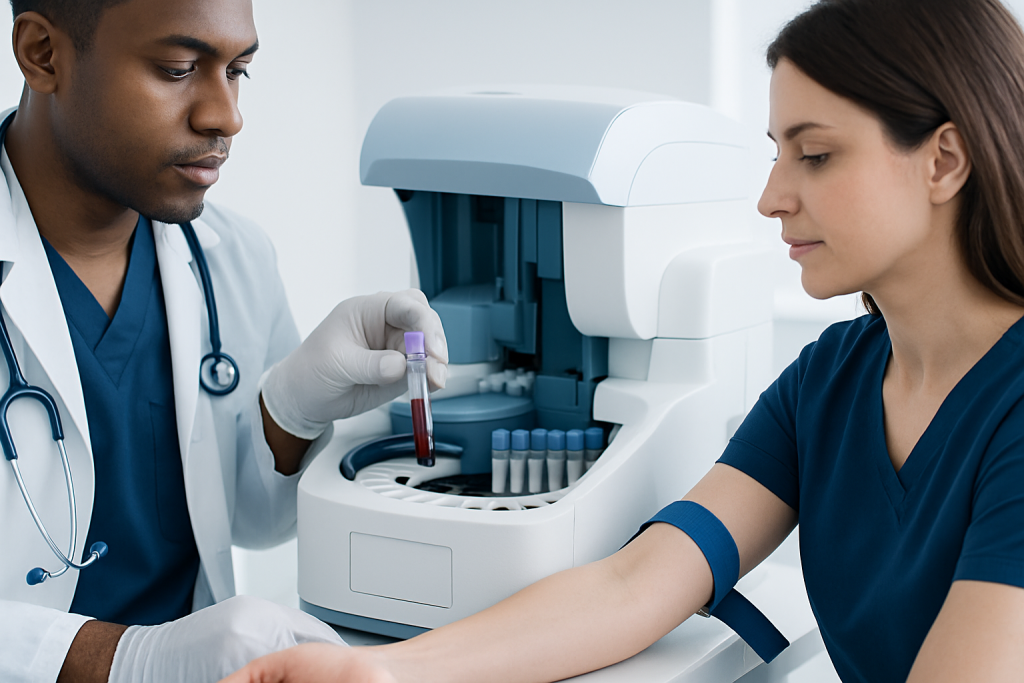
From the patient’s point of view, an RPR blood test is unremarkable. It requires a standard venipuncture: a phlebotomist cleans the skin, applies a tourniquet, and collects a small tube of blood, usually in under a minute. No fasting is needed, no special preparation is required, and normal activities can continue immediately afterward. Mild bruising or brief soreness at the puncture site is the most common side effect.
Turnaround time depends on the laboratory, but results are frequently available within a day or two. Many people receive them through a patient portal before speaking with a clinician, which can be unsettling if the report simply reads “reactive” without context. It is worth remembering that a single laboratory line does not equal a diagnosis, and that the interpretation belongs in a conversation with the ordering doctor.
Timing also matters. Antibodies take time to develop after exposure, so a test performed very soon after a possible exposure may be nonreactive even if infection is present — the so-called window period. A clinician may therefore recommend repeat testing after an interval rather than relying on one early result.
Understanding RPR Results: Nonreactive, Reactive and Titers
Nonreactive (negative) is the normal result and means no reagin antibodies were detected. In most people with no symptoms and no recent exposure, this is reassuring. It does not, however, exclude a very recent infection, and in rare cases of very high antibody levels a technical phenomenon called the prozone effect can produce a falsely nonreactive reading; laboratories guard against this by diluting suspicious samples.
Reactive (positive) means antibodies were detected. This raises the possibility of current or past syphilis, but on its own it is a signal to investigate further — not a conclusion. It may reflect an active untreated infection, an infection that was treated in the past and left a persistent low-level antibody trace, or a false positive triggered by something unrelated.
The titer adds valuable detail. A higher titer, such as 1:32 or 1:64, generally suggests more active disease, while low titers such as 1:1 or 1:2 are more often seen in late, previously treated or falsely positive cases. Doctors pay particular attention to changes in titer: a fourfold decline (for example, from 1:32 to 1:8) after treatment is typically interpreted as a favorable response, while a fourfold rise may indicate new infection or treatment failure. Because titers can differ between laboratories and between test types, comparisons are most meaningful when the same test and, ideally, the same laboratory are used throughout follow-up.
False Positives and Confirmatory Testing
Nontreponemal tests such as the RPR can react in the absence of syphilis. These biological false positives are usually low-titer and can be associated with pregnancy, older age, recent vaccination or viral infection, malaria, tuberculosis, injection drug use, and autoimmune conditions such as lupus or antiphospholipid syndrome. This is a normal limitation of a screening test designed to be highly sensitive, and it is precisely why a second test is standard practice.
Confirmation uses a treponemal test — for example TP-PA, FTA-ABS or a treponemal immunoassay — which detects antibodies directed specifically against the syphilis bacterium. When both the RPR and a treponemal test are reactive, the picture points strongly toward current or past syphilis, and the clinician then uses history, examination findings and prior test records to determine the stage and whether treatment has already been given. When the RPR is reactive but the treponemal test is negative, a false positive is the most likely explanation.
One nuance often causes confusion: treponemal tests usually remain reactive for life, even after successful treatment. So a person who was treated years ago may continue to test positive on the confirmatory test indefinitely, while their RPR titer falls to low levels or becomes nonreactive. Keeping copies of previous results is genuinely useful, as it helps any future clinician interpret new numbers correctly.
What Happens After a Reactive Result
A confirmed diagnosis of syphilis is treatable, and treatment is well established. The specific medication, route and course are determined by the treating physician based on the stage of infection, pregnancy status, allergies and other individual factors — this is not something to self-manage or estimate from the internet. Depending on the situation, a doctor may also recommend evaluation for neurological, eye or ear involvement, and testing for other sexually transmitted infections, including HIV, since co-infection is common.
Follow-up is part of the plan rather than an afterthought. Repeat RPR testing at intervals chosen by the clinician allows the titer trend to be tracked over months. Sexual partners from a relevant time window should be informed so they can be tested and treated as needed; public health departments in the United States can assist with confidential partner notification. Abstaining from sexual contact until a clinician confirms it is appropriate helps prevent onward transmission and reinfection.
People who are pregnant deserve special mention. Untreated syphilis in pregnancy can affect the baby, which is why screening is routine and why prompt evaluation of any reactive result is a priority. Obstetric and infectious disease teams typically coordinate care together in these cases.
Prevention, Self-Care and When to See a Doctor
Prevention rests on familiar, practical measures: consistent and correct condom use (recognizing that sores outside the covered area can still transmit infection), open conversations with partners about testing, limiting the number of partners, and regular screening if risk factors are present. Anyone previously treated for syphilis can be infected again — immunity does not develop — so continued screening remains sensible.
Medical advice should be sought promptly for a painless sore on the genitals, anus or mouth; an unexplained rash, particularly one involving the palms or soles; unexplained fever, sore throat, hair loss or swollen glands; a partner’s diagnosis of a sexually transmitted infection; or any reactive test result received through a portal. New vision changes, hearing loss, severe headache, confusion or difficulty walking in someone with known or suspected syphilis warrant urgent assessment. Pregnant individuals should discuss screening timing at the first prenatal visit.
Interpreting a laboratory report is rarely a do-it-yourself task, and the reassuring reality is that most questions are resolved quickly with the right second test and a short discussion. For patients traveling from abroad, Acibadem Health Point coordinates access to multidisciplinary specialists and JCI-accredited hospitals within the Acıbadem Healthcare Group, arranging appointments, interpreters and follow-up communication so that testing, confirmation and any needed treatment are organized in one clear pathway. Wherever care takes place, a qualified physician should always guide diagnosis and management.
Frequently asked questions
01Does a reactive RPR blood test mean I definitely have syphilis?
No. A reactive result means antibodies were detected and that further testing is needed. It could reflect current infection, a past treated infection, or a false positive caused by pregnancy, an autoimmune condition or another illness. A confirmatory treponemal test and a review of your history are required before any diagnosis is made.
02What is considered a normal RPR result?
A nonreactive result is the normal finding and means no reagin antibodies were detected. It is generally reassuring in someone without symptoms or recent exposure. However, antibodies take time to appear after infection, so a very recent exposure may need repeat testing at a later date as advised by a clinician.
03What does the titer number such as 1:8 or 1:32 mean?
The titer reflects how much the blood sample can be diluted and still react. Higher titers often suggest more active infection, while low titers are more common in late, previously treated or falsely positive cases. Doctors focus mainly on how the titer changes over time rather than on a single number.
04How soon after a possible exposure will the test be accurate?
Antibodies generally take several weeks to develop, so a test performed immediately after exposure may be nonreactive even if infection has occurred. Clinicians usually recommend repeat testing after an appropriate interval. Your doctor can advise on the best timing based on the type and date of exposure.
05Do I need to fast or prepare for an RPR blood test?
No special preparation is needed. The test uses a standard blood draw from a vein in the arm, takes only a minute or two, and does not require fasting. You can return to normal activities right away, aside from possible mild soreness or bruising at the needle site.
06Will my test stay positive forever after treatment?
The RPR titer typically falls after successful treatment and may eventually become nonreactive, though some people retain a low persistent titer. The separate confirmatory treponemal test usually stays positive for life. Keeping records of your results helps future clinicians interpret any new testing accurately.
07Is the RPR test the same as the VDRL test?
They are closely related nontreponemal tests that work on similar principles, and both screen for syphilis. However, their titer values are not directly interchangeable. For monitoring, doctors prefer to use the same test at the same laboratory so that changes over time can be compared reliably.
This article is for general information only and is not a substitute for professional medical advice. Please consult a qualified doctor about your individual situation.
Explore treatments in Turkey — costs, top hospitals & a free quote
JCI-accredited · board-certified surgeons · reply within 24h
Add us as a Preferred Source to see more of our trusted health content across Google Search, AI Overviews and Discover.