Medicine Ball Exercises: Safe Techniques That Actually Help

Key Takeaways
- Medicine ball exercises can support strength, balance, power, and core control.
- Good technique matters more than using a heavier ball.
- People with joint pain, spine problems, or recent injuries should seek guidance before starting.
- Warming up, choosing a manageable weight, and keeping movements controlled reduce injury risk.
- Medicine balls can be adapted for beginners, older adults, and rehab-focused programs.
- If pain, dizziness, or instability appears, the exercise should stop and be reviewed by a clinician.
Medicine ball exercises are a practical way to build strength, power, coordination, and core stability when they are done with good form and the right load. This guide explains how they help, who should be cautious, and how to use them safely in everyday fitness or rehabilitation settings.
Overview
Medicine ball exercises are a simple but versatile form of training that uses a weighted ball for throwing, catching, lifting, rotating, pressing, and controlled body movements. When performed well, they can help the body learn to generate force safely, stabilize the trunk, and move with more coordination. For many people, they are a practical bridge between basic strengthening and more dynamic fitness or rehabilitation work.
These exercises are not limited to athletes. They can also support adults who want to improve everyday function, people rebuilding confidence after certain injuries, and patients who need a gentle way to reintroduce power and balance under professional guidance. The key is not how hard the movement looks, but whether the person can maintain alignment, control breathing, and avoid pain.
Because the ball can be held close to the body or moved quickly through space, medicine ball training can be scaled up or down easily. That flexibility makes it useful in supervised gym programs and in medically guided rehabilitation plans, especially when a clinician wants to train the core, hips, shoulders, or reaction time without complicated equipment.
What medicine ball exercises actually improve
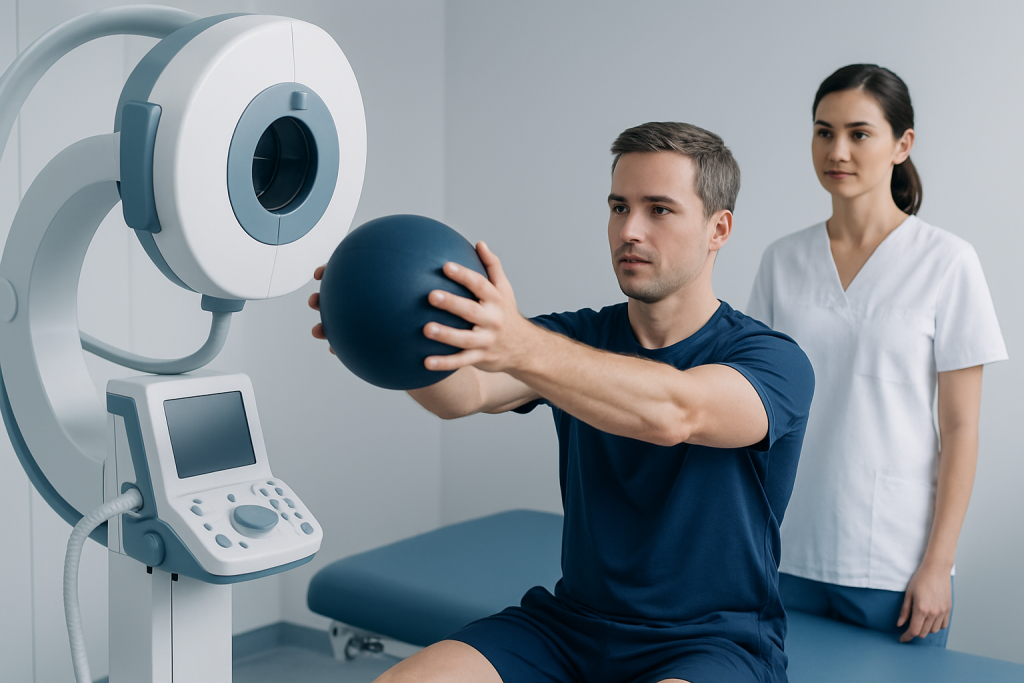
One reason medicine ball exercises remain popular is that they train several abilities at once. Depending on the movement, they may improve muscular endurance, explosive power, balance, coordination, and trunk control. Rotational drills, for example, challenge the muscles that help the torso turn and resist twisting, while overhead presses can build shoulder stability and upper-body strength.
They can also help the nervous system and muscles work together more efficiently. Catching and throwing drills, even at a light intensity, ask the body to react, stabilize, and shift weight smoothly. That is useful not only in sports, but also in daily tasks such as reaching, lifting groceries, or turning quickly without losing balance.
In rehabilitation settings, medicine balls are often chosen because they allow gradual progress. A therapist may begin with slow, supported movements and then increase range, speed, or complexity once the person shows good control. In this way, the ball becomes a tool for rebuilding confidence as much as for building strength.
Common symptoms of poor technique

Medicine ball work should feel challenging, but it should not create sharp pain or make the body feel unstable. Warning signs of poor technique often include a rounded back during lifts, shoulders hiking toward the ears, knees collapsing inward, or the person holding their breath to force the movement. These patterns can reduce the benefit of the exercise and may increase strain on the neck, back, or joints.
Another common issue is using a ball that is too heavy. When the load is excessive, the movement often becomes jerky, and control is lost during the lowering phase, not just the lifting phase. The result may be soreness in places that are not meant to be overloaded, such as the low back, wrists, or front of the shoulder.
People should also pay attention to symptoms that suggest the exercise is not suitable at that time. These may include dizziness, numbness, radiating pain, joint catching, or a feeling that the shoulder, knee, or spine is going to give way. In such cases, the workout should stop and be reviewed by a qualified clinician or physiotherapist.
Causes and risk factors for injury
Injury risk rises when medicine ball exercises are used without proper progression. Common contributing factors include poor warm-up, choosing a ball that is too heavy, performing fast rotational drills before the body is ready, or copying advanced movements without learning the basics first. Fatigue can also change form, especially during repeated throws or long circuits.
Some people need extra caution. Those with neck, shoulder, elbow, wrist, hip, knee, or back pain may find that certain positions aggravate their symptoms. People recovering from surgery, dealing with osteoporosis, balance disorders, or uncontrolled blood pressure should not assume that a medicine ball routine is automatically safe simply because it looks low-tech.
Technique errors are more likely when a person is working alone and trying to judge progress by effort alone. A movement that feels “hard enough” is not always effective if it is done with strain. A safer approach is to increase only one factor at a time, such as range of motion, number of repetitions, or speed, while keeping the body controlled and the breath steady.
How diagnosis and exercise assessment are done
When medicine ball exercises are being considered for fitness or rehabilitation, the first step is usually an assessment of movement quality rather than a test of athletic ability. A clinician or exercise professional may look at posture, shoulder mobility, trunk stability, single-leg balance, and how the person squats, hinges, or rotates. This helps identify which movements are likely to be helpful and which may need modification.
If someone already has pain or a known condition, the evaluation may include questions about symptom patterns, previous injuries, medications, and daily activity limits. For international patients planning care away from home, this assessment is especially important because it helps create a program that can be continued safely after travel, not just during a short visit.
In some cases, imaging or further medical review may be needed before exercise is advanced, particularly if symptoms suggest a structural problem or if there has been a recent injury. The purpose is not to exclude exercise, but to match the exercise to the person’s current capacity and recovery stage.
Safe techniques and treatment options
The safest medicine ball exercises usually start with simple, controlled patterns. Examples include seated or standing chest passes, gentle squat-to-press movements, wall throws at low force, torso rotations with a light load, and ball passes between the hands or around the body. These exercises are easiest to keep controlled and can be adapted for beginners or people in rehabilitation.
A few technique principles make a large difference. The feet should be positioned firmly, the spine should stay long rather than overly arched or rounded, and the movement should begin from the hips and trunk when appropriate. Breathing matters too: exhaling during effort can help avoid unnecessary pressure and improve control.
Progression should be gradual. A person can increase difficulty by adding repetitions, moving through a slightly larger range, or using a more dynamic pattern, but not all at once. For many patients, supervised exercise therapy, physical therapy, or a medically guided strength program is the best way to introduce medicine ball work safely.
- Start with a light ball and slower tempo.
- Choose stable positions before adding rotation or speed.
- Stop if pain becomes sharp, unusual, or persistent.
- Use a wall or partner only when the movement pattern is already reliable.
- Allow recovery between sessions, especially after injury or surgery.
For patients traveling for treatment, a plan that includes supervised instruction, a home program, and follow-up guidance is often more valuable than a single intensive workout session. Acibadem Health Point’s multidisciplinary specialists and JCI-accredited hospitals can diagnose and treat musculoskeletal concerns for international patients, while helping tailor exercise recommendations to each person’s medical situation.
Prevention and self-care
Good preparation is one of the easiest ways to keep medicine ball training safe. A warm-up should gently raise body temperature and prepare the joints, muscles, and nervous system for movement. This may include walking, mobility work, or light bodyweight exercises before the medicine ball is introduced.
Self-care also means respecting recovery. Muscle soreness after a new routine can be normal, but lingering joint pain, swelling, or movement limitations are not signs to push through. People who train several times a week usually do better when the session is short, focused, and followed by rest or lower-intensity activity.
Helpful habits include staying hydrated, wearing supportive footwear, practicing in enough space to move safely, and keeping the exercise area free from obstacles. For anyone with a medical condition, checking with a doctor or physiotherapist before starting is the safest choice, particularly if there is a history of falls, fractures, hernia, or spine problems.
When to see a doctor
A doctor or physiotherapist should be consulted if medicine ball exercises trigger pain that does not settle, swelling, weakness, numbness, or a sense of joint instability. Medical review is also wise when a person has ongoing back, shoulder, neck, or knee symptoms and is unsure which movements are appropriate.
People recovering from surgery, fractures, or significant sprains should not resume medicine ball training without clearance from their treating team. The same applies to anyone with a chronic condition that affects balance, bone strength, blood pressure, or coordination. A professional can decide when it is appropriate to return to dynamic exercise and how fast to progress.
For those arranging care internationally, it helps to plan follow-up before travel begins. A clear exercise prescription, a list of warning signs, and a realistic home program make it easier to continue recovery confidently after returning home.
Frequently asked questions
01Are medicine ball exercises good for beginners?
Yes, they can be a good entry point if the ball is light and the movements are simple. Beginners usually do best with controlled presses, passes, and squats before trying fast throws or twisting drills. A coach or clinician can help make sure the form is safe.
02Do medicine ball exercises help the core?
They can, especially when the movement asks the trunk to resist rotation or stay steady during a throw or lift. The core works best when the person keeps the ribs and pelvis under control rather than forcing the motion from the back. Quality matters more than speed.
03How heavy should a medicine ball be?
The right weight is one that allows controlled movement with good posture and steady breathing. If the person has to swing, strain, or hold their breath, the ball is probably too heavy. A professional can recommend a suitable starting point based on the goal and fitness level.
04Can medicine ball exercises hurt the back?
They can if the spine is rounded, twisted aggressively, or loaded before the body is ready. Many back-friendly versions use lighter loads, smaller ranges, and slower movements. Anyone with back pain should get individualized advice before starting.
05What is the difference between medicine ball training and regular weight training?
Medicine ball training often focuses more on dynamic movement, coordination, and controlled power, while traditional weight training usually emphasizes resistance against a fixed load. Both can be useful, and many programs use them together. The best choice depends on the person’s goals and health status.
06Can medicine ball exercises be part of rehabilitation?
Yes, they are often used in rehabilitation when a clinician wants to rebuild strength, balance, and function in a gradual way. The exercises should be matched to the injury stage and the person’s movement quality. Supervision is especially helpful after surgery or when pain is still present.
This article is for general information only and is not a substitute for professional medical advice. Please consult a qualified doctor about your individual situation.
Joint and spine care in Turkey — expert assessment & treatment
JCI-accredited · board-certified surgeons · reply within 24h
Add us as a Preferred Source to see more of our trusted health content across Google Search, AI Overviews and Discover.