Exercises for Pulled Groin Muscle: Safe Techniques That Actually Help

Key Takeaways
- A pulled groin muscle usually heals best with rest, pain-guided movement, and a stepwise exercise plan.
- Gentle exercises should begin only when sharp pain is settling, not during the most painful phase.
- Stretching and strengthening both matter, but pushing too hard can slow recovery.
- A groin injury that causes swelling, bruising, a lump, or trouble walking deserves medical evaluation.
- Returning to sport or running too early can turn a minor strain into a longer-lasting problem.
Exercises for a pulled groin muscle can help restore flexibility, strength, and confidence in movement when they are introduced at the right time. The safest approach is gradual: calm the pain first, then progress from gentle range-of-motion work to strengthening and finally to sport-specific movement.
Overview
A pulled groin muscle, also called a groin strain, happens when the inner-thigh muscles are overstretched or torn. These muscles help bring the leg inward, stabilize the pelvis, and support quick changes in direction, which is why the injury is common in running, football, hockey, dance, and sudden twisting movements.
For many people, the first question is whether exercises for pulled groin muscle will help or make things worse. The answer depends on timing. In the early phase, the goal is to protect the muscle and reduce pain; once the sharpest symptoms ease, carefully chosen movements can support healing by restoring mobility, preventing stiffness, and rebuilding strength.
The challenge is that the groin area is sensitive and easy to aggravate. Helpful recovery is rarely about aggressive stretching. It is usually about small, controlled steps that respect pain levels and the body’s healing pace.
Symptoms

A groin strain often announces itself with a sudden pull, twinge, or sharp pain in the inner thigh or where the leg meets the pelvis. Some people can keep walking but notice discomfort when climbing stairs, changing direction, getting in and out of a car, or squeezing the legs together.
Common symptoms include:
- Pain or tenderness in the inner thigh or groin
- Stiffness, especially after rest
- Discomfort when lifting the knee or crossing the legs
- Weakness when pushing off, running, or side-stepping
- Mild swelling or bruising in some cases
More severe strains can make walking difficult or cause a feeling that the muscle “gave way.” If the pain is deep, severe, or associated with a visible bulge, it may not be a simple muscle strain and should be assessed by a clinician.
Causes & Risk Factors
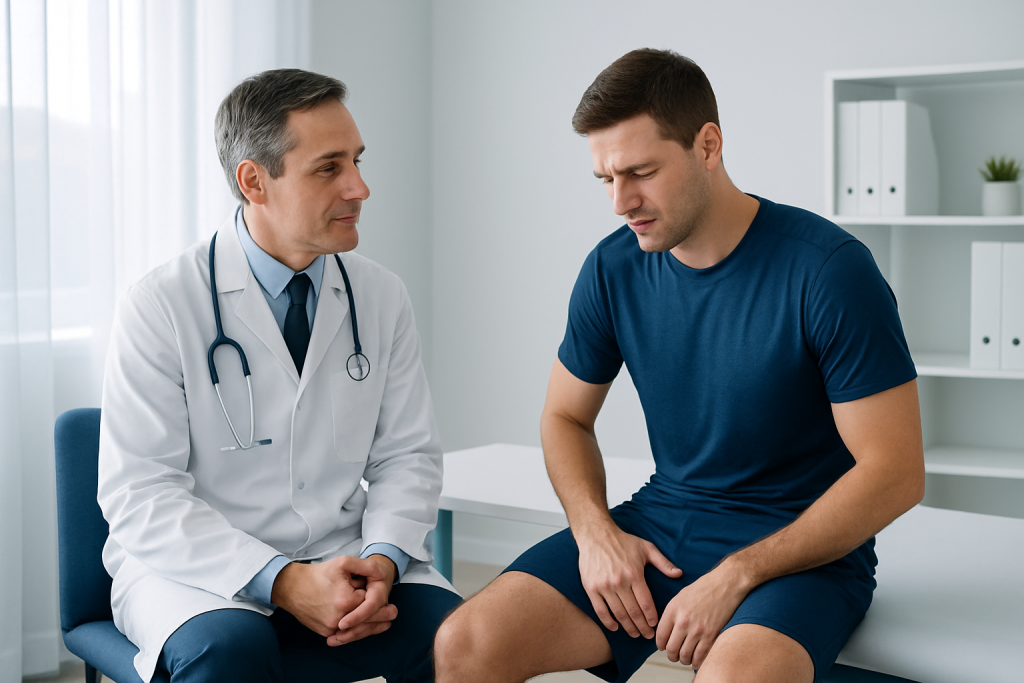
The groin muscles are vulnerable when they are asked to lengthen quickly under load. This can happen during sprinting, kicking, sliding, lunging, skating, or abrupt changes in direction. The injury may be sudden, or it may develop when a muscle is already fatigued and not moving well.
Several factors can raise the risk of a groin strain. Prior groin injury is a common one, because a previously strained muscle may be less resilient if recovery was incomplete. Limited hip mobility, weak core or hip muscles, poor warm-up, muscle imbalance, and returning to sport before full healing can also contribute.
In some people, the real issue is not only the muscle itself but also the movement pattern around it. Hip stiffness, pelvic control problems, or overtraining can place extra strain on the inner thigh. That is one reason recovery plans often work best when they look beyond the painful spot and address how the whole lower body is moving.
Diagnosis
Doctors usually diagnose a groin strain by listening to how the injury happened and checking where the pain is felt, what movements hurt, and whether the muscle is weak or tender. They may ask the person to bring the leg inward against resistance or move the hip in certain directions to see which actions reproduce symptoms.
Imaging is not always needed, especially for a mild strain that improves as expected. However, if symptoms are severe, the exam is unclear, or recovery is slower than expected, a clinician may recommend ultrasound or MRI to look more closely at the muscle and nearby structures.
Diagnosis also helps rule out other causes of groin pain, such as a hernia, hip joint problems, tendon irritation, or, less commonly, a fracture or abdominal condition. This matters because the best exercises for pulled groin muscle are only helpful when the underlying problem is truly a muscle strain.
Treatment Options
Early treatment is usually conservative. Relative rest, avoiding painful activities, and using short bouts of ice may help reduce discomfort in the first phase. Some people benefit from compression shorts or a supportive wrap, but these are comfort measures rather than cures.
Once pain begins to settle, exercise becomes part of treatment. The safest progression is usually:
- Gentle range-of-motion work: slow, pain-light movements to keep the hip from stiffening
- Isometric strengthening: contracting the groin muscles without moving the joint much
- Controlled strengthening: bridges, adduction work, and core exercises as tolerated
- Functional drills: walking, light jogging, and direction changes only when strength and comfort return
Helpful early exercises may include lying on the back and gently sliding the heel in and out, seated or supine inner-thigh squeezes using a pillow or soft ball, and standing weight shifts that keep pain minimal. Later, a therapist may add resisted adduction, side-lying leg work, glute strengthening, and exercises that improve balance and pelvic control.
What should be avoided? Deep lunges, forceful stretching, sprinting, cutting movements, and “testing” the muscle by trying to see how much pain it can tolerate. Pain should not be chased. A mild stretching sensation may be acceptable later in recovery, but sharp pain is a sign to scale back.
In more stubborn cases, rehabilitation guided by a physiotherapist is especially valuable. A specialist can tailor the sequence, correct movement faults, and decide when running, sport drills, or travel-related walking demands are safe again. For international patients, that planning can be important when treatment must fit around flights, hotel stays, and follow-up appointments in another country.
Prevention & Self-care
Once the muscle starts to improve, prevention becomes part of the recovery plan. The main aim is not to make the groin “more flexible” at any cost, but to make it stronger, better coordinated, and less likely to be overloaded again.
Self-care habits that usually help include a thorough warm-up before exercise, gradual return to training, and balanced strengthening of the hips, glutes, core, and inner thighs. People who play field sports often do better when they build sprinting and cutting drills back in step by step rather than jumping straight to full-intensity practice.
Practical recovery tips include:
- Use pain as a guide, not a challenge
- Stop if symptoms sharpen or linger noticeably after exercise
- Choose supportive shoes and avoid slippery or uneven surfaces during early recovery
- Keep up gentle walking if it does not increase pain
- Sleep, hydration, and regular meals support tissue repair
For travelers recovering away from home, it can help to plan exercise around the realities of the trip: long sitting periods, airport walking, luggage handling, and time-zone changes can all affect soreness and fatigue. Short movement breaks and a sensible schedule are often more useful than trying to “make up” for missed exercise later.
When to See a Doctor
Medical review is wise if the pain is severe, the person cannot walk normally, or the discomfort does not begin to improve over several days. It is also important to seek care if there is marked swelling, bruising, a lump in the groin, numbness, fever, testicular pain, or pain that seems to come from the hip or abdomen rather than the muscle.
Anyone who was injured during contact sport, felt a pop, or cannot bear weight should be assessed promptly. These features can indicate a more significant tear or another diagnosis that needs different treatment.
It is also sensible to consult a doctor or physiotherapist before returning to full training after a groin strain, especially if the person has repeated injuries. Clear guidance can reduce the chance of re-injury and make the return to normal activity more predictable.
Acibadem Health Point’s multidisciplinary specialists and JCI-accredited hospitals diagnose and treat groin strains for international patients, with care plans that can include rehabilitation support and follow-up coordination when needed.
Safe Exercises for Pulled Groin Muscle
The best exercises for pulled groin muscle are simple, controlled, and matched to the healing stage. In the first few days, gentle motions that do not provoke sharp pain are usually the right starting point. The aim is to keep the area moving enough to avoid stiffness while allowing the irritated tissue to calm down.
A practical early routine may include pelvic tilts, heel slides, and very light adductor squeezes with the knees bent. These movements are often well tolerated because they load the muscle without forcing it into a deep stretch. If an exercise causes a clear spike in pain, it should be reduced or paused and reviewed with a clinician.
As symptoms improve, a therapist may progress the program with standing hip adduction using a resistance band, side-lying inner-thigh strengthening, bridges, and single-leg balance work. This stage is important because the groin rarely recovers fully on flexibility alone; it also needs strength and control to handle daily and athletic movement.
For people returning to sport, the later phase usually includes walking briskly, then jogging, then short accelerations, and only after that cutting, kicking, or pivoting. Each step should feel increasingly normal both during the activity and the next day. That “next-day check” is often one of the most useful ways to judge readiness.
Recovery Timeline and Realistic Expectations
Recovery time varies widely depending on the size of the strain, the person’s activity level, and how quickly treatment begins. A mild strain may settle relatively quickly with rest and guided movement, while a more significant tear can need a longer rehabilitation period.
People often feel impatient once the sharp pain fades, but tissue strength usually returns more slowly than day-to-day comfort. That is why a stepwise plan matters. The muscle may feel “almost fine” before it is ready for fast running, sudden turns, or a full sport session.
Progress is usually heading in the right direction when walking becomes easier, stairs hurt less, squeezing the thighs is more comfortable, and exercises can be done without worsening symptoms afterward. If recovery plateaus, or if the pain keeps returning each time activity increases, reassessment is appropriate.
FAQs
Healing a groin strain is often less about doing one perfect exercise and more about choosing the right exercise at the right time. The questions below cover the concerns people most often raise when they are trying to recover safely and return to normal movement.
Frequently asked questions
01What are the best exercises for a pulled groin muscle?
The best exercises are usually gentle and pain-guided at first, such as heel slides, pelvic tilts, and light inner-thigh squeezes. As recovery progresses, strengthening exercises for the hips, glutes, core, and adductors become more important. The ideal plan depends on how severe the strain is and how the person responds over the next day or two.
02Should stretching be done after a groin strain?
Yes, but only gently and only when sharp pain has started to settle. Forceful stretching early on can irritate the muscle further and slow recovery. A mild, comfortable stretch may be introduced later if it does not increase symptoms.
03How do people know if the groin muscle is healing?
Signs of improvement include less pain with walking, easier stairs, better comfort when bringing the legs together, and no symptom flare-up after light exercise. Healing usually happens gradually, so the next-day response matters as much as how the exercise feels in the moment. If symptoms keep returning, the plan may need adjustment.
04Can a pulled groin muscle heal on its own?
Many mild strains improve with conservative care, rest from aggravating activity, and a gradual exercise program. However, medical assessment is still useful if the pain is severe, walking is difficult, or recovery is not moving forward. A proper diagnosis helps make sure the injury is not something else.
05When can someone return to running or sport?
Return should happen in stages, not all at once. A person usually needs near-normal walking, good strength, minimal tenderness, and the ability to do light sport movements without pain before trying faster or more complex drills. A physiotherapist or doctor can help decide when the body is ready.
06Is it normal for the groin to feel tight during recovery?
Yes, a sense of tightness is common while the muscle is healing and regaining mobility. The key is whether the tightness is mild and temporary or sharp and worsening. If the sensation is strong, persistent, or paired with weakness, it should be checked.
This article is for general information only and is not a substitute for professional medical advice. Please consult a qualified doctor about your individual situation.
Joint and spine care in Turkey — expert assessment & treatment
JCI-accredited · board-certified surgeons · reply within 24h
Add us as a Preferred Source to see more of our trusted health content across Google Search, AI Overviews and Discover.