Early Stage White Skin Cancer: Diagnosis and Treatment

Early stage white skin cancer commonly refers to basal cell carcinoma or squamous cell carcinoma that is confined to the skin. These cancers are often treated successfully, and prompt assessment of a new, changing, bleeding, or non-healing skin lesion helps protect both health and surrounding tissue.
Understanding early stage white skin cancer
Early stage white skin cancer is a non-medical term often used for the common non-melanoma skin cancers: basal cell carcinoma (BCC) and cutaneous squamous cell carcinoma (SCC). The word “white” may describe a pearly, pale, scaly, or flesh-coloured spot, but these cancers do not always look white. They can also appear pink, red, brown, crusted, or as a sore that does not heal.
At an early stage, the cancer is limited to the skin and has not spread to nearby lymph nodes or distant organs. Most early BCCs and SCCs can be treated effectively. The best treatment depends on the exact diagnosis, the size and depth of the lesion, its location, whether it has been treated before, and the person’s overall health.
Basal cell carcinoma is the most common type and tends to grow slowly. Squamous cell carcinoma may grow more quickly and, in a small number of cases, can spread if not treated. Melanoma is a different, less common type of skin cancer that may arise in a mole or dark patch and needs prompt medical evaluation.
How serious is early stage skin cancer?
Early stage skin cancer is usually very manageable because it can often be removed or destroyed before it causes significant damage. For many people, treatment is a relatively small procedure performed under local anaesthetic, followed by routine wound care and follow-up skin examinations.
However, “early stage” does not mean a lesion should be ignored. Skin cancers can continue to enlarge, ulcerate, bleed, become painful, or affect nearby structures. A lesion near the eye, nose, lips, ears, hands, feet, or genitals may require especially careful planning because preserving normal function and appearance is important.
Risk is assessed individually. Doctors consider the type of cancer, its borders, size, growth pattern, location, immune status, and whether the cancer has recurred. People who have had one skin cancer have an increased chance of developing another, so ongoing skin awareness remains important after successful treatment.
Signs, causes and factors that raise risk

Early skin cancers may be subtle. Basal cell carcinoma can look like a shiny or pearly bump, a pink patch, a scar-like pale area, or a sore that repeatedly crusts or bleeds. Squamous cell carcinoma may appear as a firm rough or scaly patch, a growing lump, a wart-like growth, or a persistent tender crust.
Ultraviolet (UV) radiation from sunlight and tanning beds is a leading cause. Risk rises with cumulative sun exposure, repeated sunburns, fair skin that burns easily, older age, outdoor work or hobbies, and a personal or family history of skin cancer. Skin cancer can still occur in people of all skin tones and on areas not regularly exposed to the sun.
Other factors include a weakened immune system, previous radiotherapy, certain long-standing wounds or inflammatory skin conditions, and exposure to arsenic. These factors do not mean a person will develop skin cancer, but they may support more regular clinical skin checks.
- Look for a spot that is new, changing, bleeding, crusting, painful, or non-healing.
- Pay attention to lesions that remain for several weeks despite normal skin care.
- Check sun-exposed areas as well as the scalp, ears, back, legs, and feet.
How early stage white skin cancer is diagnosed
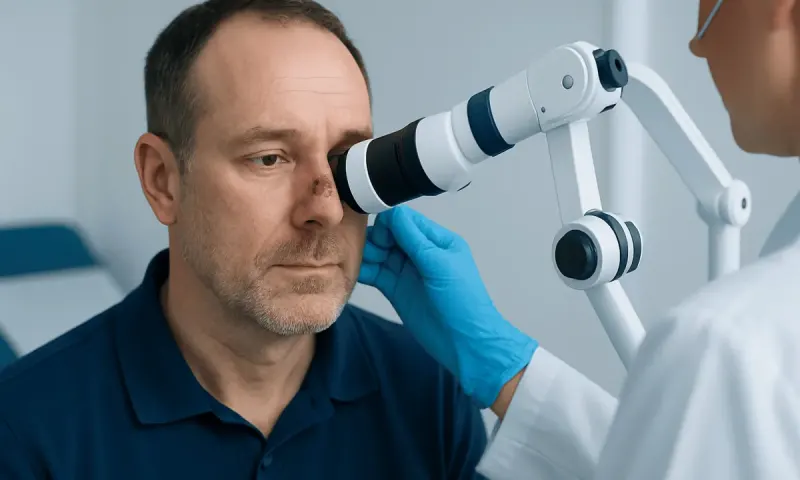
A dermatologist or other qualified clinician begins by examining the skin and asking when the lesion appeared, whether it has changed, and whether there is a history of sun exposure, prior skin cancer, or immune suppression. A dermatoscope, a handheld magnifying device with light, may help the clinician examine patterns beneath the skin surface.
A biopsy is usually needed to confirm skin cancer. During this procedure, a small sample or the entire lesion is removed under local anaesthetic and examined by a pathologist. The report identifies the cancer type and may describe features that affect treatment planning.
If the lesion appears small and low risk, diagnosis and treatment may sometimes occur during the same procedure. Imaging tests are not routinely required for uncomplicated early BCC or SCC. They may be considered when a cancer appears larger, deeper, recurrent, near important structures, or when there is concern that it has spread.
What are the treatment options for early stage skin cancer?
Removal by surgery is a common treatment for early stage BCC and SCC. Standard excision removes the visible cancer together with a small margin of surrounding skin. The tissue is then examined to help confirm that the cancer has been fully removed. In selected cases, curettage and electrodesiccation may be used to scrape and destroy certain low-risk lesions.
Mohs micrographic surgery may be recommended for cancers on cosmetically or functionally sensitive areas, cancers with unclear borders, recurrent cancers, or some higher-risk tumours. It removes the cancer in stages while examining the edges during the procedure, helping preserve as much healthy skin as possible. This may form part of skin cancer treatment planning when tissue preservation is important.
For carefully selected superficial or low-risk cancers, alternatives can include cryotherapy, photodynamic therapy, topical prescription medicines, or radiation therapy. These approaches are not suitable for every lesion and may not provide a tissue specimen to confirm complete removal. The clinician will explain the expected benefits, limitations, cosmetic considerations, and follow-up requirements.
Advanced medicines, such as immunotherapy or targeted treatments, are generally reserved for unusual cases that cannot be treated adequately with local therapies or that have spread. They are not typically needed for straightforward early stage disease.
What happens if you don't remove the basal cell?
Basal cell carcinoma usually grows slowly and rarely spreads to distant parts of the body. Even so, it does not normally disappear without treatment. Over time, it may become larger, repeatedly bleed or ulcerate, and require a more extensive procedure than it would have needed when first detected.
An untreated BCC can grow into nearby skin and, in some cases, deeper tissue such as cartilage, muscle, or bone. This is particularly important on the face, scalp, ears, and around the eyes, where a slowly enlarging tumour may affect delicate structures. Spread beyond the original area is very uncommon, but neglected or aggressive BCC can cause serious local damage.
Anyone with a suspected basal cell lesion should arrange a medical assessment rather than watch it indefinitely. A clinician can confirm whether the spot is BCC or another condition and discuss a treatment approach suited to its site and features.
How deep does basal cell carcinoma grow?
The depth of basal cell carcinoma varies. Many early lesions are confined to the upper layers of the skin, while others extend into the dermis, the deeper supportive layer of skin. A lesion’s visible size does not always show how far it extends beneath the surface, especially when its borders are not clearly defined.
Some BCC subtypes have a more infiltrative pattern, meaning thin strands of cancer cells can extend into surrounding tissue. A biopsy and clinical examination help identify features that may suggest a higher likelihood of deeper or wider growth. Location also matters: lesions on the central face, ears, scalp, hands, feet, or genital area may be managed more cautiously.
Pathology after removal provides important information about the tumour and its margins. When cancer cells are found at an edge of the removed tissue, additional treatment may be advised to reduce the chance of recurrence. Basal cell carcinoma is therefore best assessed and treated early, before it has an opportunity to involve deeper structures.
When to seek medical care
A person should arrange a medical appointment for a new or persistent skin lesion that does not heal, especially if it bleeds, crusts, grows, changes colour, becomes painful, or looks different from surrounding spots. This is also sensible for a new rough patch or firm bump that remains despite moisturising or other routine care.
More urgent assessment is appropriate for a rapidly growing lesion, a sore with repeated bleeding, a painful growth, or a spot near the eye that is changing. People who take medicines that suppress the immune system, have had previous skin cancer, or have received an organ transplant should have a lower threshold for seeking review.
Until assessment, it is helpful to avoid picking at the lesion and to protect the area from further sun exposure. Taking a clear photograph with the date may help document change, but photographs cannot replace an in-person examination or biopsy.
Acıbadem Health Point’s multidisciplinary specialists and JCI-accredited hospitals assess and treat skin cancer for international patients, with treatment planning based on the individual lesion and pathology findings.
Reducing future risk and planning follow-up
Sun protection is an important part of prevention after any skin Prostate Cancer Diagnosis: Tests and Next Steps" class="ahp-ilk">cancer diagnosis. This includes seeking shade when UV exposure is strongest, wearing protective clothing and a broad-brimmed hat, using sunglasses, and applying broad-spectrum sunscreen with appropriate sun protection factor to exposed skin. Sunscreen should complement, rather than replace, shade and protective clothing.
Regular self-checks can help identify a change early. A person may examine their face, ears, scalp, neck, arms, hands, trunk, legs, and feet, using mirrors or asking someone to help with hard-to-see areas. Any changing or suspicious spot should be shown to a clinician.
Follow-up schedules vary according to the cancer type, treatment, number of prior skin cancers, and individual risk factors. During follow-up, the clinician checks the treated area for recurrence and examines the rest of the skin for new lesions. Avoiding tanning beds is also recommended because they expose the skin to harmful UV radiation.
Frequently asked questions
01Is early stage white skin cancer curable?
Most early basal cell and squamous cell skin cancers can be treated successfully, particularly when they are confined to the skin. The appropriate treatment and outlook depend on the cancer type, location, size, depth, and whether it has recurred. Follow-up is important because new skin cancers can develop later.
02Can basal cell carcinoma be treated without surgery?
Some superficial, low-risk basal cell carcinomas can be treated with options such as topical medicines, freezing, photodynamic therapy, or radiation in selected circumstances. Surgery is often preferred because it can remove the tumour and allow the tissue edges to be examined. A dermatologist can advise which approach is appropriate for the individual lesion.
03Does basal cell carcinoma spread to other organs?
Basal cell carcinoma very rarely spreads to lymph nodes or distant organs. Its more typical concern is local growth into nearby skin and deeper tissues when left untreated. Early assessment and treatment greatly reduce the risk of extensive local damage.
04How quickly does early stage skin cancer grow?
Growth rates vary by cancer type and individual tumour. Basal cell carcinoma often grows slowly over months or years, while squamous cell carcinoma may grow more quickly. Because it is not possible to judge the diagnosis or growth pattern reliably by appearance alone, a persistent changing spot should be assessed.
05Will a biopsy make skin cancer spread?
No. A skin biopsy does not cause skin cancer to spread. It is a standard and important diagnostic procedure that allows the clinician to identify the lesion accurately and choose the right treatment.
06Can sunscreen prevent all skin cancers?
Sunscreen helps reduce UV damage, but it cannot prevent every skin cancer on its own. Combining sunscreen with shade, protective clothing, hats, sunglasses, and avoiding tanning beds provides stronger protection. Regular skin checks remain useful even for people who use sun protection consistently.
This article is for general information only and is not a substitute for professional medical advice. Please consult a qualified doctor about your individual situation.
Persistent digestive symptoms? Get evaluated in Turkey
JCI-accredited · board-certified surgeons · reply within 24h
Add us as a Preferred Source to see more of our trusted health content across Google Search, AI Overviews and Discover.