Does a Newborn Have Kneecaps?

Key Takeaways
- Newborns have kneecaps, but they are not fully bone yet.
- Cartilage gradually turns into bone during early childhood.
- Soft kneecaps help protect the knee and support early growth.
- A kneecap-looking asymmetry is not always a problem, but persistent swelling or pain should be checked.
- Most knee development questions are answered by a pediatrician or orthopedic specialist after a simple examination.
Does a newborn have kneecaps? Yes—newborns do have kneecaps, but they are made mostly of soft cartilage rather than fully hardened bone. Over time, these kneecaps gradually ossify, which is a normal part of growth.
Overview
Yes, a newborn does have kneecaps. The important detail is that those kneecaps are not yet the hard, fully ossified bones adults have. In early life, the kneecap area is largely made of cartilage, a flexible tissue that gradually turns into bone as a child grows.
This is one reason infant knees do not look or behave like adult knees on imaging or during movement. The knee joint is still developing, and that development is completely normal. For parents comparing one baby to another, it can be reassuring to know that timing varies and that the process happens over several years rather than overnight.
From a medical perspective, the kneecap is called the patella. It helps the thigh muscles work efficiently and protects the front of the knee. In newborns, the patella is present from the start, even though it may be too cartilaginous to be seen on a standard X-ray.
What the Kneecap Looks Like in a Newborn

At birth, the patella is usually a soft structure within the knee. Because cartilage is flexible and does not show up well on X-rays, many parents are surprised to learn that a baby can have kneecaps that are “there” but still invisible on routine imaging. This is normal anatomy, not a missing body part.
The kneecap is part of a broader pattern in infant development: several bones begin as cartilage templates before they harden. In the knee, this means the patella starts as cartilage and later becomes more bone-like through a natural process called ossification. The timing can differ from child to child without indicating disease.
During infancy, the knee also has different proportions and range of motion compared with later childhood. Babies often keep their legs bent, and the joint’s soft tissues are still adapting. That can make the area look unusual to new parents, even when it is completely typical.
How Kneecaps Develop Over Time
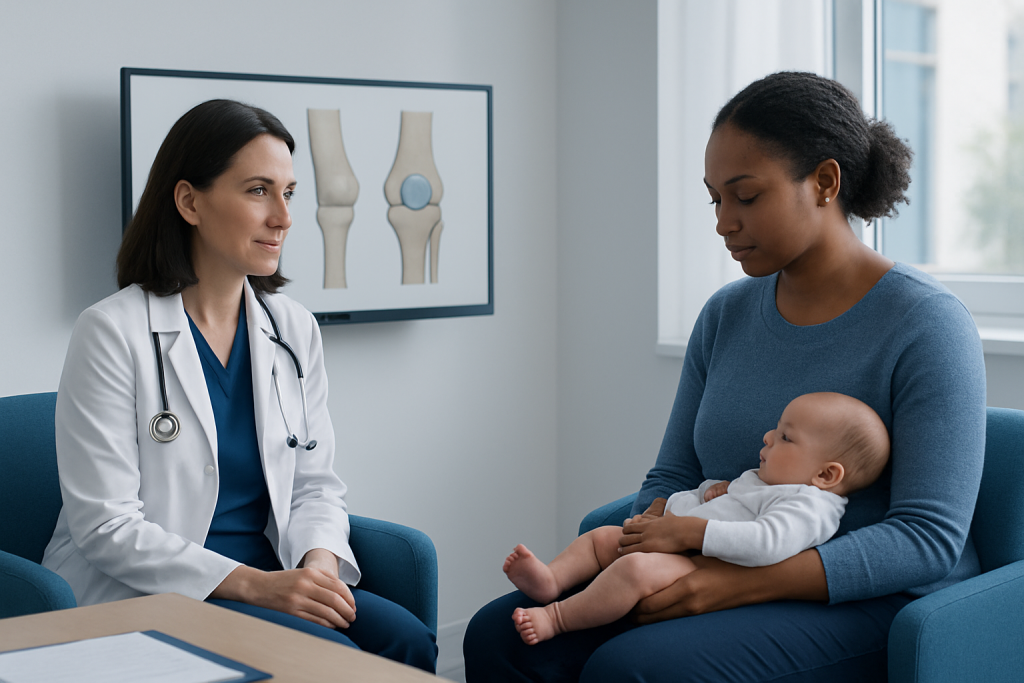
Kneecap development happens gradually. The patella begins as cartilage before small centers of bone formation appear later in childhood. This is part of normal growth and is one of the reasons pediatric knee anatomy cannot simply be judged by adult standards.
There is no single moment when a baby’s kneecaps “arrive” or suddenly become visible. Instead, the process unfolds over time, with the kneecap becoming more mineralized as the child matures. Because of this, a knee X-ray in infancy may not clearly show the patella even though it is present.
Parents sometimes hear different descriptions from different sources, which can be confusing. The simplest way to think about it is this: the newborn knee contains the building blocks of the kneecap, but those building blocks are still soft and unfinished.
Why This Matters for Parents
Understanding newborn kneecaps helps explain normal knee appearance, normal imaging results, and why some baby movements look different from adult movements. It also helps reduce worry when a routine exam or scan does not show a hard kneecap in the way many people expect.
For families traveling for pediatric consultation, knee development questions often come up during a general growth or orthopedic assessment. A specialist may explain whether what is being seen is simply normal cartilage development or whether a separate concern needs attention. This is usually a calm, step-by-step conversation based on the child’s overall development, not on one isolated observation.
Another practical point is that newborn knees are built to support growth, not early walking. Babies are not yet bearing full weight, so the musculoskeletal system is still preparing for later milestones. That normal preparation includes a cartilaginous patella that will gradually mature.
When a Knee Appears Different: Common Concerns
Parents may notice that one knee looks puffier than the other, bends differently, or seems to move with a slightly different pattern. In many cases, these differences are harmless and related to positioning, soft tissue variation, or the natural appearance of a baby’s developing joints.
That said, not every knee concern is just “normal growth.” Persistent swelling, redness, limited movement, obvious pain when the knee is touched, or a history of injury deserve medical review. These signs are less about the kneecap itself and more about making sure the joint, bones, and surrounding tissues are healthy.
- Uneven swelling that does not improve
- Refusal to move the leg or kick normally
- Warmth, redness, or fever with joint changes
- Visible deformity after a fall or trauma
- Concern that one leg is not developing like the other
How Doctors Check the Knee in Babies
When a pediatrician or orthopedic specialist examines a baby’s knee, the first step is usually a physical exam. The clinician looks at symmetry, swelling, skin color, range of motion, and how the baby moves the leg. Many questions can be answered from this examination alone.
If imaging is needed, ultrasound or X-ray may be considered depending on the concern. Because cartilage does not show on X-ray the way bone does, a newborn patella may be difficult to see, which is expected. If a more detailed look is needed, the doctor may suggest another test or follow-up over time.
The goal is not to label every difference as a problem, but to distinguish normal development from conditions that need treatment. That approach is especially important for international patients who may arrive after receiving different explanations elsewhere and want a clear, coordinated opinion before making decisions about care.
Treatment Options
There is no treatment needed for a normal cartilaginous kneecap in a newborn. The patella develops on its own as the child grows, and the process does not require medication, supplements, or special equipment in routine cases.
If a doctor identifies a separate issue, treatment depends entirely on the diagnosis. Some conditions may only need observation and follow-up, while others may require bracing, physical therapy, or, in uncommon situations, more advanced orthopedic care. The plan should always be individualized to the child’s age, symptoms, and examination findings.
Because babies’ bones and joints are still developing, treatment decisions are made carefully and conservatively whenever possible. Families should avoid trying to interpret a child’s knee shape through online images alone, since normal infant anatomy can look very different from adult anatomy.
Prevention & Self-care
Parents cannot speed up kneecap ossification, and they do not need to. The best self-care is ordinary, age-appropriate infant care: gentle handling, safe positioning, and routine pediatric checkups that track development over time.
If a baby seems uncomfortable during leg movement, parents should not force stretching or massage the knee without guidance. Gentle movement during normal care is usually fine, but any persistent pain, stiffness, or asymmetry should be evaluated by a clinician rather than managed at home.
Keeping a simple note of what was seen, when it started, and whether it changes can be helpful during a consultation. For families arranging care from another country, bringing any prior scans, discharge notes, or photos of the concern can make the appointment more efficient and reduce repeated testing.
When to See a Doctor
A doctor should evaluate a baby if the knee looks swollen, red, warm, or painful, or if the child avoids moving that leg. Medical review is also sensible if the difference between the knees is getting more noticeable rather than settling over time.
Parents should seek prompt advice after any injury, even if the baby appears comfortable at first. In infants, symptoms can be subtle, and a simple assessment can clarify whether the issue is a normal developmental finding or something that needs attention.
In some cases, an orthopedic or pediatric specialist may be the right next step, especially when the question involves bone growth, joint structure, or unusual imaging findings. Acibadem Health Point’s multidisciplinary specialists and JCI-accredited hospitals diagnose and treat orthopedic concerns for international patients, with care planned around the child’s needs and the family’s travel situation.
Frequently asked questions
01Does a newborn have kneecaps or not?
Yes, a newborn does have kneecaps. They are present from birth, but they are mostly made of cartilage and have not fully turned into bone yet. That is why they may not be visible on an X-ray in the newborn period.
02Why can’t a baby’s kneecaps be seen on X-rays?
Cartilage does not show up on standard X-rays the way bone does. Since a newborn’s kneecap is still largely cartilaginous, it may not appear clearly even though it is there. This is a normal part of development.
03At what age do kneecaps harden?
The kneecap gradually ossifies over time during childhood. The exact timing varies from child to child, so there is a normal range rather than one fixed age. A pediatrician can explain what is expected for a child’s stage of growth.
04Is it normal if one knee looks different from the other in a baby?
A mild difference can be normal in infants because of positioning and ongoing growth. However, swelling, redness, pain, or reduced movement should be checked by a doctor. Persistent asymmetry deserves medical evaluation.
05Can a baby’s kneecap be injured easily?
The kneecap itself is still soft early in life, but the whole knee area can still be affected by injury. Any fall, unusual swelling, or change in movement should be assessed. Babies may not show pain in the same way older children do, so a careful examination matters.
06Do all babies develop kneecaps in the same way?
The overall pattern is the same, but the timing can differ. Some children’s kneecap ossification becomes visible earlier than others without this meaning there is a problem. Doctors look at the whole child, not just one developmental detail.
This article is for general information only and is not a substitute for professional medical advice. Please consult a qualified doctor about your individual situation.
Joint and spine care in Turkey — expert assessment & treatment
JCI-accredited · board-certified surgeons · reply within 24h
Add us as a Preferred Source to see more of our trusted health content across Google Search, AI Overviews and Discover.