Dextroconvex Curvature on Imaging: Meaning and Context
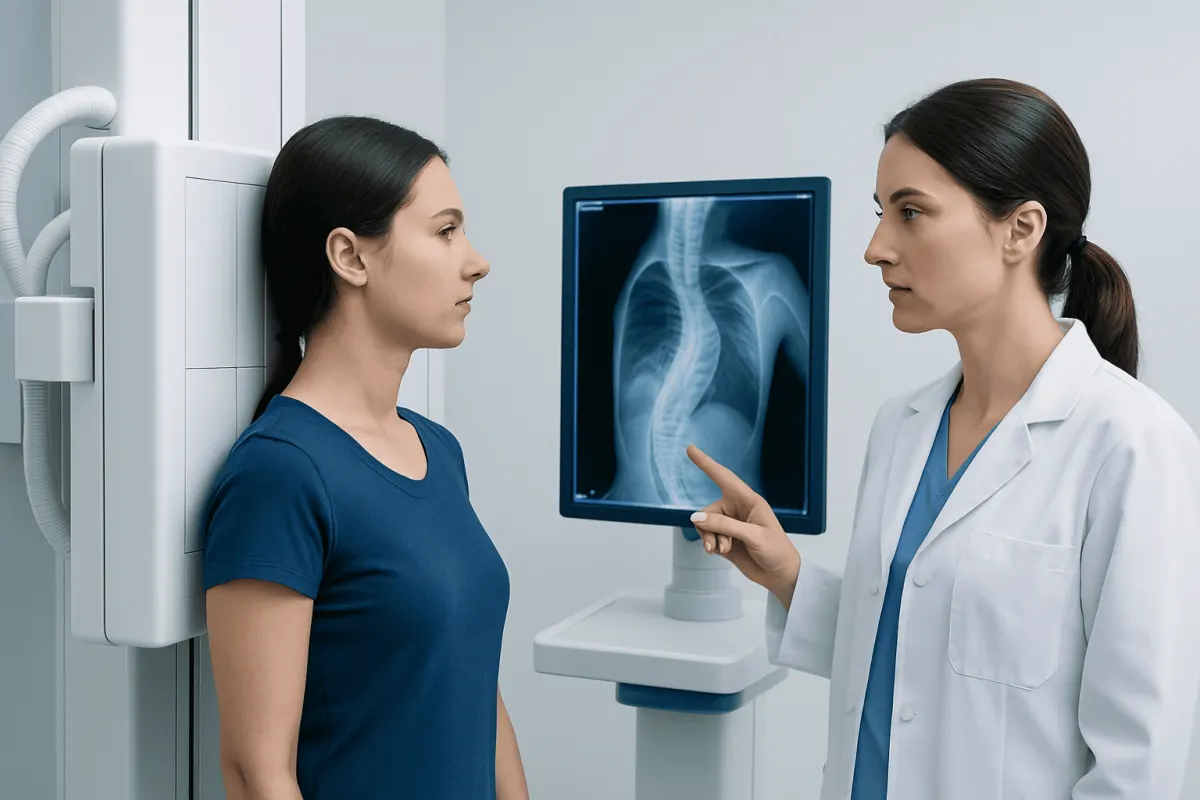
Dextroconvex curvature is an imaging term describing a curve that bows toward the right side of the body, most often in the spine. It is a descriptive finding rather than a diagnosis on its own, and its importance depends on the curve’s location, angle, symptoms, age, and cause.
What does dextroconvex curvature mean?
Dextroconvex curvature means that a curve bulges or bends toward the right side. In medical imaging, the phrase is most often used to describe the spine. For example, an X-ray report may state that there is a “dextroconvex curvature of the thoracic spine,” meaning that the middle or upper back curves toward the right.
The phrase itself does not explain why the curve is present or whether it requires treatment. It is a directional description. Doctors interpret it together with the degree of curvature, the part of the spine involved, a person’s age and growth stage, physical examination findings, symptoms, and any changes over time.
A right-sided curve is often seen in the thoracic spine in people with scoliosis. However, a mild curve can sometimes reflect posture, positioning during an X-ray, muscle spasm, or an underlying difference in the spine. A clinician can help distinguish a temporary or positional finding from a structural spinal curve.
How spinal curves are described and measured
The spine naturally has gentle curves when viewed from the side. Dextroconvex curvature refers instead to a side-to-side curve seen when the body is viewed from the front or back. The opposite term, levoconvex, means the curve points toward the left.
Clinicians generally use the Cobb angle to measure a sideways spinal curve on standing X-rays. A Cobb angle of 10 degrees or more is typically used to define scoliosis. The word dextroconvex does not tell a person the Cobb angle, so it does not indicate severity by itself.
Reports may also describe the curve by its location. A thoracic curve affects the upper or middle back, a lumbar curve affects the lower back, and a thoracolumbar curve involves the area where these regions meet. Curves can have more than one bend, and the spine may rotate slightly as part of a structural scoliosis curve.
- Mild curves are often monitored, especially if the person is still growing.
- Moderate curves may require closer follow-up and, in some growing children, bracing.
- Larger or progressing curves may need assessment by a spine specialist to discuss individualized options.
Possible causes and risk factors
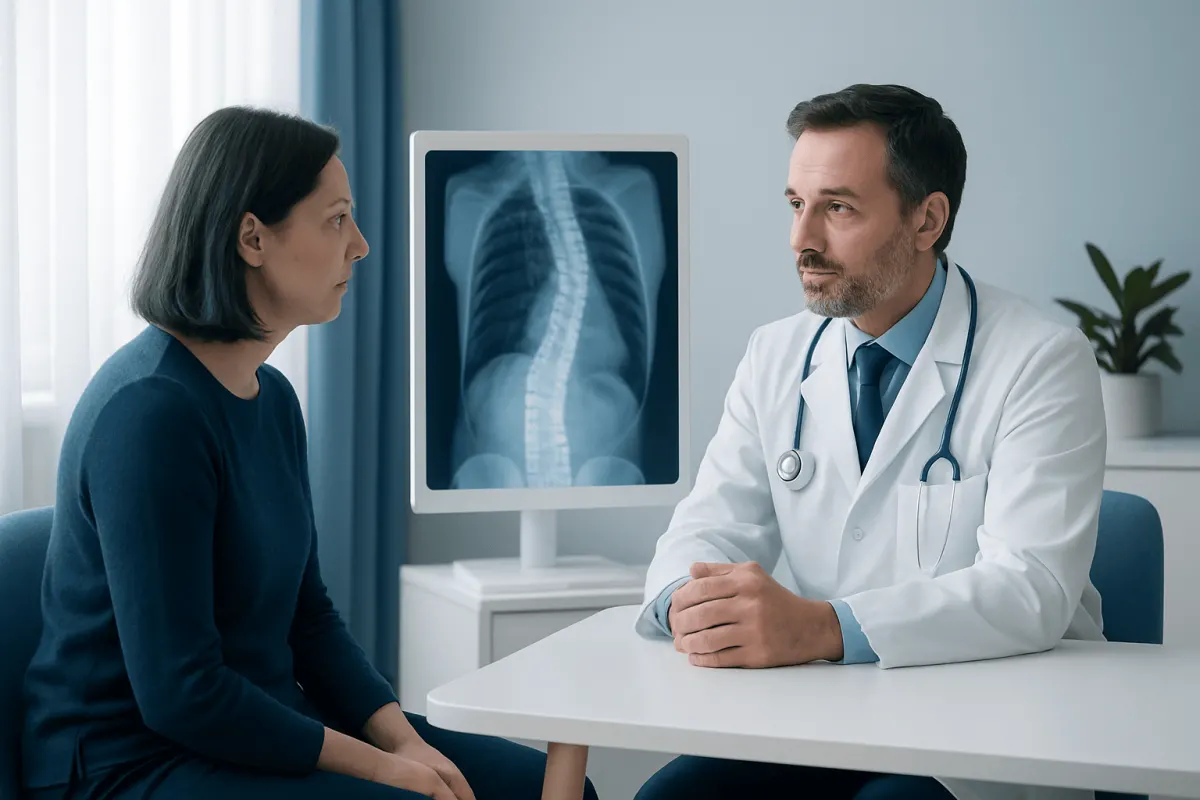
In many children and teenagers, scoliosis has no identifiable cause. This is called adolescent idiopathic scoliosis. It commonly becomes noticeable during periods of rapid growth and may run in families. A dextroconvex thoracic curve can be one pattern seen in this condition.
Spinal curvature may also be present from birth because of differences in how vertebrae formed. In adults, a new or increasing curve may occur as discs and joints of the spine change with age; this is often called degenerative scoliosis. Prior spinal surgery, unequal leg length, muscle spasm, osteoporosis-related vertebral changes, and certain neuromuscular conditions can also influence spinal alignment.
Not every apparent curve is structural scoliosis. Painful muscle spasm may cause a person to lean or shift temporarily, producing a functional curve. For this reason, doctors consider the medical history and examination rather than relying only on a single phrase in an imaging report.
Most spinal curves are not caused by poor posture, carrying a backpack, playing sports, or routine exercise. These activities may affect comfort or posture, but they are not established causes of idiopathic scoliosis.
Symptoms and day-to-day effects
Many people with a mild dextroconvex spinal curve have no symptoms. A curve may first be noticed because one shoulder appears higher, one shoulder blade is more prominent, the waist looks uneven, or clothing hangs differently. During a forward-bend examination, a rib or lower-back prominence may be visible because scoliosis can include spinal rotation.
Back discomfort can occur, particularly in adults or when arthritis and disc changes are also present. However, significant or persistent pain should not automatically be attributed to a spinal curve. A clinician may check for other causes of pain, including muscle strain, nerve irritation, inflammatory conditions, or injury.
Most mild and moderate curves do not affect heart or lung function. Very large thoracic curves can sometimes reduce chest movement and contribute to shortness of breath, particularly when other lung or heart conditions are present. Changes in walking, leg weakness, numbness, or balance problems are not typical features of uncomplicated adolescent idiopathic scoliosis and deserve medical review.
How doctors evaluate a dextroconvex curve
Evaluation begins with a discussion of symptoms, medical history, family history, growth, previous injuries, and any known conditions affecting nerves, muscles, or bones. During the examination, the clinician observes posture, shoulder and pelvic height, walking, range of motion, and signs of nerve involvement. A forward-bend test may help identify asymmetry.
Standing full-spine X-rays are often used to confirm and measure scoliosis. They allow the care team to calculate the Cobb angle and compare future images for signs of progression. Radiation exposure is kept as low as reasonably possible, particularly in children who may need follow-up imaging.
MRI is not routinely necessary for every spinal curve. It may be recommended when there are unusual features, such as rapid progression, substantial pain, weakness, numbness, abnormal reflexes, an atypical curve pattern, or concern for a problem involving the spinal cord or surrounding tissues. CT is used selectively, often when detailed bony anatomy is needed.
A person with a confirmed spinal curve may be referred for assessment of scoliosis by an orthopedic spine specialist, particularly if they are growing, have a larger curve, or have symptoms. Follow-up timing is individualized and depends on the curve, maturity, and clinical findings.
Treatment options and supportive care
Treatment is based on the person rather than the word “dextroconvex.” Important factors include the Cobb angle, curve location, whether the curve is changing, skeletal maturity, symptoms, overall health, and personal goals. Observation with periodic clinical visits and X-rays is appropriate for many mild curves, especially when there is little risk of progression.
For some children and adolescents who are still growing and have curves within a range likely to progress, a specialist may recommend a brace. Bracing does not straighten every curve, but its purpose is usually to reduce the chance that a progressing curve will become severe. The type of brace and wearing plan are selected individually.
Exercises and physical therapy can improve strength, movement, body awareness, and comfort. Scoliosis-specific exercise programs may be useful as part of a wider care plan. General activity is encouraged for most people, and exercise does not usually worsen a stable curve. Pain management may include guided activity changes, physiotherapy, heat or cold measures, and medicines recommended by a healthcare professional.
Surgery is considered only for selected people with large, progressing, symptomatic, or functionally significant curves. Scoliosis surgery is planned carefully after detailed imaging and specialist discussion, with the aim of improving alignment and limiting further progression when appropriate. The potential benefits, recovery, and risks vary from person to person.
Self-care, monitoring, and when to seek medical care
People with a dextroconvex curve can usually continue normal daily activities unless a clinician advises otherwise. Regular physical activity, adequate sleep, attention to ergonomics, and maintaining bone health through an appropriate diet and medical guidance may support general spinal health. These measures do not replace clinical monitoring when a structural curve is present.
It can be helpful to keep follow-up appointments and bring previous imaging reports or X-rays when possible. Parents and caregivers of growing children should watch for visible changes in shoulder height, waist symmetry, or trunk balance, but should avoid repeatedly checking or causing worry between scheduled reviews.
When to seek medical care: A non-urgent appointment is appropriate for a newly noticed uneven shoulder, rib prominence, persistent back pain, or an imaging report mentioning spinal curvature. Prompt medical assessment is important for severe or rapidly worsening pain, new weakness or numbness, difficulty walking, loss of bowel or bladder control, fever with back pain, unexplained weight loss, or shortness of breath.
Acıbadem Health Point’s multidisciplinary specialists and JCI-accredited hospitals can assess and treat spinal conditions for international patients, with care plans based on imaging findings and individual needs.
Frequently asked questions
01Is dextroconvex curvature the same as scoliosis?
Dextroconvex curvature describes the direction of a curve, meaning it points to the right. Scoliosis is a diagnosis generally based on a measured side-to-side spinal curve of at least 10 degrees. A dextroconvex curve may be scoliosis, but the imaging measurement and clinical assessment are needed to confirm this.
02Is a dextroconvex curvature serious?
Its significance depends on the curve’s angle, location, cause, symptoms, and whether it is progressing. Many mild curves do not cause major health problems and are monitored over time. A doctor can explain what the finding means in the context of the individual imaging report and examination.
03Can a dextroconvex spinal curve get worse?
Some curves can progress, particularly during rapid growth in childhood and adolescence. In adults, progression may occur with age-related changes in discs and joints, although not every curve worsens. Follow-up recommendations are based on the measured curve and the person’s stage of growth or health.
04Can exercise correct dextroconvex curvature?
Exercise can support strength, flexibility, function, and comfort, and specialized programs may be included in scoliosis care. However, exercise alone may not fully correct a structural spinal curve. A physiotherapist or spine specialist can recommend activities that fit the person’s condition and goals.
05Does a dextroconvex curve cause back pain?
A mild curve often causes no pain. Some people, especially adults with additional wear-related spinal changes, may experience discomfort. Persistent, severe, or new pain should be evaluated because it may have a cause other than the curve itself.
06What tests are needed after a dextroconvex curvature is found?
A clinician may review the imaging, perform a physical examination, and request standing spine X-rays if they have not already been done. MRI or other tests are usually reserved for specific concerns such as nerve symptoms, unusual pain, rapid progression, or atypical features. The appropriate testing depends on the individual situation.
This article is for general information only and is not a substitute for professional medical advice. Please consult a qualified doctor about your individual situation.
Joint and spine care in Turkey — expert assessment & treatment
JCI-accredited · board-certified surgeons · reply within 24h
Add us as a Preferred Source to see more of our trusted health content across Google Search, AI Overviews and Discover.