When Do Infants Start Talking?

Key Takeaways
- Talking begins with early communication skills such as eye contact, cooing, and babbling before true words appear.
- Most infants say their first meaningful words sometime in the first year to 18 months, but development varies widely.
- Hearing ability, social interaction, and regular language exposure all influence speech and language growth.
- A pause in babbling, lack of response to sound, or loss of skills should be discussed with a doctor.
- Early evaluation can clarify whether a child needs hearing testing, speech-language support, or closer developmental follow-up.
Many babies begin to communicate long before they say their first clear word, using cries, facial expressions, coos, gestures, and babble. Understanding the usual language timeline can help parents know what is typical, what to watch for, and when to ask a clinician for guidance.
Overview
Parents often ask a simple question that does not always have a simple calendar answer: when will infants start talking? The more useful answer is that speech develops in stages. Long before a baby speaks a first recognizable word, the child is already learning the building blocks of communication: making eye contact, turning toward voices, copying sounds, and using facial expressions to get a response.
Language growth usually starts with listening and connecting. A newborn does not “talk” in the adult sense, but the brain is already taking in rhythm, tone, and repeated patterns in speech. Over the months that follow, these early experiences gradually become cooing, babbling, gestures, and then words. For families living across borders or traveling for care, it can help to think in milestones rather than a single deadline, because clinicians assess the whole communication pattern, not just one phrase or one birthday.
Every child develops at a different pace, and small variations are common. Still, there are broad age ranges that help parents and doctors understand whether language is progressing as expected. When a baby is quiet, delayed, or less responsive than expected, the next step is usually calm observation and, when needed, a developmental or hearing assessment.
How infant communication usually unfolds

Infant speech development is often easiest to understand as a sequence. In the first months, babies respond to sound, settle to a familiar voice, and begin making soft vowel-like noises. Around this stage, caregivers may notice cooing, smiling during interaction, and an emerging back-and-forth rhythm that resembles conversation.
Later, babies begin to experiment with consonants and repeated sounds such as “ba-ba” or “da-da.” This babbling stage is important because it shows that the child is practicing the movements needed for speech. Gestures also matter: pointing, reaching, waving, and showing objects are all part of communication and often arrive before full sentences.
First words usually emerge after this broader foundation has been established. A child may say “mama,” “dada,” or another familiar word and use it with meaning, even if pronunciation is not yet clear. Some children speak a few early words near the end of the first year, while others take longer and then make rapid progress later. The exact timing is less important than steady forward movement across the child’s communication skills.
- Early sounds: cooing, vowel noises, squeals
- Practicing speech: babbling with repeated syllables
- Social communication: eye contact, gestures, shared attention
- First words: simple meaningful words used intentionally
Typical signs by age
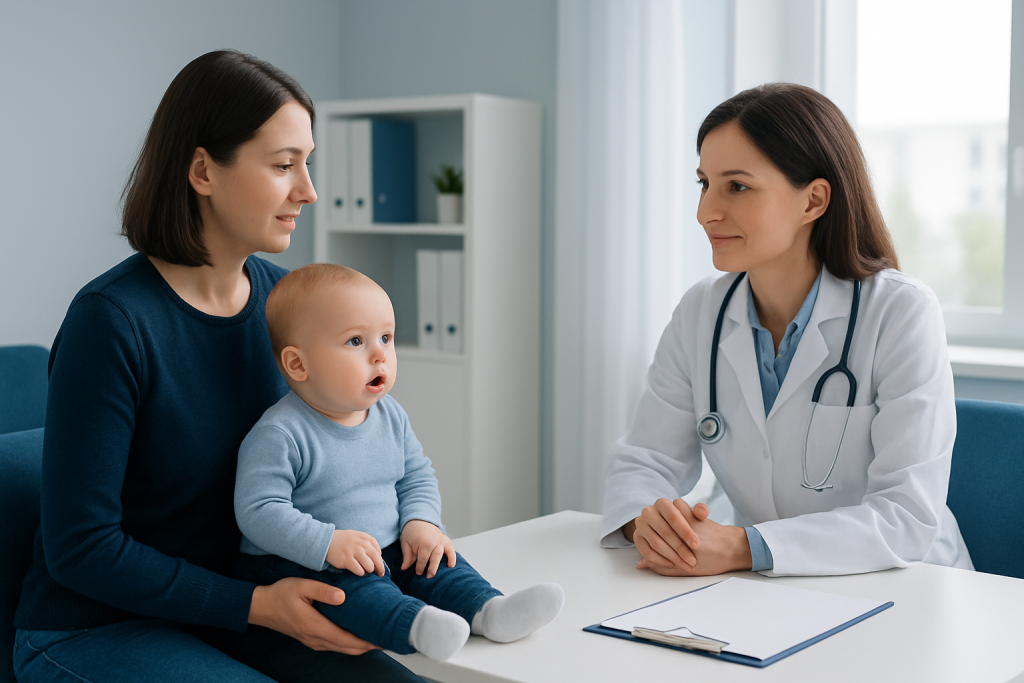
Milestones are guides, not tests. A baby does not need to match every listed behavior on a specific day, but the overall pattern should move forward. In the early months, infants usually react to voices and sound. By mid-infancy, many begin to turn toward familiar speech, smile in response, and make more varied vocalizations.
In the second half of the first year, babbling becomes more complex and intentional. Babies may respond to their name, imitate tone, and communicate through gestures. As the first birthday approaches, some children have one or more meaningful words, while others mainly use gestures and sound play but are clearly understood by their caregivers.
By 18 months, many children use several words and show clear interest in communicating. By age 2, word combinations often begin, though the pace can still vary. Families should remember that bilingual exposure does not cause speech delay; children may distribute vocabulary across languages while building one shared language system.
- 0–3 months: responds to sound, calms to a voice, coos
- 4–6 months: laughs, squeals, turns toward voices, experiments with sounds
- 6–10 months: babbles, imitates sounds, uses gestures
- 10–15 months: may say first meaningful words, points and shows objects
- 15–24 months: vocabulary expands; simple word combinations may appear
What can influence language development
Several factors shape how quickly an infant begins to talk. Hearing is one of the most important. If a child cannot hear speech clearly because of fluid in the ear, recurrent ear infections, or another hearing problem, language may progress more slowly. That is why hearing concerns deserve prompt attention even when the child seems otherwise healthy.
Social interaction also plays a major role. Babies learn language through repeated human exchanges: being spoken to, hearing names for objects, and seeing how words connect to actions. Children who receive consistent responsive interaction often have more chances to practice both understanding and expression. The amount of “baby talk” matters less than the quality of warm, repeated conversation.
Other influences include prematurity, neurological differences, oral-motor challenges, developmental conditions, and family history of speech or language delay. In some cases, a child is simply a late talker and later catches up. In others, delayed speech is an early sign that a fuller evaluation would be helpful. Parents do not need to sort out the cause alone; that is part of a clinician’s job.
How doctors evaluate delayed speech
If a child is not meeting expected communication milestones, doctors usually begin with a detailed history and developmental review. They may ask when the baby started babbling, whether the child responds to sounds, whether there are gestures, and whether language seems to be progressing, plateauing, or regressing. These details help distinguish a normal variation from a pattern that needs further assessment.
A hearing check is often one of the first steps, because hearing problems can be easy to miss without formal testing. Depending on the child’s age and signs, the clinician may also examine the ears, review growth and neurologic development, and ask about play skills, social interaction, and motor milestones. If there are concerns about broader development, referral to a speech-language pathologist or developmental specialist may be recommended.
For families seeking evaluation while traveling or planning care from another country, it can be useful to bring any available records, birth history, and notes about milestones in both languages the child hears. A clear timeline and simple examples of what the baby says or understands can make the visit more efficient and informative.
Ways to support speech at home
Parents do not need special toys or complicated exercises to support early language. Everyday interaction is usually the most effective environment for speech growth. Talking during routines, naming what the baby sees, and pausing so the child has a chance to respond all help build communication.
Reading aloud, singing, and repeating simple words are also useful. Responding to babbles as if they are part of a conversation teaches turn-taking, which is a core language skill. When a baby points or reaches, naming the object can link meaning to sound. Screen time is not a substitute for live back-and-forth interaction, especially in the earliest years.
Helpful habits include:
- Talk during feeding, bathing, dressing, and play.
- Use clear, simple language and repeat key words naturally.
- Pause after speaking so the baby can vocalize or gesture.
- Follow the child’s attention and describe what they are looking at.
- Read and sing regularly, even for short periods.
If parents are raising a child in more than one language, they can continue using the languages that matter most in the family. A rich language environment in more than one language is generally beneficial and does not confuse children in the long term.
When to see a doctor
It is wise to ask a doctor about speech development if a baby is not responding to sounds, does not babble by the late infant months, or shows little interest in back-and-forth interaction. A child who once used sounds or gestures and then stops doing so should also be assessed without delay. Loss of skills is a different concern from being a little late.
Medical advice is also important if there are concerns about hearing, frequent ear infections, feeding problems, low muscle tone, poor eye contact, or delays in other developmental areas such as sitting, crawling, or social engagement. These signs do not point to one diagnosis by themselves, but they help clinicians understand the full picture.
When parents seek care early, the evaluation is usually straightforward and supportive. Many children simply need monitoring, hearing assessment, or speech-language guidance. If the issue is broader, early intervention can make a meaningful difference. Acibadem Health Point’s multidisciplinary specialists and JCI-accredited hospitals also evaluate and treat speech and developmental concerns for international patients in a coordinated setting.
Looking ahead with a realistic timeline
The question “when will infants start talking” is best answered with patience and attention to the pattern of progress. A baby’s first words are important, but they are only one milestone in a much larger communication journey. Long before those first words, the child is learning how human conversation works.
Families can watch for steady gains in sound, attention, gestures, and understanding. If those gains are not appearing, a calm evaluation can help identify whether the issue is temporary, hearing-related, or part of a broader developmental picture. That information is valuable because it turns uncertainty into a plan.
With responsive interaction at home and timely medical support when needed, many infants move forward well. The goal is not to rush speech but to make sure the child has the best chance to develop language in a healthy way.
Frequently asked questions
01When do most babies say their first words?
Many babies say their first meaningful words sometime near the end of the first year or during the second year of life. The exact age varies, and some children focus on babbling and gestures first before words appear. Progress over time matters more than one specific date.
02Is it normal if a baby babbles but does not say words yet?
Yes, babbling without words can still be part of normal development, especially if the baby is making new sounds, responding to voices, and using gestures. Babbling is an important step toward speech. If there is no progress over time, a doctor should evaluate the child.
03Can bilingual exposure delay speech?
No, learning more than one language does not cause speech delay. Bilingual children may use words from different languages as they build vocabulary, which can make their total language skills look different from monolingual children. Doctors consider the whole language environment when assessing development.
04Can parents help a late-talking baby at home?
Yes, simple daily conversation, reading, singing, and responsive turn-taking can support language growth. Naming objects and pausing to let the baby react are especially helpful. Home strategies are useful, but they do not replace medical evaluation if there are concerns.
This article is for general information only and is not a substitute for professional medical advice. Please consult a qualified doctor about your individual situation.
Explore treatments in Turkey — costs, top hospitals & a free quote
JCI-accredited · board-certified surgeons · reply within 24h
Add us as a Preferred Source to see more of our trusted health content across Google Search, AI Overviews and Discover.