

What Is Normal Hip Xray? A Complete Medical Guide

Key Takeaways
- A normal hip Xray often shows well-aligned bones, preserved joint space, and no visible fracture or dislocation.
- Xrays are useful for bone problems, but they may miss early arthritis, cartilage injury, tendon issues, and some stress fractures.
- Hip pain with a normal Xray still deserves evaluation if it persists, limits walking, or follows an injury.
- Other tests such as MRI, ultrasound, or repeat imaging may be needed depending on the symptoms.
- Treatment depends on the cause, not just the Xray result, and may include rest, physical therapy, activity changes, or specialist review.
A normal hip Xray usually means the bones and joint alignment of the hip look healthy on plain radiography, with no obvious fracture, dislocation, or advanced arthritis. It can be reassuring, but it does not always rule out early cartilage, tendon, labral, or soft-tissue problems.
Overview
When someone asks what a normal hip xray means, the simplest answer is that the picture does not show a clear structural problem in the bones or joint that plain radiography can detect. In a typical normal study, the femoral head sits smoothly in the hip socket, the joint space looks reasonably preserved, and there is no obvious fracture, dislocation, deformity, or advanced wear.
This result is often reassuring, especially after a fall or when hip pain has just started. Still, a normal Xray is only one piece of the clinical picture. The hip is supported by cartilage, muscles, tendons, bursae, and the labrum, and many of those tissues do not appear in detail on an Xray.
For that reason, doctors interpret the image together with the person’s age, symptoms, physical examination, and how the pain began. For an international patient arranging care from another country, the practical question is rarely only “Is the Xray normal?” It is more often, “If the Xray looks normal, what else should be checked next?”
That broader view helps prevent both under-treatment and unnecessary worry. A normal report may rule out some urgent bone problems, while still leaving room to investigate persistent pain, stiffness, limping, or reduced range of motion.
What a normal hip Xray usually shows
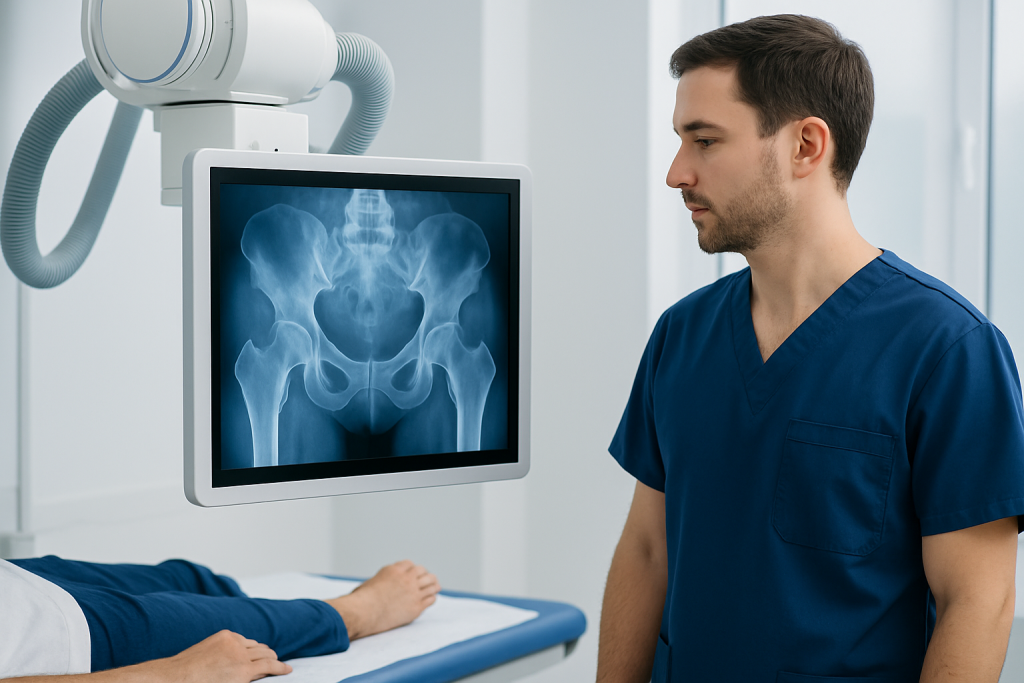
A healthy hip Xray is expected to show the ball-and-socket joint in good alignment. The femoral head should be round and seated inside the acetabulum, with no sign that the bones have shifted out of place. The joint surfaces should look smooth rather than irregular or collapsed.
Another reassuring feature is preserved joint space, which suggests there is no major loss of cartilage visible on the film. The surrounding bone should not show obvious cracks, bone fragments, destructive lesions, or clear signs of severe bone thinning in the scanned area. Doctors also look for differences between the two hips, since comparison can reveal subtle asymmetry.
Depending on the reason for the study, the report may also mention the pelvis, lower spine, or sacroiliac joints. Sometimes a hip pain complaint starts in the back, groin, or thigh, so the image is reviewed with those nearby regions in mind. A normal result does not automatically mean “nothing is wrong,” but it does tell the clinician that no major abnormality is visible on plain film.
In everyday practice, the terms used in a report may vary, but similar reassuring phrases include: no acute osseous abnormality, no fracture, no dislocation, maintained joint space, and no significant degenerative change.
Symptoms that can still happen when the Xray is normal

People sometimes expect imaging to explain every symptom, yet hip discomfort can occur even when the Xray looks normal. Pain may be felt in the groin, outer hip, buttock, or upper thigh. Some people notice stiffness after sitting, trouble climbing stairs, or discomfort when putting on socks and shoes.
A normal Xray is especially common in conditions that involve soft tissues. Examples include muscle strain, tendon irritation, bursitis, mild labral injury, early inflammation, and some nerve-related pain patterns. Early cartilage wear or a stress fracture may also be missed on the first film, particularly if the change is subtle.
Symptoms that deserve attention even after a normal image include:
- pain that lasts more than a few weeks
- limping or difficulty bearing weight
- pain after a fall or sports injury
- night pain that keeps returning
- loss of range of motion
- feeling that the hip catches, locks, or gives way
The symptom pattern matters. Groin pain with movement may point toward the joint itself, while pain on the outer side may suggest a tendon or bursa issue. A careful history helps doctors decide whether the normal Xray is truly enough or whether further assessment is needed.
Causes and risk factors behind hip pain with a normal Xray
Hip pain with a normal Xray can come from several different sources. Some are mechanical and temporary, while others are early-stage conditions that have not yet changed the bones enough to appear on radiography. This is why a normal image should be interpreted as helpful, but not final.
Common possibilities include tendon overuse, trochanteric pain syndrome, iliopsoas irritation, labral tears, early osteoarthritis, hip impingement, referred pain from the lower back, and inflammatory conditions. In younger adults and athletes, repetitive running, pivoting, or sudden twisting can contribute to pain even when the bones remain intact. In older adults, osteopenia, balance problems, or a recent minor fall may raise concern for a hidden injury.
Risk factors vary by age and activity level. These may include prior hip injury, repetitive sports, obesity, reduced muscle strength, pregnancy-related biomechanical changes, inflammatory disease, and occupations that involve climbing, lifting, or prolonged standing. For some patients, pain is not caused by the hip joint at all, but by the lumbar spine, sacroiliac joints, abdomen, or groin structures.
Understanding the likely source helps avoid unnecessary treatment. For example, rest alone may help a strain, while a persistent labral problem may require specialist evaluation. A normal Xray is therefore best viewed as a starting point for diagnosis rather than the end of the workup.
How doctors diagnose hip pain when the Xray is normal
Diagnosis begins with a detailed discussion of the pain: where it is located, when it started, whether there was trauma, and which movements make it worse. A physical examination can reveal whether the hip joint, nearby tendons, or lower back appears to be the main source of symptoms. Doctors may check gait, range of motion, strength, and specific pain-provocation tests.
If the plain film is normal but symptoms continue, the next test depends on the clinical suspicion. MRI is often used to evaluate soft tissues, early stress injury, cartilage, and the labrum. Ultrasound may help assess bursae and tendons or guide an injection when needed. In some situations, repeat Xrays are taken later because certain fractures or degenerative changes become visible only with time.
Blood tests are not always required, but they may be ordered if inflammation, infection, or a systemic condition is suspected. When symptoms seem to originate elsewhere, imaging or evaluation of the spine or pelvis may be more useful than further hip-focused testing.
For patients traveling internationally for care, a well-organized diagnostic plan matters. Bringing previous images, reports, and a concise symptom history can save time and help the orthopedic team decide whether advanced imaging or another specialist is the most appropriate next step.
Treatment options
Treatment is guided by the cause of the pain, not by the Xray alone. If the exam suggests a mild strain or overuse injury, initial care may include temporary activity modification, ice or heat as advised by a clinician, and gradual return to movement. Physical therapy is often important because hip mechanics depend on both strength and flexibility.
When pain comes from inflammation around tendons or bursae, doctors may recommend targeted rehabilitation and changes in activity. If the pain reflects early arthritis, treatment may focus on exercise planning, weight management when appropriate, mobility preservation, and symptom control. In selected cases, an injection or a procedure may be discussed after a full evaluation.
If a hidden fracture, labral injury, or hip impingement is suspected, more specific treatment may be needed. Some problems respond well to conservative care, while others require orthopedic follow-up, especially when pain persists or the person cannot return to normal function. Surgery is not the first answer for every case; it is considered only when the diagnosis and expected benefit are clear.
It is also important to avoid self-treating for too long when symptoms are not improving. A normal Xray can create false reassurance, and delaying care may allow a manageable problem to become more limiting.
Prevention and self-care
Not every hip problem can be prevented, but the joint generally responds well to sensible habits. Regular movement, strength work for the glutes and core, and gradual increases in exercise load can reduce strain. Warm-up routines before sport and supportive footwear may also help some people.
For day-to-day self-care, short-term modification is usually safer than complete inactivity. Many people do better when they keep moving within a comfortable range, avoid repetitive movements that clearly trigger pain, and return to walking or exercise in stages. If sitting makes symptoms worse, standing breaks and gentle mobility exercises may help.
Practical self-care steps include:
- keeping a simple symptom diary
- noticing which movements trigger pain
- using assistive support if walking is difficult
- following a clinician’s advice about rest and rehabilitation
- seeking review if symptoms change or intensify
For travelers who may need follow-up after returning home, it is helpful to leave the appointment with a clear plan: what activities are safe, what symptoms should trigger a recheck, and how imaging or reports will be shared with the next treating doctor. Good follow-up is part of good care, especially when the evaluation crosses borders.
When to see a doctor
Hip pain should be assessed promptly if it follows a fall, a twist, or any injury and weight-bearing is difficult. Medical review is also important if the pain is severe, associated with fever, the hip looks deformed, or the person cannot move the leg normally. These features may indicate a more urgent problem, even if the first Xray appears normal.
A doctor should also be consulted if pain lasts longer than expected, keeps returning, or interferes with sleep, work, or walking. Ongoing symptoms after a normal image often mean that a different type of tissue or a hidden injury needs to be considered. In older adults, persistent groin pain after a minor fall deserves particular attention because some fractures are not visible right away.
When the diagnosis remains unclear, it is reasonable to seek an orthopedic opinion. Acibadem Health Point’s multidisciplinary specialists and JCI-accredited hospitals diagnose and treat hip conditions for international patients, with coordinated imaging and follow-up when needed.
Prompt review does not mean something serious is certain; it simply helps ensure the cause is identified accurately and treated in the most appropriate way.
Frequently asked questions
01What does a normal hip Xray mean?
It means the Xray did not show a clear problem in the hip bones or joint that plain radiography can detect. Common findings such as fracture, dislocation, or advanced arthritis are not seen. It does not rule out every cause of pain, especially soft-tissue or early joint problems.
02Can I still have hip pain if the Xray is normal?
Yes. Tendon irritation, bursitis, labral injury, early arthritis, muscle strain, or pain coming from the back can all cause symptoms with a normal Xray. The doctor uses the history and exam to decide whether more testing is needed.
03What tests are done after a normal hip Xray?
The next step depends on the symptoms and examination. MRI is often used when soft tissue injury, stress fracture, or labral damage is suspected, while ultrasound may help with tendons or bursae. Sometimes no further test is needed if the pain is improving and the exam is reassuring.
04Does a normal Xray mean there is no arthritis?
Not necessarily. Xrays can miss early cartilage wear or show only subtle change at first. A doctor may still consider early arthritis if symptoms and examination suggest it.
05How long should hip pain last before it is checked?
If pain is not improving after a short period of rest and sensible activity modification, it should be reviewed. Pain lasting more than a few weeks, pain after injury, or pain that affects walking deserves assessment sooner. Persistent symptoms deserve a clearer diagnosis rather than repeated guesswork.
06Is a normal hip Xray enough to return to sports?
Not always. Return to sport should depend on symptom resolution, strength, range of motion, and the doctor’s assessment of the likely cause. If pain continues with running, pivoting, or impact, further evaluation is safer than pushing through it.
This article is for general information only and is not a substitute for professional medical advice. Please consult a qualified doctor about your individual situation.
Joint and spine care in Turkey — expert assessment & treatment
JCI-accredited · board-certified surgeons · reply within 24h
Add us as a Preferred Source to see more of our trusted health content across Google Search, AI Overviews and Discover.


